
Chapter 1
Selling a technology before it pays its way
When a technology has not yet reached commercial use, the price is hard to agree and harder to pay in cash.
Energy technologies reach the market in stages: a prototype, a first grid-connected unit, a pipeline of sites, and only then a business that earns its keep. Between those stages ownership often changes. A large industrial owner that backed the early work may decide to step back, and a smaller, focused company may want the assets. Neither side can easily agree a cash price for something whose value depends on the next ten years.
Cash is hard for both sides. A buyer of an early-stage technology is often itself a company that spends more than it earns, so paying in cash means raising it first. A seller asked for a cash price has to accept one number today for a value that depends on consents, grid connections and costs not yet known. Paying in shares avoids both problems and creates others. This paper sets out which.
Tidal stream power in 2015 shows the problem. In August 2014 Bloomberg New Energy Finance had cut its forecast of global tidal stream capacity in 2020 by 11%, to 148 MW. Bloomberg estimated that tidal and wave projects remained the most expensive sources of power, at four times the cost of coal (Downing, 2015).
The case: Marine Current Turbines, Atlantis Resources and Siemens
Marine Current Turbines (MCT) was a tidal energy business based in Bristol. Its SeaGen S system, a 1.2 MW tidal turbine installed in Strangford Lough, Northern Ireland, in 2008, was still operating and had generated about 10 GWh. MCT held six tidal lease agreements in Wales, Northern Ireland and England, with a potential capacity of nearly 200 MW, and the designs of two further turbines (Atlantis Resources, 2015a). In the year to September 2014 it reported a loss, mostly from research and development (Atlantis Resources, 2015a).
Siemens had taken a majority stake in MCT in 2012 (offshoreWIND.biz, 2012). In 2014 it decided to sell, saying the market and the supply chain were taking too long to grow (Downing, 2015). Atlantis Resources, a tidal turbine maker and developer, agreed on 29 April 2015 to buy the whole of MCT from Siemens, and completed the deal on 1 July 2015 (Atlantis Resources, 2015a; 2015b). ICONIC advised on the all-share acquisition of Marine Current Turbines by Atlantis Resources from Siemens.
How it was paid
No cash changed hands (IPP Journal, 2015). Siemens received new Atlantis shares as its sole consideration and became Atlantis’s second-largest shareholder (Atlantis Resources, 2015b). It agreed not to sell the shares for a period after completion, except in certain circumstances, and MCT was acquired debt-free (Atlantis Resources, 2015a). Share numbers, values and the lock-up date are given in the PDF edition of this Insight, available through the download form above.
No cash changed hands.
Inside the paper
Paid in shares: when selling an unproven energy technology for stock works for both sides
DOC IPFA-INS-CF-MNA-2611-IPF-021-V1
Fill out the form to read the full paper.
Download the PDFPDF edition
Download the full Insight
Register below. We will ask you to confirm your e-mail address and then send you a personal download link.
Chapter 2
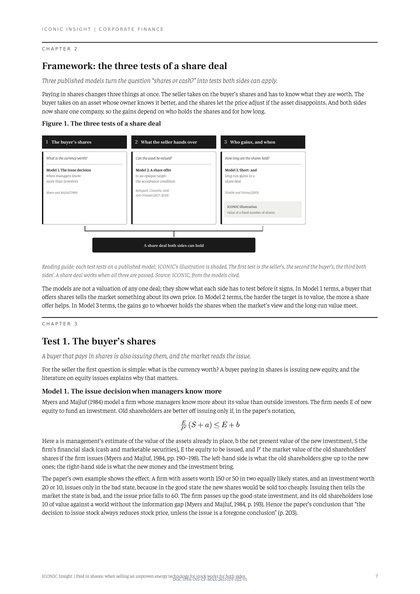
Framework: the three tests of a share deal
Three published models turn the question “shares or cash?” into tests both sides can apply.
Paying in shares changes three things at once. The seller takes on the buyer’s shares and has to know what they are worth. The buyer takes on an asset whose owner knows it better, and the shares let the price adjust if the asset disappoints. And both sides now share one company, so the gains depend on who holds the shares and for how long.
The models are not a valuation of any one deal; they show what each side has to test before it signs. In Model 1 terms, a buyer that offers shares tells the market something about its own price. In Model 2 terms, the harder the target is to value, the more a share offer helps. In Model 3 terms, the gains go to whoever holds the shares when the market’s view and the long-run value meet.
Chapter 3
Test 1. The buyer’s shares
A buyer that pays in shares is also issuing them, and the market reads the issue.
For the seller the first question is simple: what is the currency worth? A buyer paying in shares is issuing new equity, and the literature on equity issues explains why that matters.
Model 1. The issue decision when managers know more
Myers and Majluf (1984) model a firm whose managers know more about its value than outside investors. The firm needs E of new equity to fund an investment. Old shareholders are better off issuing only if, in the paper’s notation,
Here a is management’s estimate of the value of the assets already in place, b the net present value of the new investment, S the firm’s financial slack (cash and marketable securities), E the equity to be issued, and P′ the market value of the old shareholders’ shares if the firm issues (Myers and Majluf, 1984, pp. 190–198). The left-hand side is what the old shareholders give up to the new ones; the right-hand side is what the new money and the investment bring.
The paper’s own example shows the effect. A firm with assets worth 150 or 50 in two equally likely states, and an investment worth 20 or 10, issues only in the bad state, because in the good state the new shares would be sold too cheaply. Issuing then tells the market the state is bad, and the issue price falls to 60. The firm passes up the good-state investment, and its old shareholders lose 10 of value against a world without the information gap (Myers and Majluf, 1984, p. 193). Hence the paper’s conclusion that “the decision to issue stock always reduces stock price, unless the issue is a foregone conclusion” (p. 203).
What the evidence shows
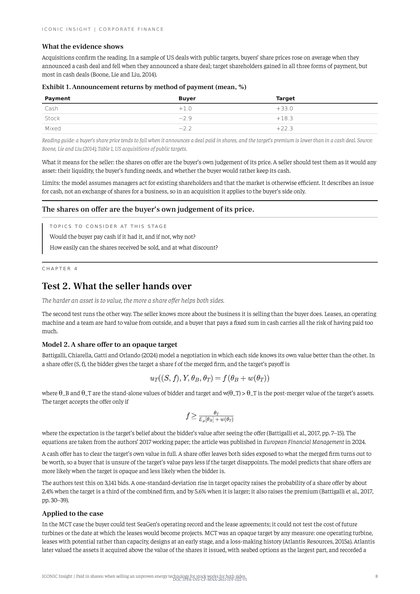
Acquisitions confirm the reading. In a sample of US deals with public targets, buyers’ share prices rose on average when they announced a cash deal and fell when they announced a share deal; target shareholders gained in all three forms of payment, but most in cash deals (Boone, Lie and Liu, 2014).
| Payment | Buyer | Target |
|---|---|---|
| Cash | +1.0 | +33.0 |
| Stock | −2.9 | +18.3 |
| Mixed | −2.2 | +22.3 |
What it means for the seller: the shares on offer are the buyer’s own judgement of its price. A seller should test them as it would any asset: their liquidity, the buyer’s funding needs, and whether the buyer would rather keep its cash.
Limits: the model assumes managers act for existing shareholders and that the market is otherwise efficient. It describes an issue for cash, not an exchange of shares for a business, so in an acquisition it applies to the buyer’s side only.
The shares on offer are the buyer’s own judgement of its price.
Topics to consider at this stage
- Would the buyer pay cash if it had it, and if not, why not?
- How easily can the shares received be sold, and at what discount?
Chapter 4
Test 2. What the seller hands over
The harder an asset is to value, the more a share offer helps both sides.
The second test runs the other way. The seller knows more about the business it is selling than the buyer does. Leases, an operating machine and a team are hard to value from outside, and a buyer that pays a fixed sum in cash carries all the risk of having paid too much.
Model 2. A share offer to an opaque target
Battigalli, Chiarella, Gatti and Orlando (2024) model a negotiation in which each side knows its own value better than the other. In a share offer (S, f), the bidder gives the target a share f of the merged firm, and the target’s payoff is
where θ_B and θ_T are the stand-alone values of bidder and target and w(θ_T) > θ_T is the post-merger value of the target’s assets. The target accepts the offer only if
where the expectation is the target’s belief about the bidder’s value after seeing the offer (Battigalli et al., 2017, pp. 7–15). The equations are taken from the authors’ 2017 working paper; the article was published in European Financial Management in 2024.
A cash offer has to clear the target’s own value in full. A share offer leaves both sides exposed to what the merged firm turns out to be worth, so a buyer that is unsure of the target’s value pays less if the target disappoints. The model predicts that share offers are more likely when the target is opaque and less likely when the bidder is.
The authors test this on 3,141 bids. A one-standard-deviation rise in target opacity raises the probability of a share offer by about 2.4% when the target is a third of the combined firm, and by 5.6% when it is larger; it also raises the premium (Battigalli et al., 2017, pp. 30–39).
Applied to the case
In the MCT case the buyer could test SeaGen’s operating record and the lease agreements; it could not test the cost of future turbines or the date at which the leases would become projects. MCT was an opaque target by any measure: one operating turbine, leases with potential rather than capacity, designs at an early stage, and a loss-making history (Atlantis Resources, 2015a). Atlantis later valued the assets it acquired above the value of the shares it issued, with seabed options as the largest part, and recorded a gain on a bargain purchase; it attributed the gain mainly to Siemens reducing its direct exposure to tidal energy as a project developer (Atlantis Resources, 2016).
What it means for the buyer: a share offer is a way to share the valuation risk of an asset it cannot fully test. What it means for the seller: accepting shares is accepting that the buyer’s doubt about the asset is priced into the deal.
Limits: the model has two types of firm on each side and a single offer; real negotiations have more stages and more bidders.
A share offer is a way to share the valuation risk of an asset the buyer cannot fully test.
Topics to consider at this stage
- Which parts of the target can be valued from documents, and which only by running them?
- How much of the price rests on leases that still need consents, grid connection and finance?
Chapter 5
Test 3. Who gains, and when
In a share deal the seller’s gain depends on how long it holds the shares.
The third test is about time. Once paid in shares, the seller owns part of the buyer. Its gain depends on the market’s view of the combined firm and on when it sells.
Model 3. Gains from a share deal over the short and the long run
Shleifer and Vishny (2003) model acquisitions when the market may misvalue firms. Target capital K is bought at a price P per unit; the bidder has capital K₁, and the market values the combined firm at S per unit of capital in the short run. In a share deal the target’s shareholders receive a fraction of the combined firm
and if all assets are worth q per unit of capital in the long run, the target’s net long-run gain is
(Shleifer and Vishny, 2003, Eq. 4 and Proposition 3). Target shareholders gain in the long run only if the price they receive per unit of capital is above the market’s short-run value of the combined firm, P > S; otherwise the bidder gains. The paper predicts that targets accept shares more readily when their managers have short horizons (Shleifer and Vishny, 2003).
What it means for both sides: in a share deal the price is only half agreed at signing. The other half is set by the market over the period the seller holds the shares, and a lock-up decides how long that is.
Limits: the model assumes the merger creates no long-run real gains, which is a simplification for a deal built on technology and sites.
Applied to the case
Siemens had said it was selling because the industry was growing too slowly (Downing, 2015). A seller with that view does not want to hold a large stake for long, but it may accept a small one if it keeps a link to the business. The structure gave Siemens a minority stake, a lock-up of limited length and a continuing role as a supplier of standard components to MCT, and made it Atlantis’s second-largest shareholder (Atlantis Resources, 2015a; 2015b). In Model 3 terms, the lock-up set the shortest horizon over which Siemens’s price would be decided.
ICONIC’s illustration: a fixed number of shares, a moving price
This is ICONIC’s own illustration, not a published model. When the consideration is a fixed number of shares n, its value at time t is
where p_t is the buyer’s share price. Between signing and completion, and through any lock-up after it, the seller’s price moves one for one with the buyer’s shares. In the MCT case, the value of the consideration shares rose between the announcement in April 2015 and completion in July 2015; the figures are in the PDF edition.
In a share deal the price is only half agreed at signing.
Topics to consider at this stage
- How long can the seller hold the shares, and what does it give up by holding them?
- What supply, cooperation or governance rights should come with a minority stake?
Chapter 6
What’s the bottom line?
Paying in shares works when each side holds the risk it understands best.
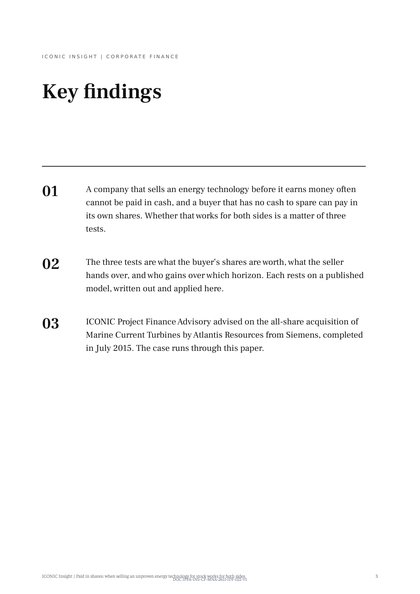
A share deal for an energy technology that has not reached commercial use works for both sides when three conditions hold. The buyer’s shares are fairly priced, or the seller has tested them as it would any asset. The target is hard to value, so sharing the outcome is worth more than a fixed price. And the seller is prepared to hold the shares long enough for the market’s view and the long-run value to meet.
In the MCT case Siemens left a sector it judged too slow, kept a stake in the company that took over its technology, and agreed to continue supplying components (Atlantis Resources, 2015a). Atlantis added leases, an operating turbine and a team without paying cash or taking on MCT’s debt.
For a seller the practical questions are the ones in the topics boxes: who would buy the shares if it had to sell, what the buyer’s own funding needs are, and how long the lock-up runs. For a buyer they are which assets it can test and which it cannot, and how much of its own company it is prepared to give for the ones it cannot.
Paying in shares works when each side holds the risk it understands best.
How ICONIC can help
ICONIC Project Finance Advisory works with buyers and sellers of energy businesses on the price, the currency and the terms that come with it.
- M&A. Structuring consideration in shares or cash, lock-ups and the supply terms that follow completion. Talk to us about a sale or an acquisition.
- Valuation. Valuing early-stage energy assets and the shares offered for them. Send us the numbers.
- Due diligence. Testing leases, machines and teams one by one before the price is set. Ask for a pre-screen.
Summary
A company that sells an energy technology before it earns money can be paid in the buyer’s shares rather than cash. Three published models turn the choice into tests. The issue model of Myers and Majluf (1984) shows that a buyer paying in shares tells the market something about its own price, and acquisition data confirm that buyers’ prices tend to fall on share deals. The opacity model of Battigalli, Chiarella, Gatti and Orlando shows that share offers help when the target is hard to value. The model of Shleifer and Vishny (2003) shows that the seller’s gain depends on how long it holds the shares. ICONIC advised on the all-share acquisition of Marine Current Turbines by Atlantis Resources from Siemens in 2015, a deal that illustrates all three tests.
Frequently asked questions
Why would a seller accept shares instead of cash?
Because a buyer of an early-stage technology often has no spare cash, and because shares let the seller keep a stake in the outcome. The seller trades a fixed price for a share of what the combined company turns out to be worth.
Why do buyers’ share prices often fall when they announce a share deal?
Because issuing shares can signal that managers think the shares are fully priced. Myers and Majluf (1984) showed why, and acquisition data show lower announcement returns for buyers in share deals than in cash deals.
What does a lock-up do in a share deal?
It stops the seller from selling the new shares for a set period. It protects the buyer’s share price after completion, and it fixes the horizon over which the seller’s price is decided.
References
- Atlantis Resources Limited (2015a) ‘Acquisition of Marine Current Turbines Limited from Siemens’, company announcement, 29 April. https://ampeak.energy/?p=1160
- Atlantis Resources Limited (2015b) ‘Completion of Marine Current Turbines Acquisition’, RNS, 1 July. https://ampeak.energy/?p=1165
- Atlantis Resources Limited (2015c) Interim results for the six months ended 30 June 2015. https://ampeak.energy/wp-content/uploads/2022/01/Atlantis-interim-period-ending-20150630.pdf
- Atlantis Resources Limited (2016) Annual Report 2015, Note 13(c). https://ampeak.energy/wp-content/uploads/2022/01/FY2015_ARL_Annual_Report.pdf
- Battigalli, P., Chiarella, C., Gatti, S. and Orlando, T. (2017) ‘M&A negotiations with limited information: how do opaque firms buy and get bought?’, IGIER Working Paper 596, Università Bocconi. Published as ‘The joint determination of the payment method and the bid premium in M&As: what is the role of firm opacity?’, European Financial Management, 30(4), pp. 2195–2241 (2024). https://doi.org/10.1111/eufm.12474
- Boone, A.L., Lie, E. and Liu, Y. (2014) ‘Time trends and determinants of the method of payment in M&As’, Journal of Corporate Finance, 27, pp. 296–304. https://doi.org/10.1016/j.jcorpfin.2014.05.015
- Downing, L. (2015) ‘Siemens sells tidal energy unit after losing faith in sector’, Bloomberg, 29 April, via gCaptain. https://gcaptain.com/siemens-sells-tidal-energy-unit-after-losing-faith-in-sector
- IPP Journal (2015) ‘Atlantis acquires Bristol based tidal business MCT from Siemens’, 30 April. https://ippjournal.com/news/atlantis-acquires-bristol-based-tidal-business-mct-from-siemens
- Myers, S.C. and Majluf, N.S. (1984) ‘Corporate financing and investment decisions when firms have information that investors do not have’, Journal of Financial Economics, 13(2), pp. 187–221. https://doi.org/10.1016/0304-405X(84)90023-0
- offshoreWIND.biz (2012) ‘Siemens acquires majority stake in Marine Current Turbines (UK)’, 17 February. https://offshorewind.biz/2012/02/17/siemens-acquires-majority-stake-in-marine-current-turbines-uk
- Shleifer, A. and Vishny, R.W. (2003) ‘Stock market driven acquisitions’, Journal of Financial Economics, 70(3), pp. 295–311. https://doi.org/10.1016/S0304-405X(03)00211-3
This Insight is for general information only and does not constitute investment, legal or tax advice. Figures from public sources are as reported at the dates shown.