Chapter 1
FSRUs have become a financing asset in their own right
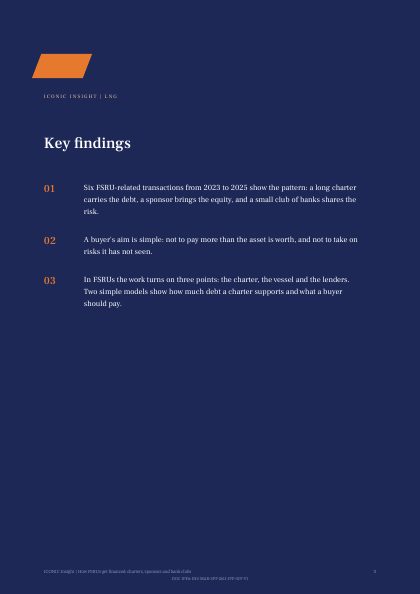
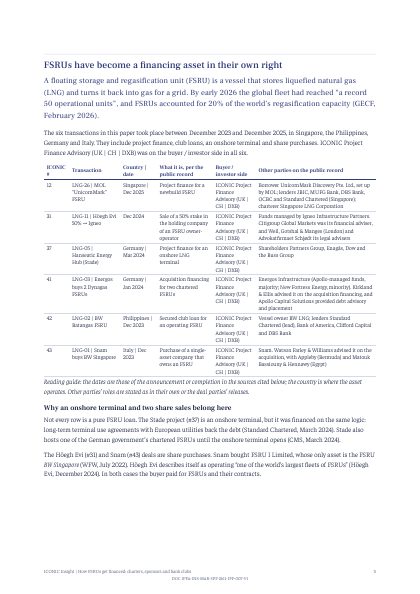
Six FSRU transactions from 2023 to 2025, from project finance to share purchases, all rest on a long charter, a sponsor and a bank club.
| ICONIC # | Transaction | Country | date | What it is, per the public record | Buyer / investor side | Other parties on the public record |
|---|---|---|---|---|---|
| 12 | LNG-26 | MOL “UnicornMark” FSRU | Singapore | Dec 2025 | Project finance for a newbuild FSRU | ICONIC Project Finance Advisory (UK | CH | DXB) | Borrower UnicornMark Discovery Pte. Ltd., set up by MOL; lenders JBIC, MUFG Bank, DBS Bank, OCBC and Standard Chartered (Singapore); charterer Singapore LNG Corporation |
| 31 | LNG-11 | Höegh Evi 50% → Igneo | Dec 2024 | Sale of a 50% stake in the holding company of an FSRU owner-operator | ICONIC Project Finance Advisory (UK | CH | DXB) | Funds managed by Igneo Infrastructure Partners. Citigroup Global Markets was its financial adviser, and Weil, Gotshal & Manges (London) and Advokatfirmaet Schjødt its legal advisers |
| 37 | LNG-05 | Hanseatic Energy Hub (Stade) | Germany | Mar 2024 | Project finance for an onshore LNG terminal | ICONIC Project Finance Advisory (UK | CH | DXB) | Shareholders Partners Group, Enagás, Dow and the Buss Group |
| 41 | LNG-03 | Energos buys 2 Dynagas FSRUs | Germany | Jan 2024 | Acquisition financing for two chartered FSRUs | ICONIC Project Finance Advisory (UK | CH | DXB) | Energos Infrastructure (Apollo-managed funds, majority; New Fortress Energy, minority). Kirkland & Ellis advised it on the acquisition financing, and Apollo Capital Solutions provided debt advisory and placement |
| 42 | LNG-02 | BW Batangas FSRU | Philippines | Dec 2023 | Secured club loan for an operating FSRU | ICONIC Project Finance Advisory (UK | CH | DXB) | Vessel owner BW LNG; lenders Standard Chartered (lead), Bank of America, Clifford Capital and DBS Bank |
| 43 | LNG-01 | Snam buys BW Singapore | Italy | Dec 2023 | Purchase of a single-asset company that owns an FSRU | ICONIC Project Finance Advisory (UK | CH | DXB) | Snam. Watson Farley & Williams advised it on the acquisition, with Appleby (Bermuda) and Matouk Bassiouny & Hennawy (Egypt) |
Why an onshore terminal and two share sales belong here
Not every row is a pure FSRU loan. The Stade project (#37) is an onshore terminal, but it was financed on the same logic: long-term terminal use agreements with European utilities back the debt (Standard Chartered, March 2024). Stade also hosts one of the German government’s chartered FSRUs until the onshore terminal opens (CMS, March 2024).
The Höegh Evi (#31) and Snam (#43) deals are share purchases. Snam bought FSRU I Limited, whose only asset is the FSRU BW Singapore (WFW, July 2022). Höegh Evi describes itself as operating “one of the world’s largest fleets of FSRUs” (Höegh Evi, December 2024). In both cases the buyer paid for FSRUs and their contracts.
In operation
50
{{STUDY}}
Inside the paper
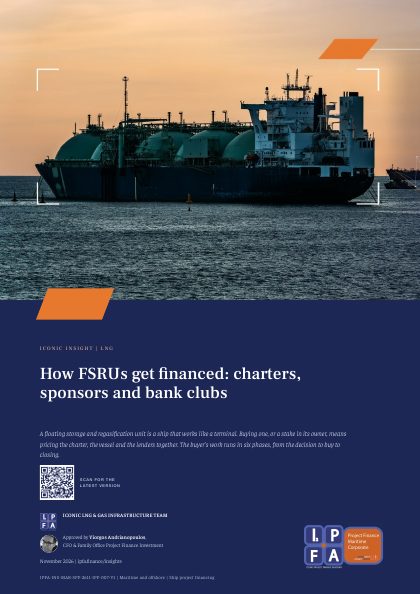
How FSRUs get financed: charters, sponsors and bank clubs
DOC IPFA-INS-MAR-SPF-2611-IPF-007-V1
Fill out the form to read the full paper.
Download the PDFPDF edition
Download the full Insight
Register below. We will ask you to confirm your e-mail address and then send you a personal download link.
Chapter 2
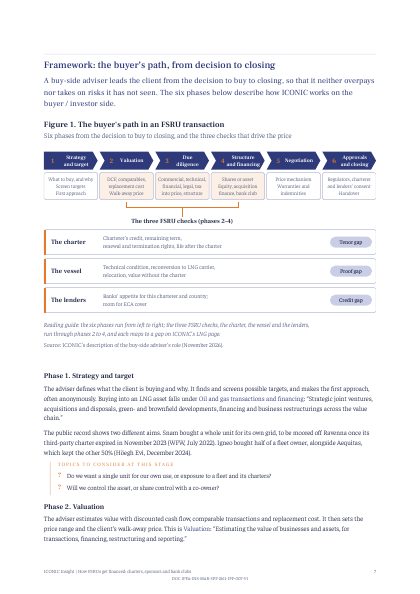
The buyer’s path, from decision to closing
A buy-side adviser leads the client through six phases, starting with what to buy and why.
A buy-side adviser leads the client from the decision to buy to closing, so that it neither overpays nor takes on risks it has not seen. The six phases below describe how ICONIC works on the buyer / investor side.
Phase 1. Strategy and target
The adviser defines what the client is buying and why. It finds and screens possible targets, and makes the first approach, often anonymously. Buying into an LNG asset falls under Oil and gas transactions and financing: “Strategic joint ventures, acquisitions and disposals, green- and brownfield developments, financing and business restructurings across the value chain.”
The public record shows two different aims. Snam bought a whole unit for its own grid, to be moored off Ravenna once its third-party charter expired in November 2023 (WFW, July 2022). Igneo bought half of a fleet owner, alongside Aequitas, which kept the other 50% (Höegh Evi, December 2024).
Topics to consider at this stage
- Do we want a single unit for our own use, or exposure to a fleet and its charters?
- Will we control the asset, or share control with a co-owner?
Chapter 3
Valuation
An FSRU’s value combines its charter and the vessel itself, and a simple model turns that into a walk-away price.
The adviser estimates value with discounted cash flow, comparable transactions and replacement cost. It then sets the price range and the client’s walk-away price. This is Valuation: “Estimating the value of businesses and assets, for transactions, financing, restructuring and reporting.”
Snam paid [value in the PDF edition] for a company holding one unit, built in 2015, with about 170,000 m³ of storage and 5 bcm a year of regasification (WFW, July 2022 and December 2023). The price of Igneo’s stake was not disclosed. An FSRU’s value has two parts: the charter’s cash flow, and the vessel’s worth without it. BW Singapore can also operate as an LNG carrier (WFW, July 2022), which supports the second part. This is the proof gap: “Lenders need numbers they can trust” (ICONIC).
What research says about pricing. Two findings matter for a buyer:
- Buying at the top of the cycle. Greenwood and Hanson (2015) find that high ship earnings, high second-hand prices and heavy ordering all predict low future returns on owning a ship. They explain it by owners extrapolating demand and neglecting their rivals’ new orders. A buyer should therefore be careful with peak-cycle comparables.
- The value of flexibility. Real-options theory holds that when an investment is hard to reverse, the ability to change course has value that a simple NPV leaves out (Dixit and Pindyck, 1994). Sødal, Koekebakker and Aadland (2008) price such an option for ships that can switch between two freight markets. In their 2004 working paper the option was worth about US$4.6m, against a newbuild premium of about US$8m. An FSRU that can trade as an LNG carrier, or move to another terminal, holds an option of the same shape. We found no peer-reviewed study that values it for FSRUs.
A model of the buyer’s value. The value of an FSRU to a buyer can be written as three branches:
Here p is the probability of a new FSRU charter when the current one ends, and the fallback is trading as an LNG carrier, or scrap. This is ICONIC’s own illustration.
Take a unit with eight years of charter left, earning hire of US$135,000 a day against operating costs of US$30,000 a day. Both figures are inside the ranges in Songhurst (2017), and give about US$38m of cash flow a year. Assume a 9% discount rate, a ten-year re-charter at 90% of today’s cash flow, and a fallback sale for US$79m. The charter is then worth about US$212m. The buyer’s value is about US$287m if p is 50%, about US$302m at 70%, and about US$316m at 90%. Each ten points of p moves the value by about US$7m.
For comparison, GECF (2026) puts a newbuild FSRU at US$400–500m and a conversion at US$200–350m. A price above the conversion cost has to be justified by the charter, not by the steel. That is where the walk-away price sits.
Topics to consider at this stage
- How much of the price rests on the current charter, and how much on the vessel itself?
- What re-charter probability is the seller’s price assuming, and is it realistic?
- What is our walk-away price, and what would a newbuild or a conversion cost instead?
Conversion cost
US$200–350m
Chapter 4
Coordinating due diligence
Three checks carry most of the weight in an FSRU deal: the charter, the vessel and the lenders.
The adviser organises the commercial, technical, financial, legal and tax reviews, done by specialists and lawyers, and turns the findings into effects on price and structure. In FSRUs, three checks carry most of the weight.
The charter. The checks cover the charterer’s credit, the remaining term, renewal and early-termination rights, and what happens if the vessel is left without a charter. In five of the six deals a long contract sits at the centre:
- #12: a state-owned terminal operator, Singapore LNG Corporation, is the charterer (JBIC, December 2025).
- #41: the German Federal Ministry for Economic Affairs and Climate Action holds long-term charters on both units (Energos, January 2024).
- #42: BW Batangas provides storage and regasification to FGEN LNG Corporation (Norton Rose Fulbright, December 2023).
- #37: about 90% of Stade’s capacity is booked long-term by EnBW, SEFE and ČEZ (Enagás, March 2024).
A strong charterer does not remove delay risk. Deutsche Energy Terminal cited “challenges during the construction” at Stade. A state-owned company sub-chartered Energos Force to Jordan, on terms requiring its return for commissioning (DET, June 2026). This is the tenor gap: “The debt runs longer than the contracts behind it” (ICONIC).
Research explains why the charter matters so much to lenders:
- Contracts and leverage. Corielli, Gatti and Steffanoni (2010) study about 2,200 project-finance tranches from 1998 to 2003. Projects without long-term contracts carry less debt. A missing construction contract adds about 32 basis points to the spread, although the evidence on spreads is weaker than on leverage.
- Longer tenors. Kleimeier and Megginson (2000) find that project-finance loans run on average 8.6 years, against 4.8 for other syndicated loans, without a price penalty.
A model of the tenor gap. The debt a charter can support is the present value of its cash flow, divided by the cover lenders require, plus any balloon left at the end:
Here Tc is the charter term, CFADS the cash flow available for debt service, DSCR the debt service cover ratio, r the loan rate and B the balloon. This is ICONIC’s own illustration.
With the same US$38m of yearly cash flow, a DSCR of 1.30x and a 7.5% rate:
- a ten-year charter supports about US$202m of debt;
- a twenty-year charter supports about US$301m.
If a lender sizes the loan on twenty years while the charter runs ten, about US$202m is still outstanding at year ten, worth about US$98m today. That balloon rests on a re-charter, not on a contract. That is the tenor gap in numbers.
The vessel. The checks cover the unit’s technical condition, whether it can be converted back to an LNG carrier or moved to another terminal, and its value regardless of the charter. Both BW Singapore and Energos Force changed location during their lives (WFW, July 2022; DET, June 2026). A unit that can move keeps value after its charter. Building one takes time: Songhurst (2017) gives 27–36 months for a newbuild FSRU and 18–24 months for a conversion. The second-hand market is thin, and trading volume follows recent price moves (Alizadeh and Nomikos, 2003). A buyer should not assume a quick exit at a fair price.
The lenders. The checks cover how willing banks are to finance this charterer in this country, and whether an export credit agency can help. In Singapore, JBIC lends [value in the PDF edition] alongside four banks; the total facility was not disclosed (JBIC, December 2025). This is the credit gap: “Banks will not carry the sponsor or the country risk alone” (ICONIC).
The make-up of the club follows the risk. Sufi (2007) finds that when a borrower needs more monitoring, the lead bank keeps a larger share and the group of lenders is smaller. In project finance, Esty and Megginson (2003) find the largest bank holds on average about 20% of a tranche and the top five about 61%. That is the shape of the four-bank clubs in #41 and #42.
Topics to consider at this stage
- What happens to the cash flow if the charter ends early, or the terminal is late?
- Could the unit work elsewhere, or as an LNG carrier, and at what cost?
- Will lenders accept this charterer and this country, and on what terms?
Average tenor
8.6 years
Chapter 5
Structure and financing
The six deals show each structuring choice: shares or asset, equity or acquisition finance, and how the bank club is built.
The adviser decides what is bought: shares or the asset, a stake or the whole. It also decides how the purchase is funded: equity, acquisition finance or a bridge. It then finds the banks, builds the bank club and negotiates the loan terms.
The six deals show each choice:
- Shares, not the asset. Snam bought the company that owns BW Singapore, from its own funds, with no acquisition debt disclosed (WFW, July 2022). Igneo bought half of the holding company (Höegh Evi, December 2024).
- Acquisition finance. Energos financed its purchase of two units with a loan “led by” BNP Paribas, Crédit Agricole CIB, Mizuho Bank and Sumitomo Mitsui Trust Bank. Apollo Capital Solutions provided debt advisory and placement (Energos, January 2024). Neither the price nor the debt was disclosed.
- A club around one bank. Standard Chartered was coordinating bank, facility agent, security agent, mandated lead arranger and lender in a [value in the PDF edition] senior secured term loan for BW Batangas (Standard Chartered, December 2023). Bank of America, Clifford Capital and DBS Bank made up the club (Norton Rose Fulbright, December 2023).
- Project finance. At Stade, Standard Chartered was mandated lead arranger and led the syndication (Standard Chartered, March 2024). The debt amount was not disclosed; the investment is put at [value in the PDF edition] (Enagás, March 2024) or [value in the PDF edition] (CMS, March 2024).
When the charter repays the debt, this is the work of Ship project financing: “Long-term funding for new and used vessels, with charter fees as the principal source of repayment and collateral structured around the shipbuilding and charter agreements.” Where the deal needs owners as well as lenders, it is the equity gap: “The project needs owners, not only lenders” (ICONIC).
Topics to consider at this stage
- Shares or asset: which liabilities, charters and loans come with what we buy?
- How much debt will the charter support, and which banks will lead?
Chapter 6
Negotiation, approvals and closing
The last two phases set the price mechanism, the protections and the consents that decide when the deal can close.
Phase 5. Negotiation
The adviser negotiates the price and how it is set: a locked box or completion accounts, and any earn-out. It also negotiates warranties, indemnities and completion terms. Lawyers draft the sale and purchase agreement, while the adviser keeps the deal’s commercial logic intact. In the Snam purchase, the price was paid in two rounds (WFW, July 2022).
Topics to consider at this stage
- Which price mechanism protects us from changes between signing and completion?
- Which risks found in due diligence are covered by warranties or indemnities, and which by price?
Phase 6. Approvals and closing
The adviser tracks regulatory and competition approvals, third-party consents such as the charterer’s or lenders’, and closing. It often plans the handover of management as well. Igneo’s purchase was subject to regulatory approvals and was expected to close in the first half of 2025 (Höegh Evi, December 2024). Snam signed in July 2022 and completed in December 2023, once the vessel’s previous charter had run off (WFW, July 2022 and December 2023).
Topics to consider at this stage
- Which approvals and consents could delay closing, and who carries the cost of delay?
- Who will manage and crew the unit from the first day after closing?
Chapter 7
What’s the bottom line?
Charters repay the debt, sponsors bring the equity and bank clubs share the risk; the buyer’s price depends on three checks.
FSRUs are financed like infrastructure but carried like ships. The charter repays the debt, the sponsor brings the equity, and a small club of banks, sometimes with a state agency, shares the risk.
For a buyer or investor, the work runs from strategy to closing, and the price depends on three checks: the charter, the vessel and the lenders. Getting them right is how a buyer avoids overpaying.
How ICONIC can help
ICONIC Project Finance Advisory works with buyers, investors and lenders on LNG shipping, floating regasification and gas-to-power:
- Ship project financing. Long-term funding for new and used vessels, with charter fees as the principal source of repayment and collateral structured around the shipbuilding and charter agreements. Pre-screen your project.
- ECA finance, trade finance, loan guarantees and insurance. Cross-border funding with improved terms through government-backed export credit agencies. Discuss a mandate.
- Valuation. Estimating the value of businesses and assets, for transactions, financing, restructuring and reporting, building on ICONIC’s legacy work since 1987. Contact always.here@ipfa.finance.
Explore ICONIC’s work across the sector on the LNG page, https://ipfa.finance/sectors/energy/lng/, under “Where we work in LNG & Gas Infrastructure” and “How we help”.
Summary
The FSRU fleet reached 50 units by early 2026. Six transactions from 2023 to 2025 show how FSRUs are financed and bought: a long charter carries the debt, a sponsor brings the equity, and a club of banks, sometimes with an export credit agency, shares the risk. Research on project-finance contracts, loan syndicates, ship prices and real options supports this reading. Two simple models put numbers on the tenor gap and on the buyer’s walk-away price. A buyer’s work runs in six phases, from strategy to closing. In FSRUs, three checks drive the price: the charter, the vessel and the lenders.
Frequently asked questions
What is an FSRU?
A floating storage and regasification unit is a vessel that stores liquefied natural gas and turns it back into gas for a pipeline grid. It lets a country import LNG without building an onshore terminal. Some units can also sail as LNG carriers.
How is an FSRU financed?
Most FSRUs are financed against a long-term charter with a terminal operator, utility or government. A club of banks lends against that contract and the vessel, sometimes with an export credit agency, and the owner provides the equity.
What does a buy-side adviser do in an FSRU purchase?
It leads the buyer from the decision to buy to closing: target, valuation, due diligence, structure and financing, negotiation and approvals. In FSRUs it pays particular attention to the charter, the vessel’s condition and redeployment value, and the lenders’ appetite for the charterer and the country.
References
- CMS (2024) ‘CMS advises on project financing for land-based terminal in Stade’, 25 March. https://cms.law/en/deu/news-information/cms-advises-on-project-financing-for-land-based-terminal-in-stade
- Deutsche Energy Terminal (2026) ‘Launch of the floating LNG terminal Stade planned for September’, 10 June. https://energy-terminal.de/en/news/news-detail/launch-of-the-floating-lng-terminal-stade-planned-for-september
- Enagás (2024) ‘FID for Stade LNG terminal in Germany’, 21 March. https://www.enagas.es/en/press-room/news-room/press-releases/fid-stade-lng-alemania/
- Energos Infrastructure (2024) ‘Energos Infrastructure announces transformative marine LNG asset transaction with long term charter contracts in Germany’, 8 January. https://www.aap.com.au/aapreleases/cision20240108ae05596
- GECF (2026) ‘FSRUs increasingly support global LNG expansion by connecting supply and demand’, 23 February. https://www.gecf.org/Events-Conferences/Events-HH/ArticleID/1641/FEATURE-ARTICLE-FSRUs-increasingly-support-global-LNG-expansion-by-connecting-supply-and-demand
- Höegh Evi (2024) ‘Igneo Infrastructure Partners to acquire the ownership interest in Höegh Evi Ltd held by funds managed by Morgan Stanley Infrastructure Partners’, 13 December. https://prnewswire.co.uk/news-releases/igneo-infrastructure-partners-to-acquire-the-ownership-interest-in-hoegh-evi-ltd-held-by-funds-managed-by-morgan-stanley-infrastructure-partners-302331189.html
- JBIC (2025) ‘Project finance for FSRU project in Singapore’, 23 December. https://www.jbic.go.jp/en/information/press/press-2025/press_00136.html
- Kirkland & Ellis (2024) ‘Kirkland advises Energos Infrastructure on acquisition of transformative marine LNG asset’, 9 January. https://www.kirkland.com/news/press-release/2024/01/kirkland-advises-energos-infrastructure-on-acquisition-of-transformative-marine-lng-asset
- Norton Rose Fulbright (2023) ‘Singapore shipping team advises on US$145m facility for BW Batangas’, December. https://nortonrosefulbright.com/en/news/ed3e6518/singapore-shipping-team-advises-on-us145m-facility-for-bw-batangas
- Standard Chartered (2023) ‘Standard Chartered plays leading role in USD145 million facility for BW Batangas’, 7 December. https://www.sc.com/EN/press-release/standard-chartered-plays-leading-role-in-usd145-million-facility-for-bw-batangas/
- Standard Chartered (2024) ‘Standard Chartered mandated lead arranger in project financing for Hanseatic Energy Hub’, 27 March. https://www.sc.com/de-en/2024/03/27/standard-chartered-mandated-lead-arranger-in-project-financing-for-hanseatic-energy-hub/
- Watson Farley & Williams (2022) ‘WFW advises Snam on FSRU acquisition’, 11 July. https://www.wfw.com/press/wfw-advises-snam-on-fsru-acquisition/
- Watson Farley & Williams (2023) ‘WFW advises Snam on acquisition of BW Singapore FSRU’, 5 December. https://wfw.com/press/wfw-advises-snam-on-acquisition-of-bw-singapore-fsru
- Milbank (2024) ‘Milbank advises lenders on Energos Infrastructure’s acquisition of two Dynagas FSRUs’, 11 January. https://www.milbank.com/en/news/milbank-advises-lenders-on-energos-infrastructures-acquisition-of-two-dynagas-floating-storage-and-regasification-units.html
- Alizadeh, A.H. and Nomikos, N.K. (2003) ‘The price-volume relationship in the sale and purchase market for dry bulk vessels’, Maritime Policy & Management, 30(4), pp. 321–337. https://doi.org/10.1080/0308883032000145627
- Corielli, F., Gatti, S. and Steffanoni, A. (2010) ‘Risk shifting through nonfinancial contracts: effects on loan spreads and capital structure of project finance deals’, Journal of Money, Credit and Banking, 42(7), pp. 1295–1320. https://doi.org/10.1111/j.1538-4616.2010.00342.x
- Dixit, A.K. and Pindyck, R.S. (1994) Investment under Uncertainty. Princeton: Princeton University Press. https://press.princeton.edu/node/27002
- Esty, B.C. and Megginson, W.L. (2003) ‘Creditor rights, enforcement, and debt ownership structure: evidence from the global syndicated loan market’, Journal of Financial and Quantitative Analysis, 38(1), pp. 37–60. https://ideas.repec.org/a/cup/jfinqa/v38y2003i01p37-60_00.html
- Greenwood, R. and Hanson, S.G. (2015) ‘Waves in ship prices and investment’, Quarterly Journal of Economics, 130(1), pp. 55–109. https://doi.org/10.1093/qje/qju035 (NBER Working Paper 19246, 2013).
- Kleimeier, S. and Megginson, W.L. (2000) ‘Are project finance loans different from other syndicated credits?’, Journal of Applied Corporate Finance, 13(1), pp. 75–87. https://doi.org/10.1111/j.1745-6622.2000.tb00043.x
- Sødal, S., Koekebakker, S. and Aadland, R. (2008) ‘Market switching in shipping: a real option model applied to the valuation of combination carriers’, Review of Financial Economics, 17(3), pp. 183–203. https://doi.org/10.1016/j.rfe.2007.04.001
- Songhurst, B. (2017) The Outlook for Floating Storage and Regasification Units (FSRUs), OIES Paper NG 123. Oxford Institute for Energy Studies. https://www.oxfordenergy.org/wpcms/wp-content/uploads/2017/07/The-Outlook-for-Floating-Storage-and-Regasification-Units-FSRUs-NG-123.pdf
- Sufi, A. (2007) ‘Information asymmetry and financing arrangements: evidence from syndicated loans’, Journal of Finance, 62(2), pp. 629–668. https://doi.org/10.1111/j.1540-6261.2007.01219.x
This Insight is for general information only and does not constitute investment, legal or tax advice. Figures from public sources are as reported at the dates shown.