Chapter 1
Industrial buyers now underwrite plants that do not yet exist
A corporate PPA with an unbuilt plant makes the buyer’s signature part of the project’s bankability.
A corporate power purchase agreement (PPA) is a long-term contract under which a company buys electricity directly from a generator, rather than from a utility at a regulated tariff. When the plant already runs, the buyer contracts for a known output. When the plant is still to be built, the buyer’s signature is part of what makes it bankable.
In Egypt, a 2026 market commentary names industrial buyers’ three priorities: competitive electricity, price certainty and lower carbon intensity (Enterprise, October 2026). Aluminium smelting is electricity-intensive (Wolfram and Pereboom, 2026). Egypt’s Minister of the Public Business Sector said in October 2025 that more than half of Egypt’s aluminium products are exported, mainly to the European Union (Daily News Egypt, October 2025).
The case: a 1.1 GWp solar-plus-storage plant in Qena
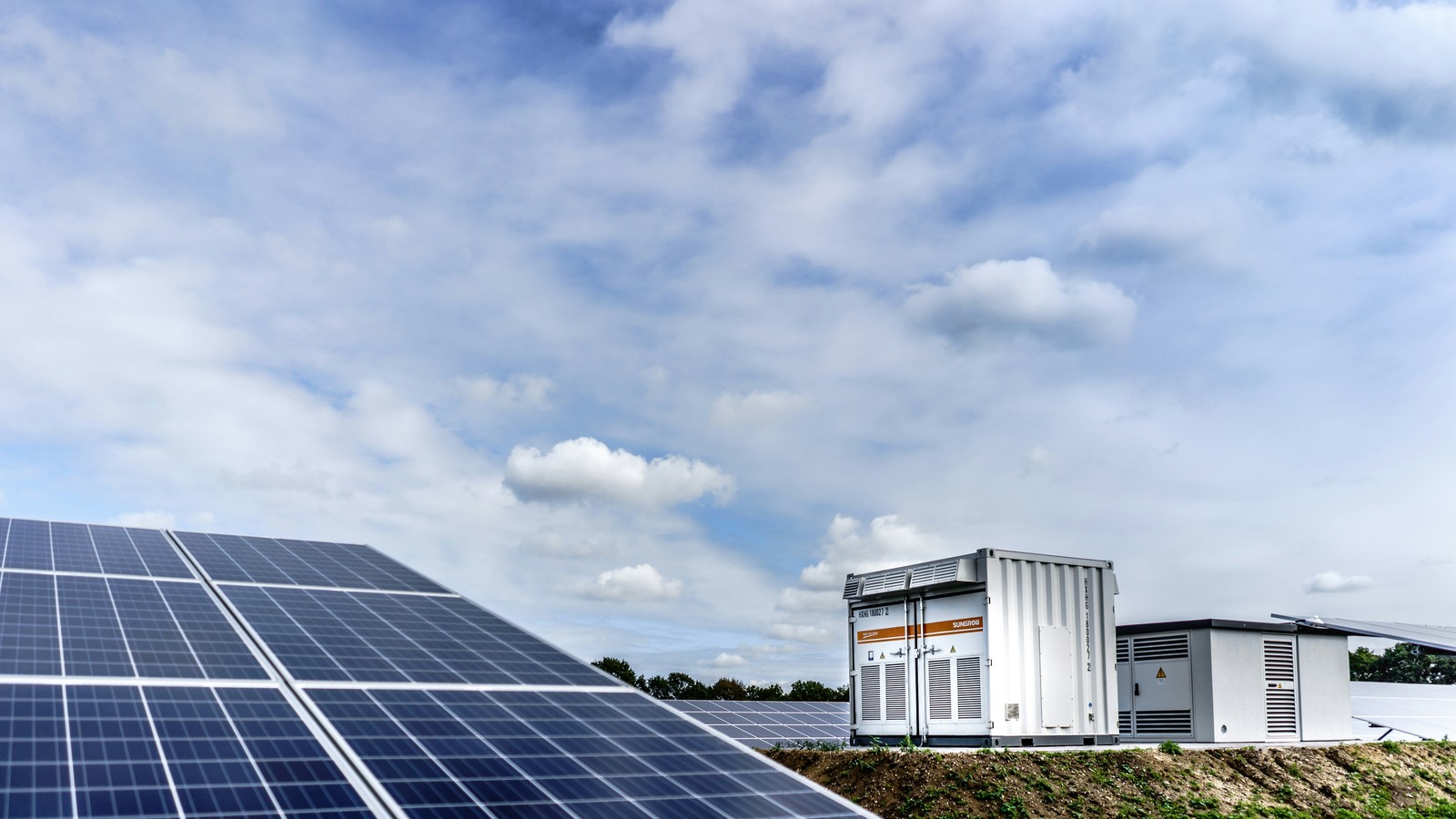
In July 2026 ICONIC announced that it had acted as adviser to an Egyptian aluminium producer, in its capacity as offtaker, on a project for the construction and operation of a 1.1 GWp solar photovoltaic plant with a co-located 50 MW / 200 MWh battery energy storage system (BESS) in Qena, Egypt. The project is expected to rely on a long-term corporate PPA with the offtaker. Delivery is planned in two adjacent phases in a desert environment (ICONIC, July 2026).
The project contributes to Egypt’s Vision 2030 and to the Integrated Sustainable Energy Strategy (ISES) 2035.
Development finance institutions finance the project, and the two European banks named in the release play different roles:
- The European Investment Bank (EIB) lists the whole 1.1 GWp plant with its 50 MW / 200 MWh BESS as a proposed project, with the aluminium producer as offtaker under an expected long-term corporate PPA (EIB project Available to registered readers, disclosed June 2026). According to ICONIC’s release, the EIB is offering a long-term project finance loan under the NDICI Investment Window 2, together with co-lenders.
- The European Bank for Reconstruction and Development (EBRD) has approved a senior loan for the first phase, a 500 MWac solar plant with 100 MWh of storage at Nagaa Hammadi (EBRD project Available to registered readers, disclosed 4 March 2026). According to ICONIC’s release, the project is categorised A under the EBRD’s Environmental and Social Policy 2024.
In October 2026 the trade press reported financial close of non-recourse financing for the first phase, with the EIB, the EBRD and the African Development Bank as lenders (PV Tech, October 2026). Transaction values are given in the PDF edition of this Insight, available through the download form below.
What the buyer’s adviser did
ICONIC acted as financial adviser to the offtaker on the negotiation and conclusion of the long-term corporate PPA. The mandate covered four workstreams: PPA structuring and negotiation support; financial analysis; counterparty assessment; and lender-facing support. The mandate did not cover legal, tax, accounting, insurance, technical or environmental advice, nor energy-market forecasting (ICONIC, July 2026).
“For an industrial buyer of this size, a long-term power purchase agreement is not only a question of price: it is a commitment measured in decades to a project that still has to be built, financed and operated. Our job was to hold those two things together — an agreement that stands up on the buyer’s balance sheet and, at the same time, to the tests the project’s lenders apply. That is the work we have been doing since 1987.”
Sal Fischer, Managing Director, ICONIC
Inside the paper
Buying power from a plant not yet built: a corporate PPA from the buyer’s side
DOC IPFA-INS-PF-PFT-2611-IPF-010-V2
Fill out the form to read the full paper.
Download the PDFPDF edition
Download the full Insight
Register below. We will ask you to confirm your e-mail address and then send you a personal download link.
Chapter 2
Framework: the buyer’s four tests
Four published models turn the four workstreams into tests a board can apply before it signs.
The four workstreams of the mandate map onto four tests. Each rests on a model from the academic literature, written out and applied in the chapters that follow; two ICONIC illustrations come in addition, labelled as such.
The models are not a forecast of any one contract; they show what the buyer has to negotiate. In Model 1 terms, a battery changes the production profile and so the profile correction. In Model 4 terms, a guarantee or letter of credit raises the survival probability the generator’s lenders can count on.
The models are not a forecast of any one contract; they show what the buyer has to negotiate.
Chapter 3
Test 1. The contract
What a pay-as-produced price should be, and why solar output lowers it.
The first workstream is the contract: its form, term, volume and shaping against the buyer’s demand, pricing and indexation, settlement, change in law, curtailment, force majeure and guarantees of origin, and the allocation of balancing, imbalance, shape and grid risk (ICONIC, July 2026). Each heading is a decision about who carries a risk.
Model 1. The fair price of a pay-as-produced PPA
In a pay-as-produced PPA the buyer takes whatever the plant generates. Chatziandreou and Karbach (2026) show that the fair fixed price, or strike, of such a contract is the production-weighted expected market price:
Here Su is the spot power price at time u, qu the plant’s production rate, T the delivery period and K⋆ the fair strike, the price at which the contract has zero expected value to either side (their equation 3.6). They then split the gap between the fair strike and the average baseload forward price F̄ into two parts:
The profile term Δprof captures the shape of expected output against the forward curve. The covariance term Δcov captures the tendency of prices to fall when output is high, which the authors call cannibalisation (their equations 3.11 to 3.13).
What the paper finds. Calibrated on hourly German data, the realised discount of the solar capture price to baseload was €24.94/MWh a month on average in the 2025 out-of-sample window. The profile term accounted for €21.57/MWh of it and the covariance term for €3.37/MWh (their Table 7). For wind, the covariance term dominated instead.
| Window | Months | Capture discount (baseload − capture) | of which profile | of which covariance |
|---|---|---|---|---|
| Calibration (2023–2024) | 24 | 14.52 | 12.32 | 2.21 |
| Context | 24 | 9.58 | 6.43 | 3.15 |
| Out-of-sample (2025) | 12 | 24.94 | 21.57 | 3.37 |
What it means for the buyer. In a solar pay-as-produced contract, most of the gap to baseload comes from the shape of output, not from randomness. Shape is negotiable. A baseload or shaped PPA moves it to the generator, at a price; a battery moves some midday energy into the evening and changes the profile term itself. The buyer’s question is therefore not only “what price?” but also which profile that price buys.
In a solar pay-as-produced contract, most of the gap to baseload comes from the shape of output, not from randomness.
Limits. The model is calibrated on Germany, not Egypt, and the working paper has not yet been peer-reviewed. The numbers show the size of the effect, not the Egyptian price.
The rest of the architecture
Form. A physical PPA delivers electricity through the grid; a financial PPA settles against a market price. In Egypt, direct private-to-private contracting, with the producer paying to use the network, has been introduced as a controlled pilot (Enterprise, October 2026).
Grid and curtailment. The Egyptian Center for Economic Studies notes grid congestion in high-resource areas such as Upper Egypt (ECES, 2026). The contract has to say who bears curtailment, and whether curtailed energy is paid for.
Change in law and guarantees of origin. Over decades, network charges, market design and carbon rules will change, and the contract has to say who owns the renewable attributes the buyer needs for its carbon reporting.
Topics to consider at this stage
- Which profile does the quoted price buy, and what would a baseload or shaped profile cost instead?
- Who pays when the grid cannot take the power, and when the rules change?
- Do we receive the certificates we need for our carbon reporting?
Chapter 4
Test 2. The numbers
How much of the price risk the PPA removes, and what it leaves with the buyer.
The second workstream turns the contract into numbers the board can approve: the cost of power over the term with downside cases, the hedge the PPA provides, and the residual exposure where volume and demand diverge (ICONIC, July 2026).
Model 2. The PPA as a hedge
Chatziandreou and Karbach (2026) write the value of a pay-as-produced PPA, from the side that receives production and pays the strike, as a floating-minus-fixed payoff:
The symbols are those of Model 1 (their equation 1.1). The payoff is positive when market prices run above the strike, offsetting what the buyer would otherwise pay. Standard futures cannot hedge it perfectly, because the volume is uncertain and moves with the price.
The authors therefore add renewable-linked claims to a futures hedge and solve for the combination that leaves the least residual variance (their Theorem 4.5). In their 2025 out-of-sample test, a futures-only hedge cut the standard deviation of a solar PPA’s result by 64.8%. Adding renewable-linked claims cut it by 96.3% (their Table 17).
What it means for the buyer. The volume and covariance risk that futures cannot reach is the part a buyer must either accept, price or move to the generator. Limits. The authors call their results an idealised frictionless benchmark that measures “model-implied hedgeability, not actual hedge performance in traded markets”.
The volume and covariance risk that futures cannot reach is the part a buyer must either accept, price or move to the generator.
ICONIC’s illustration: the buyer’s cost of power
The board needs the cost of power in its own terms. In any period t, the buyer pays the contract price for the contracted volume and the market price for the rest of its demand:
Here PPPA,t is the PPA price after indexation, Qt the contracted volume, Dt the buyer’s demand and pt the price it pays for the rest of its power. When Qt exceeds Dt, the buyer sells the surplus at the market price. This is ICONIC’s own illustration, not a published model.
Two measures follow from it. The share of demand that the PPA fixes, ht = Qt / Dt, is the hedge ratio. The residual exposure, (Dt − Qt) × pt, is what still moves with the market. A solar PPA’s hedge ratio is high at noon and zero at night, while a smelter runs around the clock, so the analysis has to run by hour or time block, not on annual totals.
Topics to consider at this stage
- What does the PPA fix, hour by hour, and what does it leave to the market?
- In the worst plausible case, what does the contract cost us, and can we carry it?
- How does the indexation compare with the way our own prices move?
Chapter 5
Test 3. The counterparty
How likely the generator is to fail, and how much support the buyer should ask for.
The third workstream looks at the generator: its credit and that of any parent or guarantor, its ability to deliver the project, and the credit and performance support required (ICONIC, July 2026).
Model 3. The distance to default
Structural credit models treat a firm’s equity as an option on its assets. Bharath and Shumway (2008) test the most widely used of them, the Merton distance to default, and its implied default probability:
Here V is the value of the firm’s assets, F the face value of its debt, μ the expected return on the assets, σV their volatility, T the horizon and N the standard normal distribution function. DD is the number of standard deviations by which asset value exceeds the debt at the horizon.
A worked number. Take a sponsor whose assets are worth 100 against debt of 70, with μ of 5% and T of one year. With asset volatility of 25%, DD is about 1.50 and the one-year default probability about 6.7%. With volatility of 15%, DD rises to about 2.64 and the probability falls to about 0.4%. The inputs are our own; the arithmetic is the model’s.
What the paper finds. Bharath and Shumway reject the hypothesis that the model’s probability is a sufficient statistic for default, but find it useful alongside other predictors.
What it means for the buyer. Leverage and volatility drive the generator’s risk, so the buyer should test both for whoever stands behind the project company. Limits. A project company in construction has no traded equity, so its volatility must be estimated; the model structures the questions rather than giving a rating.
Leverage and volatility drive the generator’s risk, so the buyer should test both for whoever stands behind the project company.
ICONIC’s illustration: sizing the support
The credit and performance support a buyer asks for can be sized on the expected loss from a generator default:
Here PD is the generator’s probability of default over the period, EAD the buyer’s exposure at that time, the replacement cost of the remaining power, and LGD the share of that exposure not recovered from the support. This is ICONIC’s own illustration, in the standard form of expected credit loss. With the 6.7% from Model 3, an LGD of 60% and an exposure of 100, the expected loss is about 4 per 100 of exposure. A guarantee that halves LGD halves it.
Topics to consider at this stage
- Who stands behind the project company, and what does that party guarantee?
- How much support do we need, in what form, and when can it be released?
Chapter 6
Test 4. The lenders
The buyer’s own credit is part of the price it is offered, and the lenders will ask for rights over its contract.
The fourth workstream turns the question round: what the generator’s lenders require of the PPA and of the buyer, including the lenders’ direct agreement, due diligence and the financing timetable (ICONIC, July 2026).
The PPA is the main security in a project financing. In the working-paper version of Corielli, Gatti and Steffanoni (2010), a project without a construction contract pays about 32 basis points more spread. In Egypt, local banks typically lend for five to seven years, against the 15 to 20 years renewable projects need (ECES, 2026), one reason why development finance institutions lead here.
Model 4. The offtaker’s default risk in the PPA price
Schütt and Kächele (2026) model what the generator expects to earn when the offtaker may default. If the offtaker defaults, the plant sells its output in the market instead:
Here V(t) is the survival function, the probability that the offtaker has not defaulted by period t; pppa the PPA price; Qt the energy produced; and Pt the market value of that energy (their equation 7, p. 6). Note that V here is a probability, not the asset value of Model 3. The generator then solves for the PPA price that still meets its lenders’ and investors’ required returns.
| Offtaker | PPA price needed | Above the default-free price |
|---|---|---|
| Default-free | 72.68 | — |
| Investment grade, AAA to A− | under 73.68 | under 1.00 |
| BB+ | 80.51 | 7.83 |
| B− | 113.55 | 40.87 |
| B−, with a 90% guarantee (with risk-based premia) | 91.95 | 19.27 |
What it means for the buyer. The buyer’s own credit is part of the price it is offered. Credit support or a third-party guarantee raises the survival probability V(t) the lenders can count on, and so lowers the price. Limits. The study is calibrated on German onshore wind and treats the offtaker’s default probability as independent of electricity prices.
The lenders will also ask for a direct agreement with step-in and cure rights over the PPA, and in a phased project the contract may take effect in stages: the first phase closed in October 2026 and the second was expected to start construction in the first half of 2027 (PV Tech, October 2026).
Topics to consider at this stage
- How does our rating show up in the price, and what support would lower it?
- What happens to our commitments if the financing of a phase is delayed?
Chapter 7
What’s the bottom line?
A corporate PPA with an unbuilt plant is two commitments in one contract, and both have to be negotiated together.
A corporate PPA with an unbuilt plant fixes the cost of a large share of the buyer’s power for decades and becomes the revenue a project financing rests on. A contract that suits the buyer but fails the lenders’ tests will not be financed. A contract that suits the lenders but not the buyer’s balance sheet will not be approved.
A contract that suits the buyer but fails the lenders’ tests will not be financed.
The four tests show where the value lies. The profile, not chance, drives most of a solar price discount. Futures leave the volume risk behind. The generator’s leverage and volatility set the support the buyer needs, and the buyer’s own credit sets part of the price it pays.
The carbon border
The release says the PPA is expected to support the offtaker in aligning with the EU Carbon Border Adjustment Mechanism (CBAM) (ICONIC, July 2026). The definitive regime applies from 1 January 2026, and aluminium is one of the six covered sectors (European Commission, 2026). For aluminium, however, the charge covers direct emissions only: indirect emissions from electricity are excluded under Annex II of the CBAM Regulation, although they are estimated at about 80% of global aluminium emissions (Wolfram and Pereboom, 2026). A Commission official said in October 2025 that there was no intention to extend the scope for steel and aluminium in the immediate future (Fastmarkets, November 2025).
So under today’s rules a renewable PPA does not lower the CBAM charge on a tonne of aluminium. Its value lies in the carbon intensity the smelter can report, which EU customers increasingly ask about, and in its position if the scope is widened. That is ICONIC’s reading, and it is why “expected to support” is the right wording.
How ICONIC can help
ICONIC Project Finance Advisory works with industrial buyers, sponsors and lenders on the contracts that carry project financings:
- Project finance transactions. Structured large-scale project finance transactions, from the buyer’s or the sponsor’s side. Discuss a mandate.
- Financial modelling. Models of the cost of power under a PPA, with sensitivities and downside cases, building on ICONIC’s legacy work since 1987. Pre-screen your project.
- Due diligence. Assessment of a counterparty’s credit and its ability to deliver a project: track record, permits, grid connection and financing plan. Contact .
Summary
An industrial buyer that signs a long-term PPA with a plant still to be built commits to decades of power and to a role in the project’s financing. ICONIC acted as financial adviser to an Egyptian aluminium producer, as offtaker, on such a PPA for a 1.1 GWp solar plant with battery storage in Qena, financed by development finance institutions. Four published models turn the mandate’s four workstreams into tests. The fair price of a pay-as-produced contract shows that the solar profile drives most of the discount to baseload. The hedge model shows what futures cannot remove. The distance to default sizes the generator’s risk, and the offtaker-default model shows that the buyer’s own credit is part of its price. Under current CBAM rules the charge on aluminium covers direct emissions only, so a renewable PPA supports alignment through reported carbon intensity rather than a lower charge.
Frequently asked questions
What is a corporate PPA?
A long-term contract under which a company buys electricity directly from a generator, at a price agreed in advance, rather than from a utility at a regulated tariff. It can deliver power physically through the grid, or settle financially against a market price.
Why does a buyer’s PPA matter to the project’s lenders?
Because the PPA is the main source of the revenue that repays the debt. Lenders size the loan on the contract, test the buyer’s credit, and ask the buyer to sign a direct agreement that lets them protect the contract if the generator defaults.
Does a renewable PPA reduce an aluminium exporter’s CBAM charge?
Not under the current rules. For aluminium, the CBAM charge covers direct emissions only; the emissions from the electricity used are excluded. A renewable PPA lowers the carbon intensity the exporter can report, and would matter if the scope of the mechanism were widened.
References
- Bharath, S.T. and Shumway, T. (2008) ‘Forecasting default with the Merton distance to default model’, Review of Financial Studies, 21(3), pp. 1339–1369. https://doi.org/10.1093/rfs/hhn044
- Chatziandreou, K. and Karbach, S. (2026) ‘Pricing and semi-static hedging of green pay-as-produced power purchase agreements’, arXiv working paper 2607.27814. https://doi.org/10.48550/arXiv.2607.27814
- Corielli, F., Gatti, S. and Steffanoni, A. (2010) ‘Risk shifting through nonfinancial contracts: effects on loan spreads and capital structure of project finance deals’, Journal of Money, Credit and Banking, 42(7), pp. 1295–1320. https://doi.org/10.1111/j.1538-4616.2010.00342.x
- Daily News Egypt (2025) ‘Egypt seals deal for “Available to registered readers” Solar Project to power aluminium giant, bolster green exports’, 6 October. Available to registered readers
- EBRD (2026) ‘Project Available to registered readers’, project summary document Available to registered readers, disclosed 4 March 2026, as recorded by the Early Warning System. Available to registered readers
- EIB (2026) ‘Available to registered readers Solar PV and BESS’, project Available to registered readers, disclosed 10 June 2026, as recorded by the Early Warning System. Available to registered readers
- Egyptian Center for Economic Studies (2026) A Series of Policy Papers on Renewable Energy, Policy Paper III: Unlocking private sector investment in Egypt’s renewable energy transition. https://eces.org.eg/wp-content/uploads/2026/06/A-Series-of-Policy-Papers-on-Renewable-Energy-Policy-Paper-III-–-unlocking-private-sector-investment-in-Egypts-renewable-energy-transition-–-from-structural-advantage-to-scalable-deployment.pdf
- Enterprise (2026) ‘Egypt wants private developers to build most of its new power. Here’s how that business works’, 14 October. https://enterpriseam.com/egypt/2026/10/14/egypt-wants-private-developers-to-build-most-of-its-new-power-heres-how-that-business-works/
- European Commission (2026) ‘CBAM definitive regime’, Taxation and Customs Union. https://taxation-customs.ec.europa.eu/carbon-border-adjustment-mechanism/cbam-definitive-regime_en
- Fastmarkets (2025) ‘EU set to keep indirect emissions out of CBAM for metals; adds pre-consumer scrap as separate product’, 7 November. https://www.fastmarkets.com/insights/eu-to-keep-indirect-emissions-out-of-cbam-for-metals
- ICONIC Project Finance Advisory (2026) ‘ICONIC advises on 1.1 GWp solar-plus-storage project’, press release, London | Qena, Egypt, July. https://ipfa.finance/media/iconic-advises-on-1-1-gwp-solar-plus-storage-project/
- PV Tech (2026) report on the financial close of the first phase, 27 October. Full reference in the PDF edition.
- Schütt, J. and Kächele, F. (2026) ‘Government backed credit guarantee schemes for offtaker counterparty risk under corporate power purchase agreements’, Energy Economics, 155, 109166. https://doi.org/10.1016/j.eneco.2026.109166
- US International Trade Administration (2025) ‘Egypt – Electricity and Renewable Energy’, Country Commercial Guide, 21 November. https://www.trade.gov/country-commercial-guides/egypt-electricity-and-renewable-energy
- Wolfram, C. and Pereboom, M. (2026) The missing carbon signal: how CBAM’s exclusion of scope 2 emissions undermines its climate/trade objectives, Policy Brief MOZ-25277. International Growth Centre, July. https://www.theigc.org/sites/default/files/2026-08/Wolfram-Pereboom-Policy-Brief-July-2026.pdf
This Insight is for general information only and does not constitute investment, legal or tax advice. Figures from public sources are as reported at the dates shown.