How to fund wind vessels when charters end before the debt does
Offshore wind installation vessels can cost more than US$300m each, yet many specialist vessels work on contracts measured in months. Export credit agencies already bridge that gap; the question is how to price and structure it.
ICONIC Maritime TeamMaritime, ICONIC Project Finance AdvisoryCharters end. Loans run on. We match the debt to the voyages ahead, bring in the lenders and export credit cover that fit, and time each ship to the cycle.ICONIC Maritime TeamCharters end. Loans run on. We match the debt to the voyages ahead, bring in the lenders and export credit cover that fit, and time each ship to the cycle.Approved by Georgos S. Andrianopoulos, CFO & Family Office Project Finance InvestmentProfessional EUR-ING by academic training and Chartered Financial Analyst, Georgos turned a long CFO career into international project, shipping and corporate finance. A motorsport enthusiast and car aficionado, he brings the same discipline to every transaction: precise set-up, rigorous modelling and timing at financial close, across maritime, infrastructure, oil and gas, renewables and PPPs. He tunes each transaction like a race car.Georgos S. AndrianopoulosProfessional EUR-ING by academic training and Chartered Financial Analyst, Georgos turned a long CFO career into international project, shipping and corporate finance. A motorsport enthusiast and car aficionado, he brings the same discipline to every transaction: precise set-up, rigorous modelling and timing at financial close, across maritime, infrastructure, oil and gas, renewables and PPPs. He tunes each transaction like a race car.11 minute read | DOC IPFA-INS-MAR-SPF-2611-IPF-009-V2
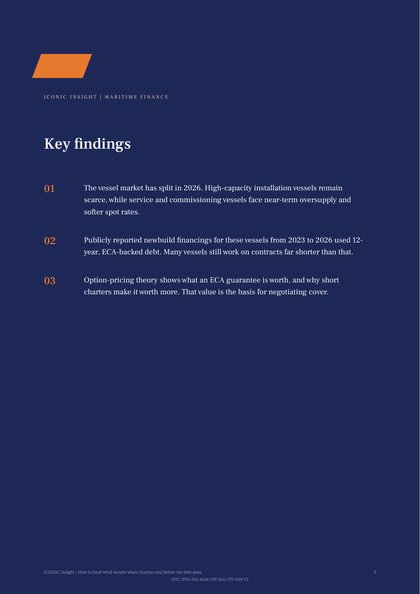
The vessel market has split in 2026. High-capacity installation vessels remain scarce, while service and commissioning vessels face near-term oversupply and softer spot rates.
Publicly reported newbuild financings for these vessels from 2023 to 2026 used 12-year, ECA-backed debt. Many vessels still work on contracts far shorter than that.
Option-pricing theory shows what an ECA guarantee is worth, and why short charters make it worth more. That value is the basis for negotiating cover.
The vessel crunch has become a vessel split
A broad surge in vessel dayrates is often assumed. Public, dated evidence shows two markets moving in different directions.
At the top end, installation capacity is still tight. In August 2026, Cadeler ordered two T-class wind turbine installation vessels (WTIVs) for €805m, for delivery in 2030–31 (Maritime Journal, 10 August 2026). The same report estimated that only 12 to 15 vessels can install the largest turbines.
Cadeler also reported a €2.5bn backlog at the half-year, with 77% past final investment decision (Cadeler H1 2026 results call).
The service segment looks different. Service operation vessels (SOVs) house technicians at a wind farm during operations; commissioning SOVs (CSOVs) do the same during construction. Offshore Wind Journal reported in August 2026 that this market had cooled as a newbuilding wave entered service (Riviera, 18 August 2026).
What a vessel costs
Cadeler’s order implies about €400m per WTIV; Eneti’s 2023 facility implies roughly US$335m each (both derived; Exhibit 2). We found no public, dated newbuild price for an SOV or CSOV, so the US$300m+ threshold applies to WTIVs only.
The duration mismatch
Spot CSOV rates were about €50,000–65,000 per day in August 2026. A three-year fixture cost about €40,000 and a ten-year fixture about €25,000 (Riviera, citing Hagland Shipbrokers).
Sponsors rarely bring a 15-year firm charter to lenders; the longest CSOV fixtures quoted publicly ran about ten years. Every ECA-backed newbuild facility we reviewed carried a 12-year tenor.
That tenor matches the OECD Sector Understanding on Export Credits for Ships, which caps repayment at 12 years after delivery.
Exhibit 1. Publicly reported ECA involvement in offshore wind vessel newbuilds, 2023–2026. Reading guide: in every disclosed case the tenor is 12 years, set by export-credit rules, not by any one charter.
Item
Value
Date
Source
WTIV newbuild cost (derived)
about €400m per vessel
Aug 2026
Maritime Journal
WTIV newbuild cost (derived)
about US$335m per vessel
Dec 2023
gCaptain
ECA-backed debt tenor
12 years after delivery
2023–2026
Exhibit 1
CSOV installation contracts
3–12 months
Jul 2026
Clarksons report, via Riviera
Longest CSOV fixtures quoted
about 10 years
Aug 2026
Riviera, citing Hagland
Average WTIV charter duration
not publicly available
—
—
Exhibit 2. Cost, debt tenor and contract length: public data points. Reading guide: a vessel costing several hundred million is financed over 12 years, while much of the fleet works on contracts of months.
Inside the paper
How to fund wind vessels when charters end before the debt does
Register below. We will ask you to confirm your e-mail address and then send you a personal download link.
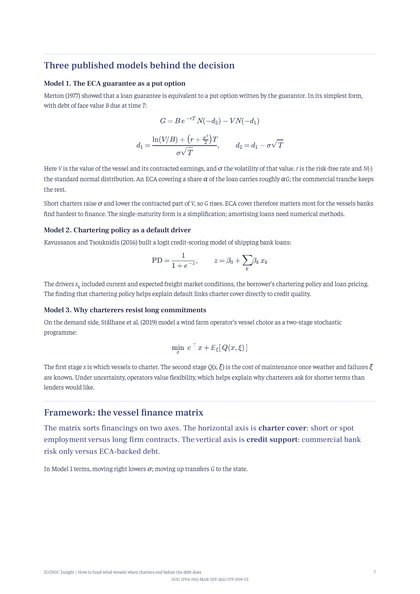
Three published models behind the decision
Model 1. The ECA guarantee as a put option
Merton (1977) showed that a loan guarantee is equivalent to a put option written by the guarantor. In its simplest form, with debt of face value B due at time T:
Here V is the value of the vessel and its contracted earnings, and σ the volatility of that value. r is the risk-free rate and N(·) the standard normal distribution. An ECA covering a share α of the loan carries roughly αG; the commercial tranche keeps the rest.
Short charters raise σ and lower the contracted part of V, so G rises. ECA cover therefore matters most for the vessels banks find hardest to finance. The single-maturity form is a simplification; amortising loans need numerical methods.
Model 2. Chartering policy as a default driver
Kavussanos and Tsouknidis (2016) built a logit credit-scoring model of shipping bank loans:
The drivers xk included current and expected freight market conditions, the borrower’s chartering policy and loan pricing. The finding that chartering policy helps explain default links charter cover directly to credit quality.
Model 3. Why charterers resist long commitments
On the demand side, Stålhane et al. (2019) model a wind farm operator’s vessel choice as a two-stage stochastic programme:
The first stage x is which vessels to charter. The second stage Q(x, ξ) is the cost of maintenance once weather and failures ξ are known. Under uncertainty, operators value flexibility, which helps explain why charterers ask for shorter terms than lenders would like.
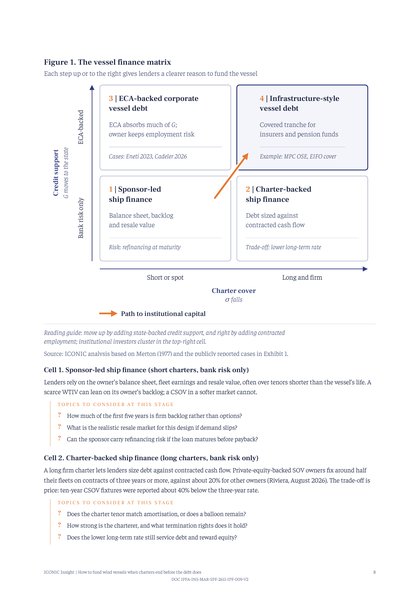
Framework: the vessel finance matrix
The matrix sorts financings on two axes. The horizontal axis is charter cover: short or spot employment versus long firm contracts. The vertical axis is credit support: commercial bank risk only versus ECA-backed debt.
In Model 1 terms, moving right lowers σ; moving up transfers G to the state.
Figure 1. The vessel finance matrix. Each step up or to the right gives lenders a clearer reason to fund the vessel. Reading guide: move up by adding state-backed credit support, and right by adding contracted employment; institutional investors cluster in the top-right cell. Source: ICONIC analysis based on Merton (1977) and the publicly reported cases in Exhibit 1.
Cell 1. Sponsor-led ship finance (short charters, bank risk only)
Lenders rely on the owner’s balance sheet, fleet earnings and resale value, often over tenors shorter than the vessel’s life. A scarce WTIV can lean on its owner’s backlog; a CSOV in a softer market cannot.
Topics to consider at this stage
How much of the first five years is firm backlog rather than options?
What is the realistic resale market for this design if demand slips?
Can the sponsor carry refinancing risk if the loan matures before payback?
Cell 2. Charter-backed ship finance (long charters, bank risk only)
A long firm charter lets lenders size debt against contracted cash flow. Private-equity-backed SOV owners fix around half their fleets on contracts of three years or more, against about 20% for other owners (Riviera, August 2026). The trade-off is price: ten-year CSOV fixtures were reported about 40% below the three-year rate.
Topics to consider at this stage
Does the charter tenor match amortisation, or does a balloon remain?
How strong is the charterer, and what termination rights does it hold?
Does the lower long-term rate still service debt and reward equity?
Most publicly reported WTIV financings sit here. The Cadeler and Eneti facilities combined commercial banks with ECA cover over 12 years (Exhibit 1). The ECA does not underwrite employment; it absorbs much of G, so banks can lend longer than the charter book alone supports.
Topics to consider at this stage
Which ECAs are eligible, given yard, equipment and owner domicile?
What share is covered, and what risk remains in the commercial tranche?
Is the ECA premium below the modelled value of the guarantee?
Long employment plus ECA cover produces a credit that resembles infrastructure debt, suited to insurers and pension funds. EIFO’s 80% guarantee on a 12-year loan for MPC OSE shows the direction.
One route is to split the debt. The ECA-covered tranche carries mainly the agency’s credit risk, so it can suit investors who cannot hold shipping risk. The uncovered tranche keeps vessel and charter risk.
Ziton reported long-term financing from banks and institutional investors in October 2026, without ECA involvement (Maritime Journal).
Topics to consider at this stage
Can the covered tranche be placed with institutional investors?
What return do they require for the uncovered tranche?
Does a green finance framework widen the investor base enough to justify its cost?
How lenders assess redeployment risk
Redeployment risk is the chance that a vessel cannot find new work at a viable rate when its contract ends. Public evidence and the models above point to three tests.
Technical relevance. Only around 12 to 15 jack-ups can install the largest turbines (Maritime Journal, August 2026). A vessel that falls out of that tier as turbines grow faces a thinner market for its next contract.
Alternative markets. Clarksons has noted vessels cross-trading between oil and gas and offshore wind (Clarksons, February 2026). Older converted CSOVs are also returning to oil and gas, and some early SOVs are leaving long-term contracts for the spot market (Riviera, August 2026).
Chartering policy and flexibility. Model 2 shows that chartering policy helps explain default. Bendall and Stent (2005) value the option to switch between operating strategies. That lets lenders price flexibility rather than ignore it.
Topics to consider at this stage
Will the vessel’s crane and leg length still serve the turbines planned for its second charter?
Which alternative markets could absorb the vessel, and at what rate?
How much value does the sponsor’s switching flexibility add, and who captures it?
What’s the bottom line?
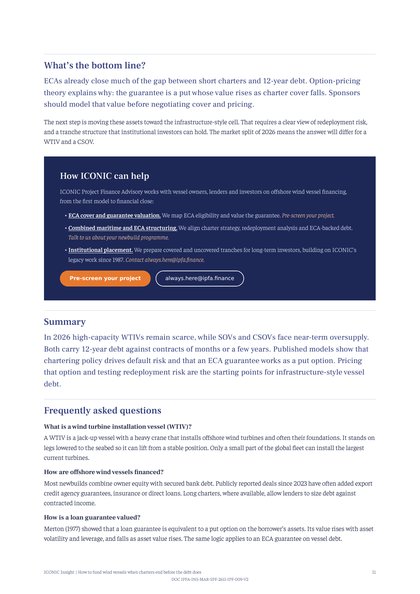
ECAs already close much of the gap between short charters and 12-year debt. Option-pricing theory explains why: the guarantee is a put whose value rises as charter cover falls. Sponsors should model that value before negotiating cover and pricing.
The next step is moving these assets toward the infrastructure-style cell. That requires a clear view of redeployment risk, and a tranche structure that institutional investors can hold. The market split of 2026 means the answer will differ for a WTIV and a CSOV.
How ICONIC can help
ICONIC Project Finance Advisory works with vessel owners, lenders and investors on offshore wind vessel financing, from the first model to financial close:
Institutional placement. We prepare covered and uncovered tranches for long-term investors, building on ICONIC’s legacy work since 1987. Contact .
Summary
In 2026 high-capacity WTIVs remain scarce, while SOVs and CSOVs face near-term oversupply. Both carry 12-year debt against contracts of months or a few years. Published models show that chartering policy drives default risk and that an ECA guarantee works as a put option. Pricing that option and testing redeployment risk are the starting points for infrastructure-style vessel debt.
Frequently asked questions
What is a wind turbine installation vessel (WTIV)?
A WTIV is a jack-up vessel with a heavy crane that installs offshore wind turbines and often their foundations. It stands on legs lowered to the seabed so it can lift from a stable position. Only a small part of the global fleet can install the largest current turbines.
How are offshore wind vessels financed?
Most newbuilds combine owner equity with secured bank debt. Publicly reported deals since 2023 have often added export credit agency guarantees, insurance or direct loans. Long charters, where available, allow lenders to size debt against contracted income.
How is a loan guarantee valued?
Merton (1977) showed that a loan guarantee is equivalent to a put option on the borrower’s assets. Its value rises with asset volatility and leverage, and falls as asset value rises. The same logic applies to an ECA guarantee on vessel debt.
References
Merton, R.C. (1977) ‘An analytic derivation of the cost of deposit insurance and loan guarantees: an application of modern option pricing theory’, Journal of Banking & Finance, 1(1), pp. 3–11. https://doi.org/10.1016/0378-4266(77)90015-2
Kavussanos, M.G. and Tsouknidis, D.A. (2016) ‘Default risk drivers in shipping bank loans’, Transportation Research Part E: Logistics and Transportation Review, 94, pp. 71–94. https://doi.org/10.1016/j.tre.2016.07.008
Stålhane, M., Halvorsen-Weare, E.E., Nonås, L.M. and Pantuso, G. (2019) ‘Optimizing vessel fleet size and mix to support maintenance operations at offshore wind farms’, European Journal of Operational Research, 276(2), pp. 495–509. https://doi.org/10.1016/j.ejor.2019.01.023
Bendall, H.B. and Stent, A.F. (2005) ‘Ship investment under uncertainty: valuing a real option on the maximum of several strategies’, Maritime Economics & Logistics, 7(1), pp. 19–35. https://doi.org/10.1057/palgrave.mel.9100122
OECD (2026) Sector Understanding on Export Credits for Ships, Annex IV to the Arrangement on Officially Supported Export Credits, January 2026 version, TAD/PG(2026)1, 26 January 2026. https://one.oecd.org/document/TAD/PG(2026)1/en/pdf
This Insight is for general information only and does not constitute investment, legal or tax advice. Figures from public sources are as reported at the dates shown.
About this article
Authors
ICONIC Maritime TeamMaritime, ICONIC Project Finance AdvisoryCharters end. Loans run on. We match the debt to the voyages ahead, bring in the lenders and export credit cover that fit, and time each ship to the cycle.ICONIC Maritime TeamCharters end. Loans run on. We match the debt to the voyages ahead, bring in the lenders and export credit cover that fit, and time each ship to the cycle.
Approved by
Georgos S. AndrianopoulosCFO & Family Office Project Finance InvestmentProfessional EUR-ING by academic training and Chartered Financial Analyst, Georgos turned a long CFO career into international project, shipping and corporate finance. A motorsport enthusiast and car aficionado, he brings the same discipline to every transaction: precise set-up, rigorous modelling and timing at financial close, across maritime, infrastructure, oil and gas, renewables and PPPs. He tunes each transaction like a race car.Georgos S. AndrianopoulosProfessional EUR-ING by academic training and Chartered Financial Analyst, Georgos turned a long CFO career into international project, shipping and corporate finance. A motorsport enthusiast and car aficionado, he brings the same discipline to every transaction: precise set-up, rigorous modelling and timing at financial close, across maritime, infrastructure, oil and gas, renewables and PPPs. He tunes each transaction like a race car.
A floating storage and regasification unit is a ship that works like a terminal. Buying one, or a stake in its owner, means pricing the charter,…
ICONIC LNG & Gas Infrastructure Team | 19 min readA floating terminal is only as good as the charter that keeps it moored. We read that contract first, measure the debt it can carry, and set up the purchase to outlast it.ICONIC LNG & Gas Infrastructure TeamA floating terminal is only as good as the charter that keeps it moored. We read that contract first, measure the debt it can carry, and set up the purchase to outlast it.
Shipowners who treat fleet growth as a sequence of purchases leave value on the table. Those who model timing and mix together can raise capital on…
ICONIC Maritime Team | 6 min readCharters end. Loans run on. We match the debt to the voyages ahead, bring in the lenders and export credit cover that fit, and time each ship to the cycle.ICONIC Maritime TeamCharters end. Loans run on. We match the debt to the voyages ahead, bring in the lenders and export credit cover that fit, and time each ship to the cycle.
ICONIC InsightsOne e-mail a month, no selling.
ICONIC Insights
Project finance, read in five minutes a month.
Market notes on infrastructure, maritime and ECA finance, and the transactions we can talk about. One e-mail a month, no selling.
ICONIC does not track you. Visits are counted anonymously, with no cookies and no IP addresses. A cookie is set only if you sign in as a reader. Our fonts load from Google, which receives your IP address under Google's own privacy policy.
ICONIC does not track you. Visits are counted anonymously, with no cookies and no IP addresses. A cookie is set only if you sign in as a reader. Our fonts load from Google, which receives your IP address under Google's own privacy policy.


 Approved by