How to grow a fleet without locking in capital at the wrong time
Shipowners who treat fleet growth as a sequence of purchases leave value on the table. Those who model timing and mix together can raise capital on better terms and avoid ordering at the top of the cycle.
ICONIC Maritime TeamMaritime, ICONIC Project Finance AdvisoryCharters end. Loans run on. We match the debt to the voyages ahead, bring in the lenders and export credit cover that fit, and time each ship to the cycle.ICONIC Maritime TeamCharters end. Loans run on. We match the debt to the voyages ahead, bring in the lenders and export credit cover that fit, and time each ship to the cycle.Approved by Georgos S. Andrianopoulos, CFO & Family Office Project Finance InvestmentProfessional EUR-ING by academic training and Chartered Financial Analyst, Georgos turned a long CFO career into international project, shipping and corporate finance. A motorsport enthusiast and car aficionado, he brings the same discipline to every transaction: precise set-up, rigorous modelling and timing at financial close, across maritime, infrastructure, oil and gas, renewables and PPPs. He tunes each transaction like a race car.Georgos S. AndrianopoulosProfessional EUR-ING by academic training and Chartered Financial Analyst, Georgos turned a long CFO career into international project, shipping and corporate finance. A motorsport enthusiast and car aficionado, he brings the same discipline to every transaction: precise set-up, rigorous modelling and timing at financial close, across maritime, infrastructure, oil and gas, renewables and PPPs. He tunes each transaction like a race car.6 minute read | DOC IPFA-RPT-MAR-SHF-2611-IPF-008-V2
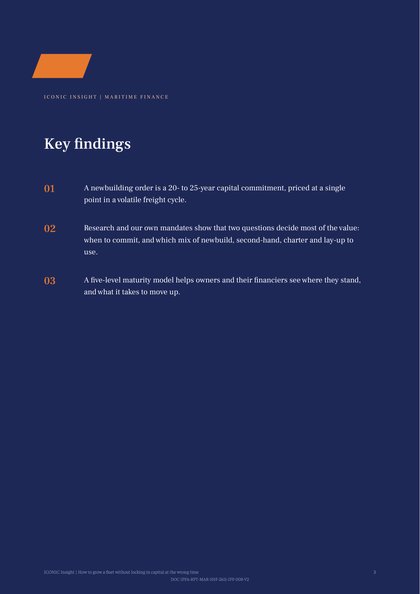
A newbuilding order is a 20- to 25-year capital commitment, priced at a single point in a volatile freight cycle.
Research and our own mandates show that two questions decide most of the value: when to commit, and which mix of newbuild, second-hand, charter and lay-up to use.
A five-level maturity model helps owners and their financiers see where they stand, and what it takes to move up.
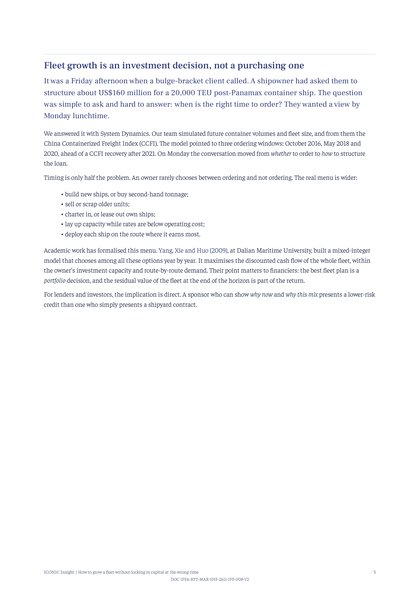
Fleet growth is an investment decision, not a purchasing one
It was a Friday afternoon when a bulge-bracket client called. A shipowner had asked them to structure about US$160 million for a 20,000 TEU post-Panamax container ship. The question was simple to ask and hard to answer: when is the right time to order? They wanted a view by Monday lunchtime.
We answered it with System Dynamics. Our team simulated future container volumes and fleet size, and from them the China Containerized Freight Index (CCFI). The model pointed to three ordering windows: October 2016, May 2018 and 2020, ahead of a CCFI recovery after 2021. On Monday the conversation moved from whether to order to how to structure the loan.
Timing is only half the problem. An owner rarely chooses between ordering and not ordering. The real menu is wider:
build new ships, or buy second-hand tonnage;
sell or scrap older units;
charter in, or lease out own ships;
lay up capacity while rates are below operating cost;
deploy each ship on the route where it earns most.
Academic work has formalised this menu. Yang, Xie and Huo (2009), at Dalian Maritime University, built a mixed-integer model that chooses among all these options year by year. It maximises the discounted cash flow of the whole fleet, within the owner’s investment capacity and route-by-route demand. Their point matters to financiers: the best fleet plan is a portfolio decision, and the residual value of the fleet at the end of the horizon is part of the return.
For lenders and investors, the implication is direct. A sponsor who can show why now and why this mix presents a lower-risk credit than one who simply presents a shipyard contract.
Inside the paper
How to grow a fleet without locking in capital at the wrong time
Register below. We will ask you to confirm your e-mail address and then send you a personal download link.
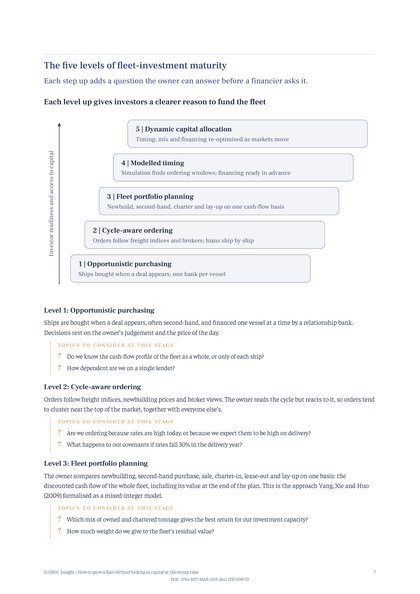
The five levels of fleet-investment maturity
Each step up adds a question the owner can answer before a financier asks it.
Level 1: Opportunistic purchasing
Ships are bought when a deal appears, often second-hand, and financed one vessel at a time by a relationship bank. Decisions rest on the owner’s judgement and the price of the day.
Topics to consider at this stage
Do we know the cash-flow profile of the fleet as a whole, or only of each ship?
How dependent are we on a single lender?
Level 2: Cycle-aware ordering
Orders follow freight indices, newbuilding prices and broker views. The owner reads the cycle but reacts to it, so orders tend to cluster near the top of the market, together with everyone else’s.
Topics to consider at this stage
Are we ordering because rates are high today, or because we expect them to be high on delivery?
What happens to our covenants if rates fall 30% in the delivery year?
Level 3: Fleet portfolio planning
The owner compares newbuilding, second-hand purchase, sale, charter-in, lease-out and lay-up on one basis: the discounted cash flow of the whole fleet, including its value at the end of the plan. This is the approach Yang, Xie and Huo (2009) formalised as a mixed-integer model.
Topics to consider at this stage
Which mix of owned and chartered tonnage gives the best return for our investment capacity?
How much weight do we give to the fleet’s residual value?
Level 4: Modelled timing
Simulation of demand, fleet supply and freight rates identifies ordering windows, as in our CCFI study. Financing is prepared for those windows, so the owner can commit when the window opens rather than search for capital after it has passed.
Topics to consider at this stage
Which windows does our model show, and how robust are they to different demand scenarios?
Is our financing ready to close inside the window?
Level 5: Dynamic capital allocation
Timing, fleet mix and financing are managed as one plan and updated as markets, technology and regulation change. The owner draws on several sources of capital (banks, export credit agencies, institutional investors, private equity) and matches each to the right part of the fleet.
Topics to consider at this stage
How often do we re-run the plan, and who owns it?
Which capital source is cheapest for each part of the fleet: newbuilds, modern second-hand, older tonnage?
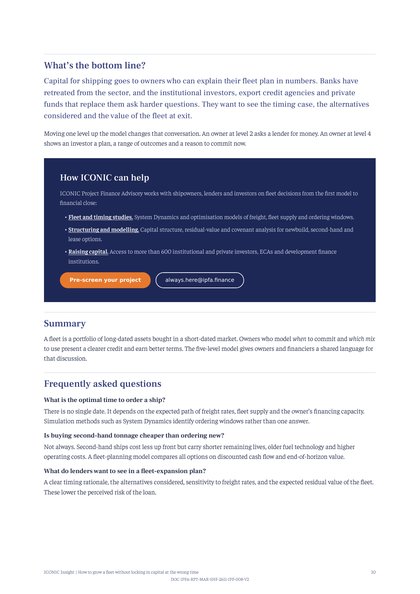
What’s the bottom line?
Capital for shipping goes to owners who can explain their fleet plan in numbers. Banks have retreated from the sector, and the institutional investors, export credit agencies and private funds that replace them ask harder questions. They want to see the timing case, the alternatives considered and the value of the fleet at exit.
Moving one level up the model changes that conversation. An owner at level 2 asks a lender for money. An owner at level 4 shows an investor a plan, a range of outcomes and a reason to commit now.
How ICONIC can help
ICONIC Project Finance Advisory works with shipowners, lenders and investors on fleet decisions from the first model to financial close:
Fleet and timing studies. System Dynamics and optimisation models of freight, fleet supply and ordering windows.
Structuring and modelling. Capital structure, residual-value and covenant analysis for newbuild, second-hand and lease options.
Raising capital. Access to more than 600 institutional and private investors, ECAs and development finance institutions.
A fleet is a portfolio of long-dated assets bought in a short-dated market. Owners who model when to commit and which mix to use present a clearer credit and earn better terms. The five-level model gives owners and financiers a shared language for that discussion.
Frequently asked questions
What is the optimal time to order a ship?
There is no single date. It depends on the expected path of freight rates, fleet supply and the owner’s financing capacity. Simulation methods such as System Dynamics identify ordering windows rather than one answer.
Is buying second-hand tonnage cheaper than ordering new?
Not always. Second-hand ships cost less up front but carry shorter remaining lives, older fuel technology and higher operating costs. A fleet-planning model compares all options on discounted cash flow and end-of-horizon value.
What do lenders want to see in a fleet-expansion plan?
A clear timing rationale, the alternatives considered, sensitivity to freight rates, and the expected residual value of the fleet. These lower the perceived risk of the loan.
References
Yang, Q., Xie, X. and Huo, W. (2009). Modeling fleet planning strategy based on multimode investment. 2009 Second International Symposium on Computational Intelligence and Design, IEEE, pp. 493–496. doi:10.1109/ISCID.2009.130
ICONIC Project Finance Advisory. Optimal timing for a ship order placement, internal study based on System Dynamics simulation of the CCFI.
This article is for general information only and does not constitute investment, legal or tax advice. Views on past market windows are illustrative and do not predict future freight rates.
About this article
Authors
ICONIC Maritime TeamMaritime, ICONIC Project Finance AdvisoryCharters end. Loans run on. We match the debt to the voyages ahead, bring in the lenders and export credit cover that fit, and time each ship to the cycle.ICONIC Maritime TeamCharters end. Loans run on. We match the debt to the voyages ahead, bring in the lenders and export credit cover that fit, and time each ship to the cycle.
Approved by
Georgos S. AndrianopoulosCFO & Family Office Project Finance InvestmentProfessional EUR-ING by academic training and Chartered Financial Analyst, Georgos turned a long CFO career into international project, shipping and corporate finance. A motorsport enthusiast and car aficionado, he brings the same discipline to every transaction: precise set-up, rigorous modelling and timing at financial close, across maritime, infrastructure, oil and gas, renewables and PPPs. He tunes each transaction like a race car.Georgos S. AndrianopoulosProfessional EUR-ING by academic training and Chartered Financial Analyst, Georgos turned a long CFO career into international project, shipping and corporate finance. A motorsport enthusiast and car aficionado, he brings the same discipline to every transaction: precise set-up, rigorous modelling and timing at financial close, across maritime, infrastructure, oil and gas, renewables and PPPs. He tunes each transaction like a race car.
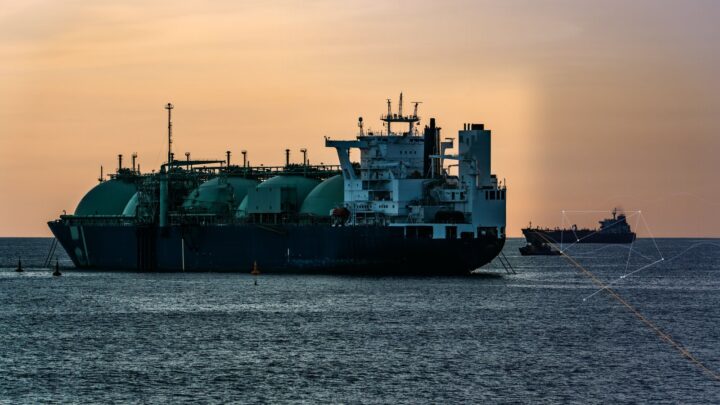
A floating storage and regasification unit is a ship that works like a terminal. Buying one, or a stake in its owner, means pricing the charter,…
ICONIC LNG & Gas Infrastructure Team | 19 min readA floating terminal is only as good as the charter that keeps it moored. We read that contract first, measure the debt it can carry, and set up the purchase to outlast it.ICONIC LNG & Gas Infrastructure TeamA floating terminal is only as good as the charter that keeps it moored. We read that contract first, measure the debt it can carry, and set up the purchase to outlast it.
Offshore wind installation vessels can cost more than US$300m each, yet many specialist vessels work on contracts measured in months. Export credit agencies already bridge that…
ICONIC Maritime Team | 11 min readCharters end. Loans run on. We match the debt to the voyages ahead, bring in the lenders and export credit cover that fit, and time each ship to the cycle.ICONIC Maritime TeamCharters end. Loans run on. We match the debt to the voyages ahead, bring in the lenders and export credit cover that fit, and time each ship to the cycle.
ICONIC InsightsOne e-mail a month, no selling.
ICONIC Insights
Project finance, read in five minutes a month.
Market notes on infrastructure, maritime and ECA finance, and the transactions we can talk about. One e-mail a month, no selling.
ICONIC does not track you. Visits are counted anonymously, with no cookies and no IP addresses. A cookie is set only if you sign in as a reader. Our fonts load from Google, which receives your IP address under Google's own privacy policy.
ICONIC does not track you. Visits are counted anonymously, with no cookies and no IP addresses. A cookie is set only if you sign in as a reader. Our fonts load from Google, which receives your IP address under Google's own privacy policy.


 Approved by