Chapter 1
Why does private equity enter shipping at the bottom?
If the cycle turns on the fund’s timetable, the terms work.
Because the cycle is where the return is. Greenwood and Hanson (2015) show that owners invest most when earnings are high, and that this predicts low returns. Buying when others must sell is the opposite trade. Shipping funds and platforms exist to make it; NRP, for example, runs shipping and real-asset funds alongside its project finance business. Ship finance itself is under stress again. Stephenson Harwood notes that lenders may “reassess aspects of their risk appetite” after renewed Middle East tension (Stephenson Harwood, 2026).
What does a ten-year fund do in a shorter cycle?
A shipping fund is a bet on the cycle with a fixed end date. If the cycle turns on the fund’s timetable, the terms work. If the fund must sell when values are low, the terms decide the loss. Bourbon Maritime shows the other end of the cycle: its creditors converted debt into shares in a new company that took over its assets (WFW, 2021).
Topics to consider at this stage
- How long is the fund’s life, and can it be extended?
- Can the fund hold assets past its term, or must it sell?
A shipping fund is a bet on the cycle with a fixed end date.
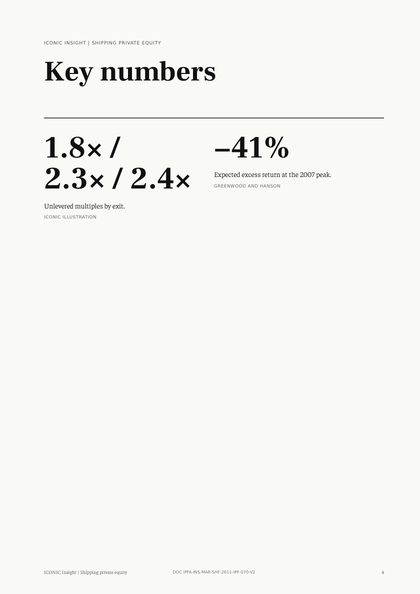
Key number
−41%
Inside the paper
Do private equity fund terms survive the shipping cycle?
DOC IPFA-INS-MAR-SHF-2611-IPF-070-V2
Fill out the form to read the full paper.
Download the PDFPDF edition
Download the full Insight
Register below. We will ask you to confirm your e-mail address and then send you a personal download link.
Chapter 2
Framework: which fund terms fit the cycle?
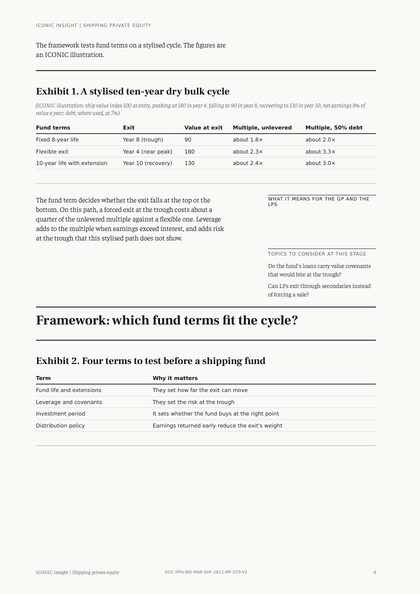
The framework tests fund terms on a stylised cycle.
The framework tests fund terms on a stylised cycle. The figures are an ICONIC illustration.
| Fund terms | Exit | Value at exit | Multiple, unlevered | Multiple, 50% debt |
|---|---|---|---|---|
| Fixed 8-year life | Year 8 (trough) | 90 | about 1.8× | about 2.0× |
| Flexible exit | Year 4 (near peak) | 180 | about 2.3× | about 3.3× |
| 10-year life with extension | Year 10 (recovery) | 130 | about 2.4× | about 3.0× |
What it means for the GP and the LPs. The fund term decides whether the exit falls at the top or the bottom. On this path, a forced exit at the trough costs about a quarter of the unlevered multiple against a flexible one. Leverage adds to the multiple when earnings exceed interest, and adds risk at the trough that this stylised path does not show.
Topics to consider at this stage
- Do the fund’s loans carry value covenants that would bite at the trough?
- Can LPs exit through secondaries instead of forcing a sale?
| Term | Why it matters |
|---|---|
| Fund life and extensions | They set how far the exit can move |
| Leverage and covenants | They set the risk at the trough |
| Investment period | It sets whether the fund buys at the right point |
| Distribution policy | Earnings returned early reduce the exit’s weight |
The fund term decides whether the exit falls at the top or the bottom.
Key number
1.8× / 2.3× / 2.4×
Chapter 3
What’s the bottom line?
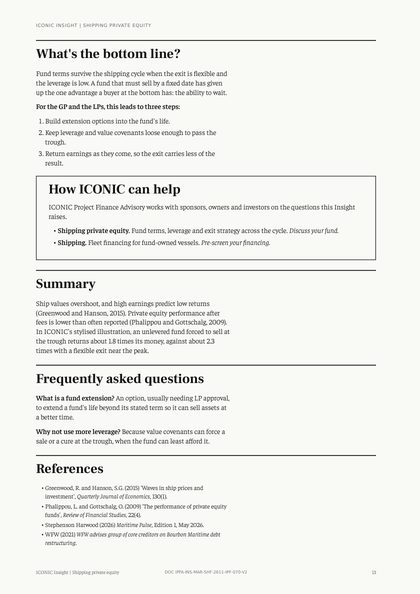
A fund that must sell by a fixed date has given up the one advantage a buyer at the bottom has: the ability to wait.
Fund terms survive the shipping cycle when the exit is flexible and the leverage is low. A fund that must sell by a fixed date has given up the one advantage a buyer at the bottom has: the ability to wait.
For the GP and the LPs, this leads to three steps:
- Build extension options into the fund’s life.
- Keep leverage and value covenants loose enough to pass the trough.
- Return earnings as they come, so the exit carries less of the result.
Fund terms survive the shipping cycle when the exit is flexible and the leverage is low.
How ICONIC can help
ICONIC Project Finance Advisory works with sponsors, owners and investors on the questions this Insight raises.
- Shipping private equity. Fund terms, leverage and exit strategy across the cycle. Discuss your fund.
- Shipping. Fleet financing for fund-owned vessels. Pre-screen your financing.
Summary
Ship values overshoot, and high earnings predict low returns (Greenwood and Hanson, 2015). Private equity performance after fees is lower than often reported (Phalippou and Gottschalg, 2009). In ICONIC’s stylised illustration, an unlevered fund forced to sell at the trough returns about 1.8 times its money, against about 2.3 times with a flexible exit near the peak.
Frequently asked questions
What is a fund extension?
An option, usually needing LP approval, to extend a fund’s life beyond its stated term so it can sell assets at a better time.
Why not use more leverage?
Because value covenants can force a sale or a cure at the trough, when the fund can least afford it.
References
- Greenwood, R. and Hanson, S.G. (2015) ‘Waves in ship prices and investment’, Quarterly Journal of Economics, 130(1).
- Phalippou, L. and Gottschalg, O. (2009) ‘The performance of private equity funds’, Review of Financial Studies, 22(4).
- Stephenson Harwood (2026) Maritime Pulse, Edition 1, May 2026.
- WFW (2021) WFW advises group of core creditors on Bourbon Maritime debt restructuring.
This Insight is for general information only and does not constitute investment, legal or tax advice.