Chapter 1
Why has infrastructure private equity grown so fast?
For fees, for manager selection and for not being able to sell.
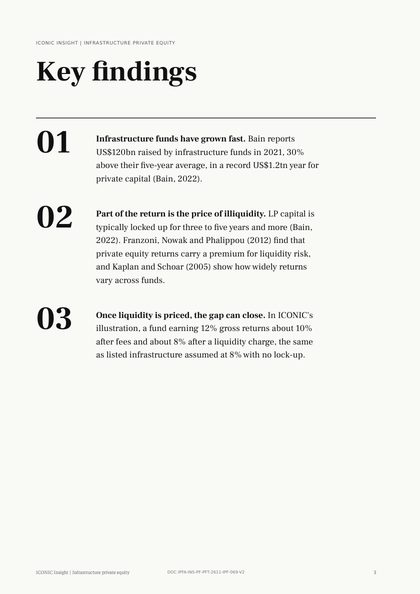
Because investors want steady, asset-backed returns, and funds have widened what they buy. Bain notes that infrastructure funds have moved beyond toll roads into “operating businesses” whose value comes mostly “from real estate and other hard assets”. Examples include a pharmacy platform and a data centre developer, AirTrunk. These businesses carry lower return hurdles (Bain, 2022).
What do its returns compensate for?
For fees, for manager selection and for not being able to sell. Bain notes that LP capital is typically locked for three to five years. Secondaries have grown to give LPs “a way out when they need it” (Bain, 2022). Franzoni, Nowak and Phalippou (2012) find a premium for liquidity risk in private equity returns. Kaplan and Schoar (2005) show that returns differ widely between managers and persist across a manager’s funds. The average is not what an investor gets from any one fund.
Topics to consider at this stage
- What would the investor pay to be able to sell at any time?
- How good is the manager, against the average and against the listed alternative?
Because investors want steady, asset-backed returns, and funds have widened what they buy.
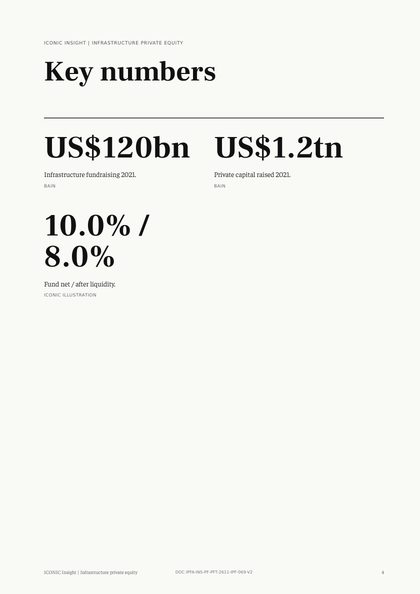
Key number
US$120bn

Inside the paper
Infrastructure private equity: what the returns pay for once liquidity is priced
DOC IPFA-INS-PF-PFT-2611-IPF-069-V2
Fill out the form to read the full paper.
Download the PDFPDF edition
Download the full Insight
Register below. We will ask you to confirm your e-mail address and then send you a personal download link.
Chapter 2
Framework: what is left of the return once liquidity and fees are priced?
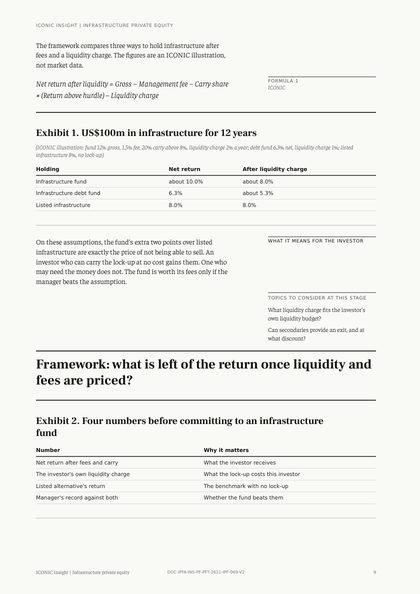
The framework compares three ways to hold infrastructure after fees and a liquidity charge.
The framework compares three ways to hold infrastructure after fees and a liquidity charge. The figures are an ICONIC illustration, not market data.
Formula 1 (ICONIC): Net return after liquidity = Gross − Management fee − Carry share × (Return above hurdle) − Liquidity charge
| Holding | Net return | After liquidity charge |
|---|---|---|
| Infrastructure fund | about 10.0% | about 8.0% |
| Infrastructure debt fund | 6.3% | about 5.3% |
| Listed infrastructure | 8.0% | 8.0% |
What it means for the investor. On these assumptions, the fund’s extra two points over listed infrastructure are exactly the price of not being able to sell. An investor who can carry the lock-up at no cost gains them. One who may need the money does not. The fund is worth its fees only if the manager beats the assumption.
Topics to consider at this stage
- What liquidity charge fits the investor’s own liquidity budget?
- Can secondaries provide an exit, and at what discount?
| Number | Why it matters |
|---|---|
| Net return after fees and carry | What the investor receives |
| The investor’s own liquidity charge | What the lock-up costs this investor |
| Listed alternative’s return | The benchmark with no lock-up |
| Manager’s record against both | Whether the fund beats them |
On these assumptions, the fund’s extra two points over listed infrastructure are exactly the price of not being able to sell.
Key number
US$1.2tn
Chapter 3
What’s the bottom line?
For an investor with a long horizon and no need to sell, the lock-up is cheap and the premium real.
An infrastructure fund is worth its fees only if the return after liquidity beats the listed alternative. For an investor with a long horizon and no need to sell, the lock-up is cheap and the premium real. For one without, it may be the whole of the extra return.
For the investor, this leads to three steps:
- Compute the fund’s net return after fees and carry.
- Charge it for the lock-up at the investor’s own cost of illiquidity.
- Compare the result with listed infrastructure and with debt.
An infrastructure fund is worth its fees only if the return after liquidity beats the listed alternative.
Key number
10.0% / 8.0%
How ICONIC can help
ICONIC Project Finance Advisory works with sponsors, owners and investors on the questions this Insight raises.
- Private wealth. Fund selection and the liquidity budget. Discuss your allocation.
- Private equity. Fund terms and secondaries. Pre-screen a commitment.
Summary
Infrastructure funds raised US$120bn in 2021 and lock capital for years (Bain, 2022). Private equity returns include a liquidity risk premium (Franzoni, Nowak and Phalippou, 2012) and vary widely by manager (Kaplan and Schoar, 2005). In ICONIC’s illustration, a fund earning 12% gross returns about 8% after fees and a 2% liquidity charge, the same as listed infrastructure with no lock-up.
Frequently asked questions
What is carried interest?
The share of profits above a hurdle rate that a fund manager receives, typically 20%.
What are secondaries?
Sales of existing fund commitments to other investors, which give LPs a way to exit before the fund ends.
References
- Bain & Company (2022) The private equity market in 2021: the allure of growth.
- Franzoni, F., Nowak, E. and Phalippou, L. (2012) ‘Private equity performance and liquidity risk’, Journal of Finance, 67(6).
- Kaplan, S.N. and Schoar, A. (2005) ‘Private equity performance: returns, persistence, and capital flows’, Journal of Finance, 60(4).
This Insight is for general information only and does not constitute investment, legal or tax advice.