Chapter 1
Why has leasing become mainstream in shipping?
Title, a purchase option or obligation, and, in a JOLCO, a lock-in.
Because lessors offered more leverage and fewer covenants than banks. WFW notes that ship leasing “was originally perceived as a relatively covenant free financing instrument which provided high financing leverage”. With the growth of Chinese leasing houses, it became mainstream (WFW, 2025). Lessors can offer “flexibility and very competitive terms” because leasing is less heavily regulated than bank lending (WFW, 2025). Alternatives keep emerging. WFW compares conditional sale and Islamic ijara structures that leave registered ownership with the shipowner (WFW, 2025).
What does a lessor ask for that a bank does not?
Title, a purchase option or obligation, and, in a JOLCO, a lock-in. Stephenson Harwood describes the JOLCO’s terms (Stephenson Harwood, 2025):
- 100% funding, 70–75% debt and 25–30% Japanese equity;
- loan tenors of six to eight years;
- no loan-to-value clause, because the Japanese SPV is the economic owner;
- no voluntary termination rights beyond the predetermined purchase options.
The structure suits owners who do not plan to sell. It is “a point of consideration for shipowners who anticipate selling portions of their fleet as the market moves”. Lewis and Schallheim (1992) show that leases and debt interact, so a lease must be compared with the loan it replaces. Greenwood and Hanson (2015) show that ship prices and investment move in waves, with owners investing most when earnings are high, which is why the freedom to sell at the right time has value.
Topics to consider at this stage
- Does the owner expect to sell the vessel before the financing ends?
- How much equity can it commit to the ship?
Because lessors offered more leverage and fewer covenants than banks.
Key number
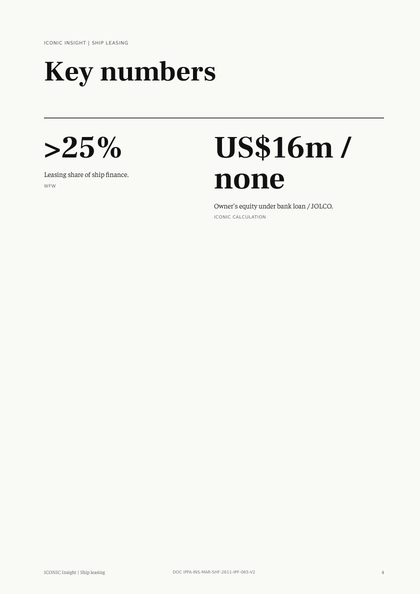
>25%
Inside the paper
Lessor or bank: which costs a shipowner less?
DOC IPFA-INS-MAR-SHF-2611-IPF-065-V2
Fill out the form to read the full paper.
Download the PDFPDF edition
Download the full Insight
Register below. We will ask you to confirm your e-mail address and then send you a personal download link.
Chapter 2
Framework: which costs less once options and covenants are counted?
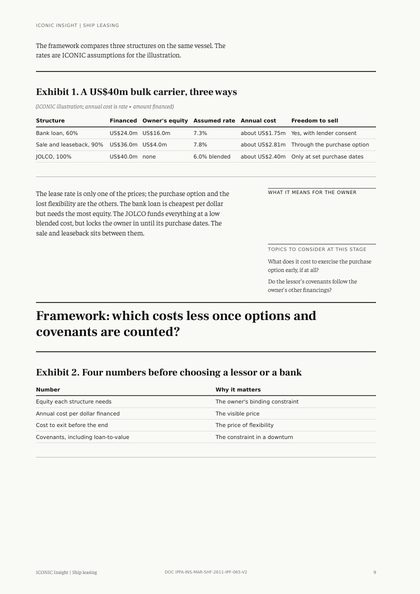
The framework compares three structures on the same vessel.
The framework compares three structures on the same vessel. The rates are ICONIC assumptions for the illustration.
| Structure | Financed | Owner’s equity | Assumed rate | Annual cost | Freedom to sell |
|---|---|---|---|---|---|
| Bank loan, 60% | US$24.0m | US$16.0m | 7.3% | about US$1.75m | Yes, with lender consent |
| Sale and leaseback, 90% | US$36.0m | US$4.0m | 7.8% | about US$2.81m | Through the purchase option |
| JOLCO, 100% | US$40.0m | none | 6.0% blended | about US$2.40m | Only at set purchase dates |
What it means for the owner. The lease rate is only one of the prices; the purchase option and the lost flexibility are the others. The bank loan is cheapest per dollar but needs the most equity. The JOLCO funds everything at a low blended cost, but locks the owner in until its purchase dates. The sale and leaseback sits between them.
Topics to consider at this stage
- What does it cost to exercise the purchase option early, if at all?
- Do the lessor’s covenants follow the owner’s other financings?
| Number | Why it matters |
|---|---|
| Equity each structure needs | The owner’s binding constraint |
| Annual cost per dollar financed | The visible price |
| Cost to exit before the end | The price of flexibility |
| Covenants, including loan-to-value | The constraint in a downturn |
The lease rate is only one of the prices; the purchase option and the lost flexibility are the others.
Key number
100% / 70–75% / 6–8 years
Chapter 3
What’s the bottom line?
An owner who plans to keep a ship through the cycle can use the JOLCO’s low blended cost and lack of a loan-to-value clause.
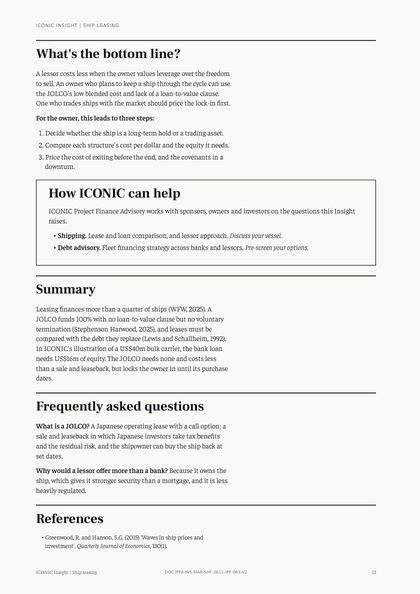
A lessor costs less when the owner values leverage over the freedom to sell. An owner who plans to keep a ship through the cycle can use the JOLCO’s low blended cost and lack of a loan-to-value clause. One who trades ships with the market should price the lock-in first.
For the owner, this leads to three steps:
- Decide whether the ship is a long-term hold or a trading asset.
- Compare each structure’s cost per dollar and the equity it needs.
- Price the cost of exiting before the end, and the covenants in a downturn.
A lessor costs less when the owner values leverage over the freedom to sell.
Key number
US$16m / none
How ICONIC can help
ICONIC Project Finance Advisory works with sponsors, owners and investors on the questions this Insight raises.
- Shipping. Lease and loan comparison, and lessor approach. Discuss your vessel.
- Debt advisory. Fleet financing strategy across banks and lessors. Pre-screen your options.
Summary
Leasing finances more than a quarter of ships (WFW, 2025). A JOLCO funds 100% with no loan-to-value clause but no voluntary termination (Stephenson Harwood, 2025), and leases must be compared with the debt they replace (Lewis and Schallheim, 1992). In ICONIC’s illustration of a US$40m bulk carrier, the bank loan needs US$16m of equity. The JOLCO needs none and costs less than a sale and leaseback, but locks the owner in until its purchase dates.
Frequently asked questions
What is a JOLCO?
A Japanese operating lease with a call option: a sale and leaseback in which Japanese investors take tax benefits and the residual risk, and the shipowner can buy the ship back at set dates.
Why would a lessor offer more than a bank?
Because it owns the ship, which gives it stronger security than a mortgage, and it is less heavily regulated.
References
- Greenwood, R. and Hanson, S.G. (2015) ‘Waves in ship prices and investment’, Quarterly Journal of Economics, 130(1).
- Lewis, C.M. and Schallheim, J.S. (1992) ‘Are debt and leases substitutes?’, Journal of Financial and Quantitative Analysis, 27(4).
- Stephenson Harwood (2025) Overview of a Japanese operating lease (with call option) in the shipping sector.
- WFW (2025) Ship leasing: does a financial lessor need to be the registered owner of the leased asset?
- WFW (2025) Further rethinking maritime finance leasing: ijara as an alternative for preserving registered ownership.
This Insight is for general information only and does not constitute investment, legal, accounting or tax advice.