Chapter 1
How often do large projects overrun?
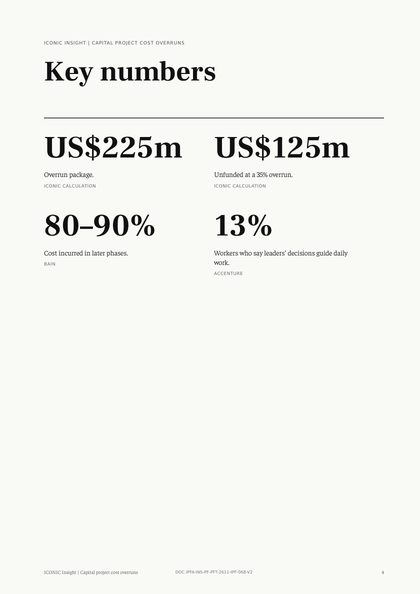
Bain notes that 80–90% of costs are incurred in the later phases, while the decisions that set them are taken early (Bain).
Often enough that lenders assume they will. Flyvbjerg, Holm and Buhl (2002) studied large transport projects and found costs underestimated far more often than overestimated. They concluded that the pattern cannot be explained by error alone. The gap between plan and practice starts inside the project. Accenture finds that 73–77% of leaders believe they improve cost, planning and schedule performance, while only 13% of workers say those decisions guide their daily work (Accenture).
Where do overruns start?
Most of a project’s cost is fixed by decisions made before most of the money is spent. Bain notes that 80–90% of costs are incurred in the later phases, while the decisions that set them are taken early (Bain). It recommends cost and schedule baselines “grounded in reference-class data, not bottom-up estimates built by the teams delivering them” (Bain). Simplifying design can save money: on one project, reviewing 71 engineering actions saved 1–2.5% of costs (Bain).
Topics to consider at this stage
- Is the budget’s contingency based on reference-class data for similar projects?
- Who holds the contingency: the contractor, the sponsor or the lenders’ account?
Most of a project’s cost is fixed by decisions made before most of the money is spent.
Key number
US$125m
Inside the paper
When a capital project overruns, contingency, sponsors and lenders share the bill in a set order
DOC IPFA-INS-PF-PFT-2611-IPF-068-V2
Fill out the form to read the full paper.
Download the PDFPDF edition
Download the full Insight
Register below. We will ask you to confirm your e-mail address and then send you a personal download link.
Chapter 2
Framework: who pays which part, and when do lenders stop?
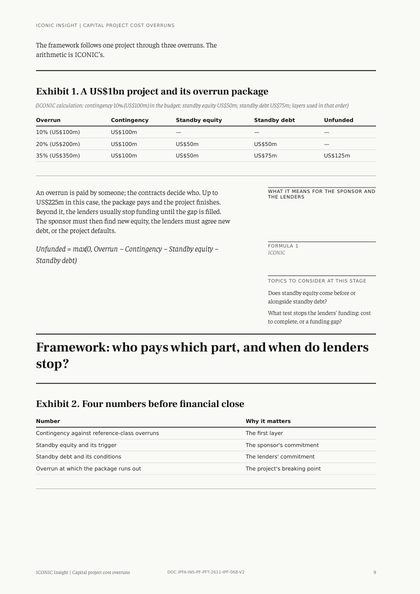
The framework follows one project through three overruns.
The framework follows one project through three overruns. The arithmetic is ICONIC’s.
| Overrun | Contingency | Standby equity | Standby debt | Unfunded |
|---|---|---|---|---|
| 10% (US$100m) | US$100m | — | — | — |
| 20% (US$200m) | US$100m | US$50m | US$50m | — |
| 35% (US$350m) | US$100m | US$50m | US$75m | US$125m |
What it means for the sponsor and the lenders. An overrun is paid by someone; the contracts decide who. Up to US$225m in this case, the package pays and the project finishes. Beyond it, the lenders usually stop funding until the gap is filled. The sponsor must then find new equity, the lenders must agree new debt, or the project defaults.
Formula 1 (ICONIC): Unfunded = max(0, Overrun − Contingency − Standby equity − Standby debt)
Topics to consider at this stage
- Does standby equity come before or alongside standby debt?
- What test stops the lenders’ funding: cost to complete, or a funding gap?
| Number | Why it matters |
|---|---|
| Contingency against reference-class overruns | The first layer |
| Standby equity and its trigger | The sponsor’s commitment |
| Standby debt and its conditions | The lenders’ commitment |
| Overrun at which the package runs out | The project’s breaking point |
An overrun is paid by someone; the contracts decide who.
Key number
US$225m
Chapter 3
What’s the bottom line?
A sponsor who sizes it on reference-class data, and agrees the order and the triggers at close, knows the overrun the project can survive.
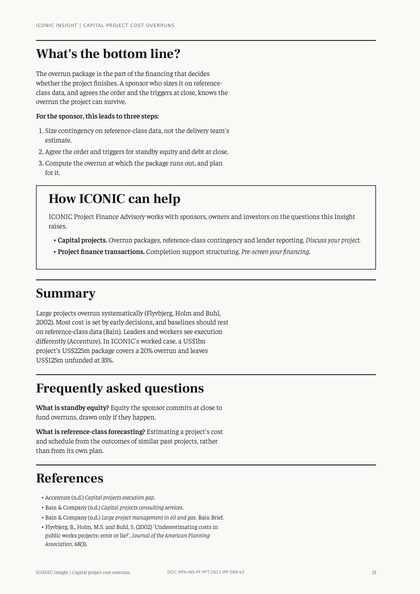
The overrun package is the part of the financing that decides whether the project finishes. A sponsor who sizes it on reference-class data, and agrees the order and the triggers at close, knows the overrun the project can survive.
For the sponsor, this leads to three steps:
- Size contingency on reference-class data, not the delivery team’s estimate.
- Agree the order and triggers for standby equity and debt at close.
- Compute the overrun at which the package runs out, and plan for it.
The overrun package is the part of the financing that decides whether the project finishes.
Key number
80–90%
How ICONIC can help
ICONIC Project Finance Advisory works with sponsors, owners and investors on the questions this Insight raises.
- Capital projects. Overrun packages, reference-class contingency and lender reporting. Discuss your project.
- Project finance transactions. Completion support structuring. Pre-screen your financing.
Summary
Large projects overrun systematically (Flyvbjerg, Holm and Buhl, 2002). Most cost is set by early decisions, and baselines should rest on reference-class data (Bain). Leaders and workers see execution differently (Accenture). In ICONIC’s worked case, a US$1bn project’s US$225m package covers a 20% overrun and leaves US$125m unfunded at 35%.
Frequently asked questions
What is standby equity?
Equity the sponsor commits at close to fund overruns, drawn only if they happen.
What is reference-class forecasting?
Estimating a project’s cost and schedule from the outcomes of similar past projects, rather than from its own plan.
References
- Accenture (n.d.) Capital projects execution gap.
- Bain & Company (n.d.) Capital projects consulting services.
- Bain & Company (n.d.) Large project management in oil and gas. Bain Brief.
- Flyvbjerg, B., Holm, M.S. and Buhl, S. (2002) ‘Underestimating costs in public works projects: error or lie?’, Journal of the American Planning Association, 68(3).
This Insight is for general information only and does not constitute investment, legal or tax advice.