Chapter 1
Why do buyers pay up for contracted cash flow?
After it ends, the asset earns whatever the market pays, and a lender will lend against that only at a discount.
Because a contract turns an asset into something close to a bond, and the buyer can borrow against it. Bain notes that infrastructure funds have moved from toll roads to operating businesses such as data centre platforms. Investors accept lower return hurdles for “steady, moderate-growth businesses” (Bain, 2022). Payment choices matter as much as price. Faccio and Masulis (2005) show that the choice between cash and shares in acquisitions depends on the buyer’s debt capacity and on control. Harford, Klasa and Walcott (2009) show that debt-financed buyers move back towards their target leverage afterwards.
What happens to the debt when the contract ends?
A contract is worth what is left of it. After it ends, the asset earns whatever the market pays, and a lender will lend against that only at a discount. Bain’s advice on LNG portfolios applies to any contracted asset: investors “should test who really carries the volume and price risk” (Bain, 2026).
Topics to consider at this stage
- How many years are left on the contract, and on what terms can it end early?
- What does the asset earn on a merchant basis after the contract?
A contract is worth what is left of it.
Key number
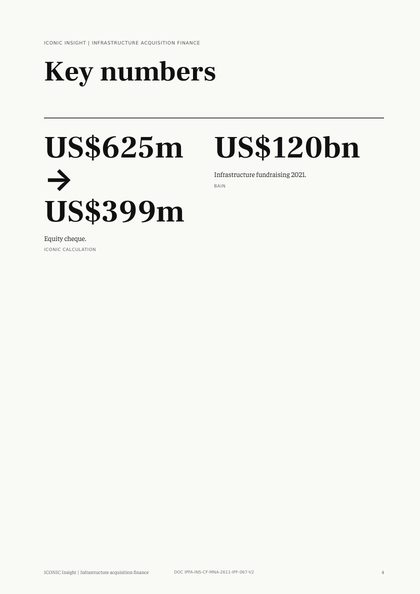
US$625m → US$399m
Inside the paper
How much debt can a buyer put on contracted cash flow?
DOC IPFA-INS-CF-MNA-2611-IPF-067-V2
Fill out the form to read the full paper.
Download the PDFPDF edition
Download the full Insight
Register below. We will ask you to confirm your e-mail address and then send you a personal download link.
Chapter 2
Framework: how is acquisition debt sized to the remaining contract?
The framework sizes acquisition debt to the remaining contract.
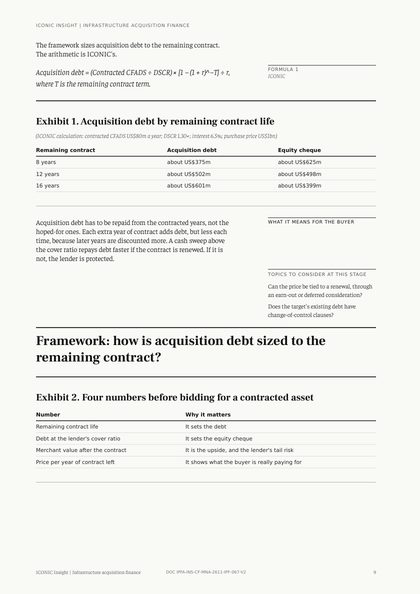
The framework sizes acquisition debt to the remaining contract. The arithmetic is ICONIC’s.
Formula 1 (ICONIC): Acquisition debt = (Contracted CFADS ÷ DSCR) × [1 − (1 + r)^−T] ÷ r, where T is the remaining contract term.
| Remaining contract | Acquisition debt | Equity cheque |
|---|---|---|
| 8 years | about US$375m | about US$625m |
| 12 years | about US$502m | about US$498m |
| 16 years | about US$601m | about US$399m |
What it means for the buyer. Acquisition debt has to be repaid from the contracted years, not the hoped-for ones. Each extra year of contract adds debt, but less each time, because later years are discounted more. A cash sweep above the cover ratio repays debt faster if the contract is renewed. If it is not, the lender is protected.
Topics to consider at this stage
- Can the price be tied to a renewal, through an earn-out or deferred consideration?
- Does the target’s existing debt have change-of-control clauses?
| Number | Why it matters |
|---|---|
| Remaining contract life | It sets the debt |
| Debt at the lender’s cover ratio | It sets the equity cheque |
| Merchant value after the contract | It is the upside, and the lender’s tail risk |
| Price per year of contract left | It shows what the buyer is really paying for |
Acquisition debt has to be repaid from the contracted years, not the hoped-for ones.
Key number
US$375m / US$502m / US$601m
Chapter 3
What’s the bottom line?
The buyer who sizes the debt on the remaining term, and prices the renewal as equity upside, bids with a financing that holds.
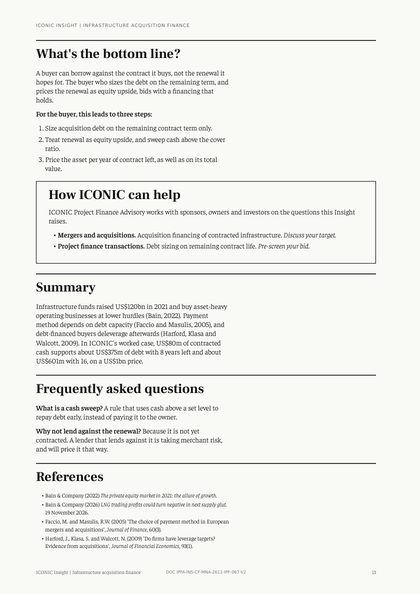
A buyer can borrow against the contract it buys, not the renewal it hopes for. The buyer who sizes the debt on the remaining term, and prices the renewal as equity upside, bids with a financing that holds.
For the buyer, this leads to three steps:
- Size acquisition debt on the remaining contract term only.
- Treat renewal as equity upside, and sweep cash above the cover ratio.
- Price the asset per year of contract left, as well as on its total value.
A buyer can borrow against the contract it buys, not the renewal it hopes for.
Key number
US$120bn
How ICONIC can help
ICONIC Project Finance Advisory works with sponsors, owners and investors on the questions this Insight raises.
- Mergers and acquisitions. Acquisition financing of contracted infrastructure. Discuss your target.
- Project finance transactions. Debt sizing on remaining contract life. Pre-screen your bid.
Summary
Infrastructure funds raised US$120bn in 2021 and buy asset-heavy operating businesses at lower hurdles (Bain, 2022). Payment method depends on debt capacity (Faccio and Masulis, 2005), and debt-financed buyers deleverage afterwards (Harford, Klasa and Walcott, 2009). In ICONIC’s worked case, US$80m of contracted cash supports about US$375m of debt with 8 years left and about US$601m with 16, on a US$1bn price.
Frequently asked questions
What is a cash sweep?
A rule that uses cash above a set level to repay debt early, instead of paying it to the owner.
Why not lend against the renewal?
Because it is not yet contracted. A lender that lends against it is taking merchant risk, and will price it that way.
References
- Bain & Company (2022) The private equity market in 2021: the allure of growth.
- Bain & Company (2026) LNG trading profits could turn negative in next supply glut. 19 November 2026.
- Faccio, M. and Masulis, R.W. (2005) ‘The choice of payment method in European mergers and acquisitions’, Journal of Finance, 60(3).
- Harford, J., Klasa, S. and Walcott, N. (2009) ‘Do firms have leverage targets? Evidence from acquisitions’, Journal of Financial Economics, 93(1).
This Insight is for general information only and does not constitute investment, legal or tax advice.