
Chapter 1
Why do families hold so little in real assets?
Private credit has grown where banks have pulled back:
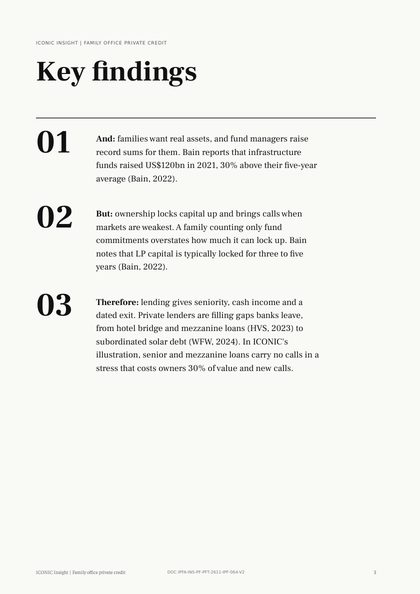
ICONIC’s earlier research found that most family offices hold nothing in infrastructure, even as they name it a theme. The reason is not the asset but the way it is held. Equity in real assets is long-dated, and it calls for capital when it is least convenient. Developments overrun, and ships need covenant cures when values fall. Andonov, Kräussl and Rauh (2021) study how institutional investors invest in infrastructure and show that the vehicle they choose shapes the returns and risks they receive.
What changes when a family lends instead?
A lender is paid first and knows when it will be repaid. Private credit has grown where banks have pulled back:
- HVS reports private equity groups entering hotel lending with “bridge loans, mezzanine debt, construction loans, and PIP loans” (HVS, 2023);
- WFW advised on a €29m ten-year loan from private debt funds to 123 MW of French solar, subordinated to the senior banks (WFW, 2024).
Topics to consider at this stage
- Does the family want the upside of ownership, or the income and the liquidity?
- How much can it lose in a stress without selling other assets?
A lender is paid first and knows when it will be repaid.
Key number
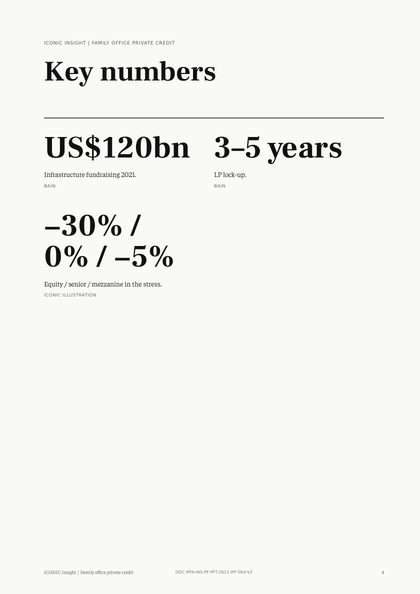
US$120bn

Inside the paper
A family can lend to real assets instead of owning them
DOC IPFA-INS-PF-PFT-2611-IPF-064-V2
Fill out the form to read the full paper.
Download the PDFPDF edition
Download the full Insight
Register below. We will ask you to confirm your e-mail address and then send you a personal download link.
Chapter 2
Framework: what does a family gain and give up by lending?
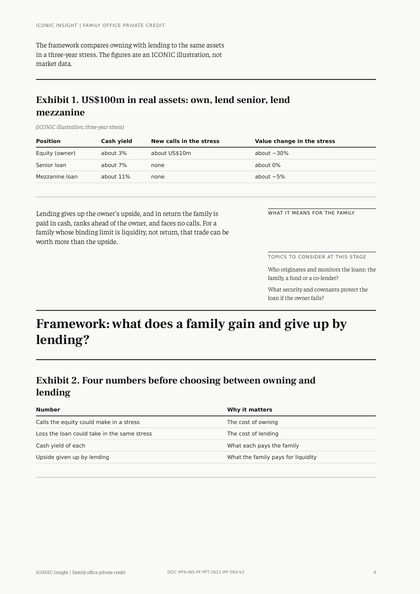
The framework compares owning with lending to the same assets in a three-year stress.
The framework compares owning with lending to the same assets in a three-year stress. The figures are an ICONIC illustration, not market data.
| Position | Cash yield | New calls in the stress | Value change in the stress |
|---|---|---|---|
| Equity (owner) | about 3% | about US$10m | about −30% |
| Senior loan | about 7% | none | about 0% |
| Mezzanine loan | about 11% | none | about −5% |
What it means for the family. Lending gives up the owner’s upside, and in return the family is paid in cash, ranks ahead of the owner, and faces no calls. For a family whose binding limit is liquidity, not return, that trade can be worth more than the upside.
Topics to consider at this stage
- Who originates and monitors the loans: the family, a fund or a co-lender?
- What security and covenants protect the loan if the owner fails?
| Number | Why it matters |
|---|---|
| Calls the equity could make in a stress | The cost of owning |
| Loss the loan could take in the same stress | The cost of lending |
| Cash yield of each | What each pays the family |
| Upside given up by lending | What the family pays for liquidity |
Lending gives up the owner’s upside, and in return the family is paid in cash, ranks ahead of the owner, and faces no calls.
Key number
3–5 years
Chapter 3
What’s the bottom line?
It keeps the exposure, removes the calls and dates the exit.
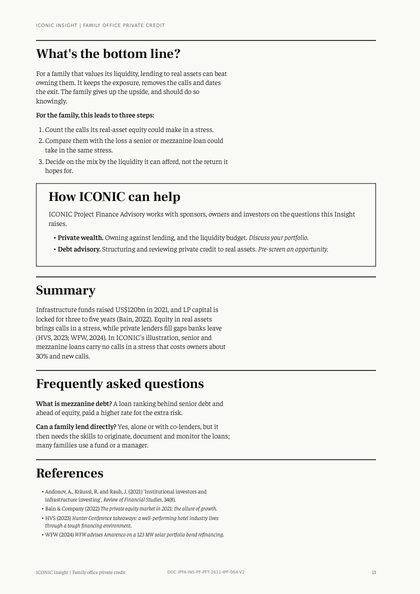
For a family that values its liquidity, lending to real assets can beat owning them. It keeps the exposure, removes the calls and dates the exit. The family gives up the upside, and should do so knowingly.
For the family, this leads to three steps:
- Count the calls its real-asset equity could make in a stress.
- Compare them with the loss a senior or mezzanine loan could take in the same stress.
- Decide on the mix by the liquidity it can afford, not the return it hopes for.
For a family that values its liquidity, lending to real assets can beat owning them.
Key number
−30% / 0% / −5%
How ICONIC can help
ICONIC Project Finance Advisory works with sponsors, owners and investors on the questions this Insight raises.
- Private wealth. Owning against lending, and the liquidity budget. Discuss your portfolio.
- Debt advisory. Structuring and reviewing private credit to real assets. Pre-screen an opportunity.
Summary
Infrastructure funds raised US$120bn in 2021, and LP capital is locked for three to five years (Bain, 2022). Equity in real assets brings calls in a stress, while private lenders fill gaps banks leave (HVS, 2023; WFW, 2024). In ICONIC’s illustration, senior and mezzanine loans carry no calls in a stress that costs owners about 30% and new calls.
Frequently asked questions
What is mezzanine debt?
A loan ranking behind senior debt and ahead of equity, paid a higher rate for the extra risk.
Can a family lend directly?
Yes, alone or with co-lenders, but it then needs the skills to originate, document and monitor the loans; many families use a fund or a manager.
References
- Andonov, A., Kräussl, R. and Rauh, J. (2021) ‘Institutional investors and infrastructure investing’, Review of Financial Studies, 34(8).
- Bain & Company (2022) The private equity market in 2021: the allure of growth.
- HVS (2023) Hunter Conference takeaways: a well-performing hotel industry lives through a tough financing environment.
- WFW (2024) WFW advises Amarenco on a 123 MW solar portfolio bond refinancing.
This Insight is for general information only and does not constitute investment, legal or tax advice.