
Transaction details are for registered readers. Sign in to request access. ICONIC reviews every request.
- ICONIC Project Finance TeamService | Project finance
- ICONIC Infrastructure TeamSector | Infrastructure
- ICONIC Energy TeamSector | Energy
 Georgos S. AndrianopoulosCFO & Family Office Project Finance Investment
At a glance
- Asset
- Sainshand wind farm, Mongolia
- Amount
- For approved readers
- Sector
- Power | PPP
ICONIC's role
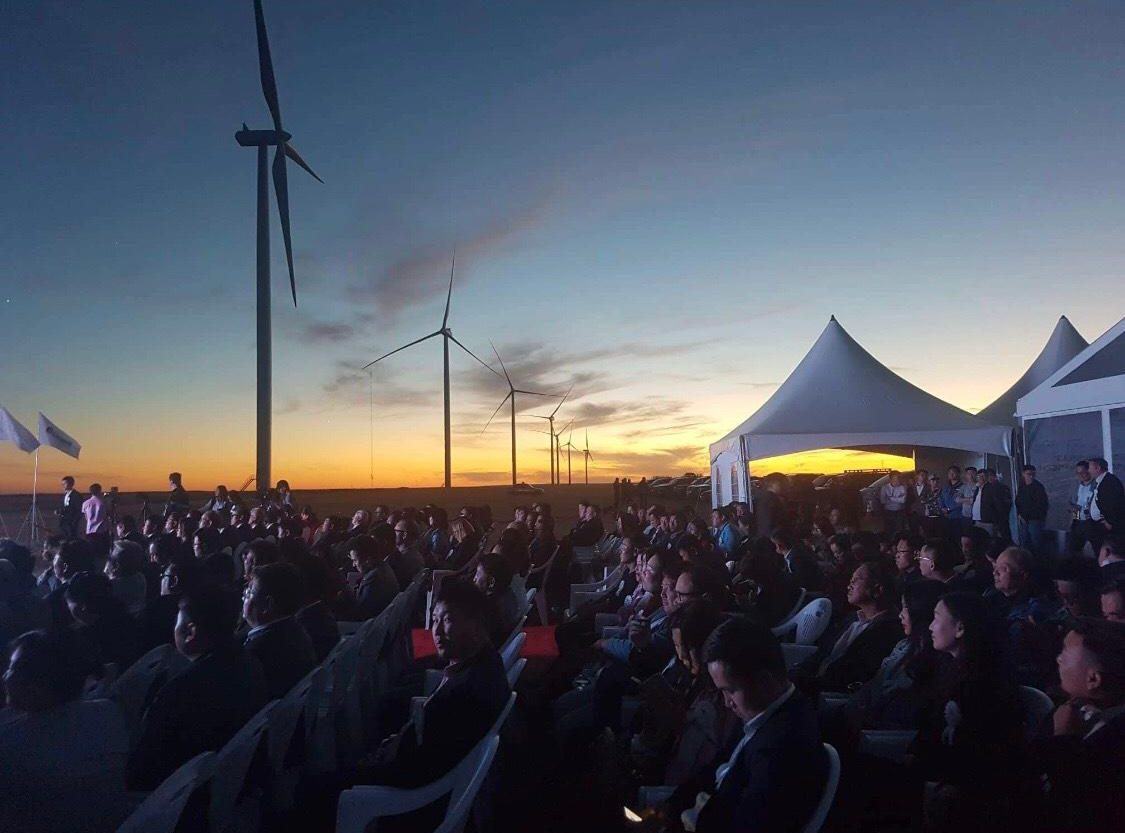
ICONIC Project Finance Advisory advised the Government of Mongolia on the project financing of the 55 MW Sainshand Shalkhin Park wind farm in the Gobi desert, shaped in consultation with the local communities. The work sits with ICONIC's Project Finance Team, its Infrastructure Team and its Energy Team. The services on the page are project finance transactions, Public-Private Partnerships, and policy and planning. Further transaction details are available to registered readers.
The asset
The wind farm stands in the Gobi Desert, about 460 km south-east of Ulaanbaatar, in Dornogobi province. It has up to 55 MW of capacity from 25 Vestas V110 turbines of 2.2 MW each. The EBRD described it as Mongolia's third privately financed wind farm, and estimated that it would save about 200,000 tonnes of carbon emissions. Three years of wind measurements came before the investment decision. China Machinery Engineering Corporation (CMEC) was the construction contractor.
The project company is Sainshand Salkhin Park LLC. Its sponsors were ENGIE of France, Ferrostaal of Germany as developer, the Danish Climate Investment Fund, and the Mongolian entrepreneur Radnaabazar Davaanyam. He spoke of "10 years of project planning and negotiations" before financial close.
The financing
In 2017 the EBRD announced financial close of the project financing. The development lenders were:
- The European Investment Bank, with the first tranche guaranteed by EKF, Denmark's export credit agency, and NORD/LB as agent.
- The EBRD.
Construction was expected to finish before the end of 2018. The EBRD noted Mongolia's targets of 20% renewable power by 2020 and 30% by 2030.
Why the government needed advice
A private wind farm in a country with few precedents depends on the state as much as on the wind. The project needs a long-term buyer for its power, usually a state utility, and a tariff that lenders can rely on. It needs a grid connection and permits. And lenders need assurance that the rules will not change after they lend. For a government, the task is to set terms that attract private sponsors and development lenders without giving away more than the project needs. The page links this transaction to the PPP and policy and planning services: the public side of a private financing.
The gaps: G1 Tenor and G4 Public
The page carries two of ICONIC's financing gaps:
- G1 Tenor: the debt runs longer than the contracts behind it. A wind farm repays over many years, and the power contract has to run long enough to carry the debt.
- G4 Public: the state cannot build or fund it on its own. Here the government's part was to make a private project possible.
What it shows
For a government, the case shows how a private renewable project can be brought to financial close with development lenders and an export credit guarantee, once the state's side of the bargain is clear. For a sponsor or an investor, it shows the usual elements of a first-of-its-kind market: a development bank in the lending group, an export credit agency behind the turbine supply, and a long preparation period.
Related reading on the site: How to fund wind vessels when charters end before the debt does, Club deals with a lender's discipline and The infrastructure gap. To discuss a similar project, use the pre-screen or write to .
Raising finance for a similar asset? Two minutes to see whether it is bankable, then a director replies.
Looking to invest in or lend to a similar asset? Tell us what you are looking for, and a director replies.