Chapter 1
What does an LNG plant borrow against?
Each structure gives the lender a different cash flow to lend against.
ICONIC Project Finance Advisory works on the financing side of energy projects. An LNG export plant is one of the largest single assets in that field, and one of the most contract-dependent. The plant itself has no use without gas coming in and buyers taking cargoes out. Its lenders therefore look past the steel to the agreements that connect it to both ends: the gas supply, the liquefaction service or sale contract, the shipping and the sponsors’ support.
Three commercial structures recur.
- Tolling. The plant owner sells liquefaction capacity for a fixed fee per unit, whether or not the customer uses it. The customer brings its own gas and takes its own cargoes. The owner carries little price risk.
- Integrated sale. The project buys or produces gas, liquefies it and sells LNG under long-term sale and purchase agreements (SPAs). Prices in many long-term contracts follow an oil benchmark through a slope and an intercept. The project carries the margin between its gas cost and that formula.
- Merchant or hybrid. Part of the output is sold short-term or at market prices. The project carries price and volume risk on that part.
Each structure gives the lender a different cash flow to lend against. The choice is therefore a financing decision as much as a commercial one, and it is best made with the debt in view.
What does the research say about long-term contracts?
The evidence on how lenders treat these contracts is thin but consistent.
- Project finance loans are long and cheaper than they look. Kleimeier and Megginson (2000) compared 4,956 project finance loans, worth about US$634bn, with other syndicated credits. Project finance loans had longer maturities, more third-party guarantees and lower spreads than comparable loans.
- Lenders use the contracts to control risk. Corielli, Gatti and Steffanoni (2010) studied more than 1,000 project finance loans worth about US$195bn, signed between 1998 and 2003. They found that lenders rely on the network of non-financial contracts to control risk, and that this network affects both spreads and leverage.
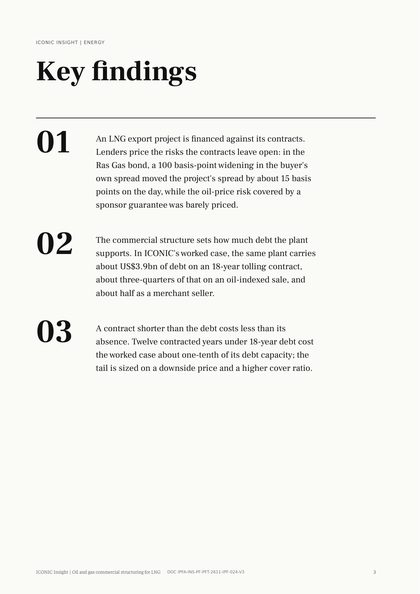
- Only the risks the contracts leave open are priced. Dailami and Hauswald (2007) followed the bonds of Ras Gas, a Qatari LNG export project, day by day. Their findings are the subject of Test 1.
A working paper adds a sense of scale. Zahur (2024) estimates that without long-term contracts, LNG sellers would invest about 27% less. The paper is not peer-reviewed, but the direction matches the lending evidence: the contract is what makes the plant financeable.
Topics to consider at this stage
- Which of the three structures does the project’s gas position allow, and which do its buyers want?
- Has the structure been chosen with the lenders’ sizing rules in view, or will it be defended to them afterwards?
The plant itself has no use without gas coming in and buyers taking cargoes out.

Inside the paper
Oil and gas commercial structuring for LNG: tolling, offtake and the debt each supports
DOC IPFA-INS-PF-PFT-2611-IPF-024-V3
Fill out the form to read the full paper.
Download the PDFPDF edition
Download the full Insight
Register below. We will ask you to confirm your e-mail address and then send you a personal download link.
Chapter 2
Test 1. Which risks will the lenders price?
The lenders do not price the plant.
The framework asks three questions of a commercial structure:
- which of its risks will the lenders price;
- how much debt does it support;
- what happens when the contract ends before the debt.
The first rests on a published model. The second and third use standard project finance debt sizing, applied by ICONIC with assumptions labelled as such.
Dailami and Hauswald studied the Ras Gas bonds, issued to finance a liquefaction project whose output was sold under a 25-year agreement with a Korean buyer. Their working paper sets out the model (Dailami and Hauswald, 2001). In simplified form, the daily spread of the Ras Gas bond over US Treasuries is explained by its own past values, by the spread of the buyer’s credit and by the oil price:
Formula 1 (simplified from Dailami and Hauswald, 2001)
where:
- RGS is the spread of the Ras Gas bond over 10-year US Treasury yields;
- KORELES is the spread of a bond of Kepco, the Korean utility the authors identify as Ras Gas’s effective offtaker, over the same Treasuries;
- BRENT is the logarithm of the Brent oil price index;
- Z holds the other controls in the paper: Korean equity, exchange rate and rating variables, and emerging-market debt returns.
| Risk | How the contracts treated it | Effect on the Ras Gas spread |
|---|---|---|
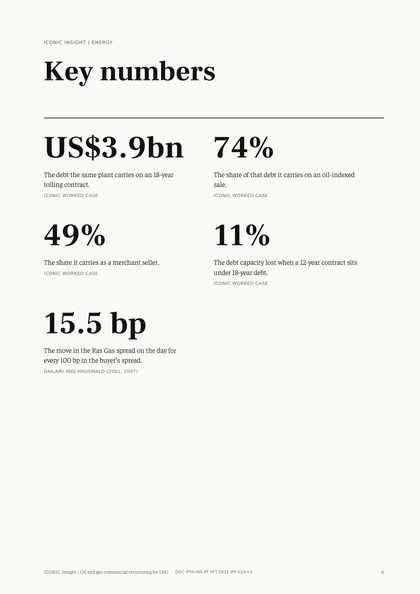
| The buyer’s credit | Left with the bondholders | About +15.5 bp on the day for every +100 bp in the buyer’s spread, reversed by about 13.6 bp the next day: a net effect of about 2 bp |
| Oil price | Covered by a sponsor guarantee of debt service, triggered by low oil prices | Marginally significant at best |
| Country risk of the buyer | Left with the bondholders | Priced, mainly through the buyer’s own spread |
What it means for the sponsor. The lenders do not price the plant. They price the residual: whatever the gas supply, the offtake and the sponsor support leave uncovered. A structure that assigns a risk clearly, to a party able to carry it, takes that risk out of the price of debt. A structure that leaves it with the project puts it straight back in.
Limits.
- The study covers one project, one buyer and one bond, in a period of Asian financial stress.
- It measures bond spreads in the secondary market, not the terms of a new bank loan.
Topics to consider at this stage
- Which risks does each contract leave with the project company, and has anyone listed them in one place?
- Is the buyer’s credit as strong as the contract’s tenor requires, and what supports it if not?
A structure that assigns a risk clearly, to a party able to carry it, takes that risk out of the price of debt.
On the day
15.5 bp
Chapter 3
Test 2. How much debt does each structure support?
The steadier the cash flow, the lower the ratio they accept.
Long-term LNG contracts commonly set the price as an intercept plus a slope times a lagged oil benchmark, and Agerton (2017) finds that the link between LNG and oil prices holds once structural breaks in these terms are allowed for. Korean and Taiwanese prices have been oil-indexed with relatively stable relationships, Spanish contracts more loosely, and Japanese series show the most breaks. For the lender, two consequences follow: the project’s margin under a sale moves with oil, and the formula itself can change during the life of the loan through price reviews.
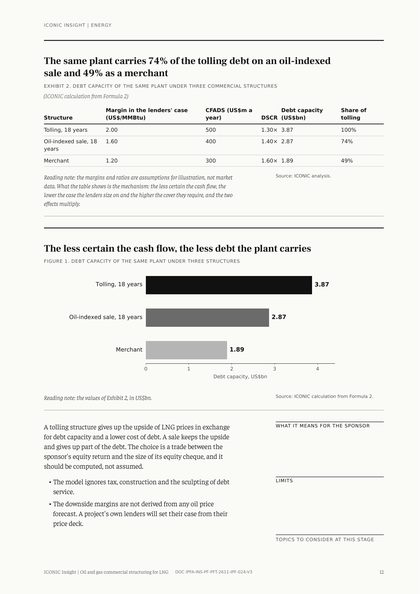
Lenders size debt on the cash flow available for debt service (CFADS) in a case they consider prudent, divided by a minimum debt service cover ratio (DSCR). The steadier the cash flow, the lower the ratio they accept. In standard form:
Formula 2 (standard project finance debt sizing)
where D is the debt the project can raise, CFADSₜ the lenders’ case for cash flow in year t, DSCR the minimum cover ratio they require, r the interest rate and T the debt tenor.
A worked case (ICONIC’s own illustration). A plant contracts 250 million MMBtu a year (MMBtu: million British thermal units). Debt runs for 18 years at 7%.
- Tolling: a fee of US$2.50 per MMBtu less operating cost of US$0.50 gives CFADS of US$500m a year, with no price risk. The lenders accept a DSCR of 1.30.
- Oil-indexed sale: the lenders size on a downside oil case, in which the margin falls to US$1.60 per MMBtu, and ask for 1.40.
- Merchant: they size on a deeper downside margin of US$1.20 and ask for 1.60.
| Structure | Margin in the lenders’ case (US$/MMBtu) | CFADS (US$m a year) | DSCR | Debt capacity (US$bn) | Share of tolling |
|---|---|---|---|---|---|
| Tolling, 18 years | 2.00 | 500 | 1.30× | 3.87 | 100% |
| Oil-indexed sale, 18 years | 1.60 | 400 | 1.40× | 2.87 | 74% |
| Merchant | 1.20 | 300 | 1.60× | 1.89 | 49% |
What it means for the sponsor. A tolling structure gives up the upside of LNG prices in exchange for debt capacity and a lower cost of debt. A sale keeps the upside and gives up part of the debt. The choice is a trade between the sponsor’s equity return and the size of its equity cheque, and it should be computed, not assumed.
Limits.
- The model ignores tax, construction and the sculpting of debt service.
- The downside margins are not derived from any oil price forecast. A project’s own lenders will set their case from their price deck.
Topics to consider at this stage
- What margin does the project earn in the lenders’ downside oil case, and what DSCR will they ask for on it?
- Does the SPA allow the price formula to be reopened during the life of the debt, and on what terms?
Tolling, 18 years
US$3.9bn
Chapter 4
Test 3. What if the contract ends before the debt?
The gap costs much less than the absence of a contract, because the uncontracted years are the most heavily discounted.
Long contracts are what make long debt possible, and Kleimeier and Megginson (2000) show that project finance loans are already longer than other syndicated credits. Many projects still face a gap: buyers want shorter or more flexible commitments, while the debt that makes the plant affordable runs longer.
Lenders handle the gap by sizing the uncontracted years on a downside case at a higher cover ratio:
Formula 3 (Formula 2 split at the contract’s end; ICONIC formulation of standard practice)
where T꜀ is the contract tenor, T_d the debt tenor, CFADSᶜ and DSCR꜀ the contracted cash flow and cover, and CFADSᵐ and DSCRₘ the downside merchant cash flow and cover.
A worked case (ICONIC’s own illustration). In the tolling case of Exhibit 2, suppose the contract runs 12 years and the debt 18. The last six years are sized on the merchant case.
- Debt capacity: about US$3.45bn, against US$3.87bn with a full-length contract.
- Cost of the gap: about 11% of the debt, or US$0.42bn.
The gap costs much less than the absence of a contract, because the uncontracted years are the most heavily discounted. Its cost rises quickly as the contract shortens, and lenders may also add a cash sweep or a balloon repayment in the tail.
What it means for the sponsor. A shorter contract is not a reason to give up long debt. It is a reason to know, before negotiating with buyers, what each year of contract tenor is worth in debt.
Limits.
- The model assumes the plant keeps running in the tail at the merchant margin. A tail with no buyer at all is worth less.
- It holds the interest rate constant across the tenor.
Topics to consider at this stage
- What is each additional year of contract tenor worth in debt capacity, and has that been put to the buyers?
- How will the lenders treat the years after the contract ends: sized on a downside case, swept or not counted at all?
Cost of the gap
11%
Chapter 5
Framework: what does each structure give the lenders?
Tests 1 to 3 give a sponsor four questions to answer before it signs its offtake.
Tests 1 to 3 give a sponsor four questions to answer before it signs its offtake.
| Lender’s question | Tolling | Oil-indexed sale | Merchant or hybrid |
|---|---|---|---|
| Which risk is left with the project? (Test 1) | The customer’s credit; operating performance | Gas cost against the price formula; price reviews | Price and volume on the uncontracted part |
| What case do the lenders size on? (Test 2) | Contracted fee | Downside oil case | Deep downside price case |
| What cover do they ask for? (Test 2) | Lowest | Higher | Highest |
| What happens if the contract is shorter than the debt? (Test 3) | Tail sized as merchant | Tail sized as merchant | Already merchant |
Chapter 6
What’s the bottom line?
An LNG export plant is financed on its contracts.
An LNG export plant is financed on its contracts. The lenders price whatever risk those contracts leave open, size the debt on the cash flow the contracts protect and treat the years after the contracts end as merchant. The commercial structure therefore sets the size, the tenor and the price of the debt before any lender is approached.
For a sponsor, this leads to three steps:
- List the risks each contract leaves with the project, and assign each to the party best able to carry it.
- Compute the debt each candidate structure supports in the lenders’ case, and set it against the equity return each leaves.
- Put a value on each year of contract tenor before negotiating with buyers.
The commercial structure is therefore the first financing decision of an LNG project.
How ICONIC can help
ICONIC works on the commercial structure of LNG projects from the lenders’ side, before it is fixed in the contracts.
- Oil and gas commercial structuring. A review of the tolling, sale or hybrid structure and of the risks each contract leaves with the project. Discuss your structure.
- Project finance transactions. Debt sized and raised on the structure chosen, from banks, export credit agencies or the bond market. Discuss a mandate.
- Financial modelling. A model that shows what each structure and each year of contract tenor is worth in debt. Test your structure.
Summary
An LNG export project borrows against its contracts. Dailami and Hauswald (2007) show that the Ras Gas bondholders priced the risks the contracts left open, above all the buyer’s credit, and largely ignored the oil-price risk the sponsor had guaranteed. Agerton (2017) shows that oil-indexed LNG prices follow their benchmark but that the terms change over time. Corielli, Gatti and Steffanoni (2010) and Kleimeier and Megginson (2000) show that lenders use the contract network to control risk and lend longer on it. In ICONIC’s worked case, the same plant carries about US$3.9bn of debt under tolling, about 74% of that under an oil-indexed sale and about 49% as a merchant, and a contract six years shorter than the debt costs about 11% of capacity. The commercial structure is therefore the first financing decision of an LNG project.
Frequently asked questions
Is tolling always the more financeable structure?
It gives the most debt for a given plant, because the lenders carry the least price risk. It also gives the sponsor the least upside. Whether it is the better structure depends on the sponsor’s gas position, its appetite for price risk and the equity it can commit.
Why does a contract shorter than the debt cost so little?
Because the uncontracted years come last and are the most heavily discounted. The cost rises as the contract shortens, and lenders may add a cash sweep or a balloon repayment to protect themselves in the tail.
Do price reviews matter to lenders?
Yes. A review clause lets the price formula change during the life of the debt. Agerton (2017) finds structural breaks in oil-indexed LNG pricing, consistent with terms being revised. Lenders will want to know how a review works and what floor, if any, protects the debt.
References
- Agerton, M. (2017) ‘Global LNG pricing terms and revisions: an empirical analysis’, The Energy Journal, 38(1), pp. 133–166. doi:10.5547/01956574.38.1.mage
- Corielli, F., Gatti, S. and Steffanoni, A. (2010) ‘Risk shifting through nonfinancial contracts: effects on loan spreads and capital structure of project finance deals’, Journal of Money, Credit and Banking, 42(7), pp. 1295–1320. doi:10.1111/j.1538-4616.2010.00342.x
- Dailami, M. and Hauswald, R. (2001) Contract Risks and Credit Spread Determinants in the International Project Bond Market. World Bank Policy Research Working Paper 2712. Washington, DC: World Bank. Available at: https://openknowledge.worldbank.org/entities/publication/5f2f53a1-b02a-537a-8fb3-884a0c03bedb/full
- Dailami, M. and Hauswald, R. (2007) ‘Credit-spread determinants and interlocking contracts: a study of the Ras Gas project’, Journal of Financial Economics, 86(1), pp. 248–278. doi:10.1016/j.jfineco.2007.03.001
- Kleimeier, S. and Megginson, W.L. (2000) ‘Are project finance loans different from other syndicated credits?’, Journal of Applied Corporate Finance, 13(1), pp. 75–87. doi:10.1111/j.1745-6622.2000.tb00043.x
- Zahur, N.B. (2024) Long-term contracts and efficiency in the liquefied natural gas industry. Queen’s Economics Department Working Paper 1518. Not peer-reviewed. Available at: https://ideas.repec.org/p/qed/wpaper/1518.html
This Insight is for general information only and does not constitute investment, legal or tax advice. Figures from public sources are as reported at the dates shown.