Chapter 1
Why do lenders commission their own reports?
A clean report lets the term sheet stand; a qualified one changes it.
Because a lender to a project company has recourse only to the project. It cannot take the sponsor’s word for the things that decide whether it is repaid, so it appoints its own advisers and relies on their reports. Esty and Megginson (2003) show that the structure of project loan syndicates responds to legal risk, a sign of how much lenders depend on what they can verify and enforce.
What happens when a report is qualified?
Each report exists because a lender cannot take the sponsor’s word for one thing. A clean report lets the term sheet stand; a qualified one changes it. Export credit agency (ECA) financings add their own layer. Banks typically require independent legal opinions that an ECA guarantee is “legally effective and enforceable, unconditional, irrevocable and payable upon default”, and the guarantee is usually a condition to drawdown (Norton Rose Fulbright, 2026).
Topics to consider at this stage
- Which reports will the lenders require, and who appoints the advisers?
- Which findings can the sponsor resolve before the reports are issued?
Each report exists because a lender cannot take the sponsor’s word for one thing.

Inside the paper
Lender due diligence: the question each report has to answer
DOC IPFA-INS-PF-PFT-2611-IPF-056-V3
Fill out the form to read the full paper.
Download the PDFPDF edition
Download the full Insight
Register below. We will ask you to confirm your e-mail address and then send you a personal download link.
Chapter 2
Framework: which question does each report answer?
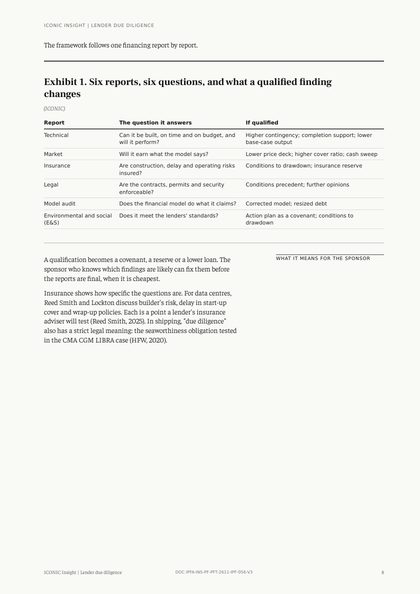
The framework follows one financing report by report.
The framework follows one financing report by report.
| Report | The question it answers | If qualified |
|---|---|---|
| Technical | Can it be built, on time and on budget, and will it perform? | Higher contingency; completion support; lower base-case output |
| Market | Will it earn what the model says? | Lower price deck; higher cover ratio; cash sweep |
| Insurance | Are construction, delay and operating risks insured? | Conditions to drawdown; insurance reserve |
| Legal | Are the contracts, permits and security enforceable? | Conditions precedent; further opinions |
| Model audit | Does the financial model do what it claims? | Corrected model; resized debt |
| Environmental and social (E&S) | Does it meet the lenders’ standards? | Action plan as a covenant; conditions to drawdown |
What it means for the sponsor. A qualification becomes a covenant, a reserve or a lower loan. The sponsor who knows which findings are likely can fix them before the reports are final, when it is cheapest.
Insurance shows how specific the questions are. For data centres, Reed Smith and Lockton discuss builder’s risk, delay in start-up cover and wrap-up policies. Each is a point a lender’s insurance adviser will test (Reed Smith, 2025). In shipping, “due diligence” also has a strict legal meaning: the seaworthiness obligation tested in the CMA CGM LIBRA case (HFW, 2020).
Topics to consider at this stage
- Which reports depend on each other: the market report on the technical report’s output, the model on both?
- Who pays for the reports if the financing does not close?
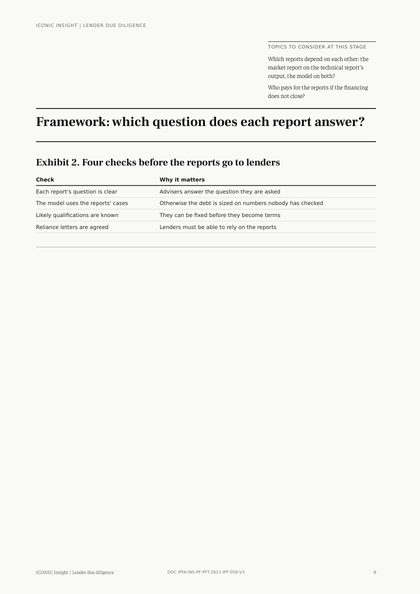
| Check | Why it matters |
|---|---|
| Each report’s question is clear | Advisers answer the question they are asked |
| The model uses the reports’ cases | Otherwise the debt is sized on numbers nobody has checked |
| Likely qualifications are known | They can be fixed before they become terms |
| Reliance letters are agreed | Lenders must be able to rely on the reports |
A qualification becomes a covenant, a reserve or a lower loan.
Chapter 3
What’s the bottom line?
A sponsor who treats the reports as answers to six questions, rather than a cost of closing, controls the terms they produce.
Due diligence is the term sheet written in evidence. A sponsor who treats the reports as answers to six questions, rather than a cost of closing, controls the terms they produce.
For the sponsor, this leads to three steps:
- Agree each report’s question with the lenders at the start.
- Run the model on the reports’ cases before they are final.
- Resolve likely qualifications before they reach the term sheet.
Due diligence is the term sheet written in evidence.
How ICONIC can help
ICONIC Project Finance Advisory works with sponsors, owners and investors on the questions this Insight raises.
- Project finance transactions. Lender diligence management, from scope to reliance. Discuss your financing.
- Model audit. Independent testing of the financial model. Pre-screen your model.
Summary
Lenders rely on their own reports because a project company is all they can recover from (Esty and Megginson, 2003). Each of six reports answers one question, and each qualification becomes a covenant, a reserve or a lower loan. ECA financings add enforceability opinions and conditions to drawdown (Norton Rose Fulbright, 2026). The lender’s reports are where the terms are set.
Frequently asked questions
What is a lenders’ technical adviser?
An engineer appointed by the lenders to review the design, construction, costs and performance of the project, and to certify drawdowns.
What is a reliance letter?
A letter that allows the lenders to rely on a report prepared for someone else, usually the sponsor.
References
- Esty, B.C. and Megginson, W.L. (2003) ‘Creditor rights, enforcement, and debt ownership structure: evidence from the global syndicated loan market’, Journal of Financial and Quantitative Analysis, 38(1).
- HFW (2020) Seaworthiness and due diligence in focus: CMA CGM LIBRA case.
- Norton Rose Fulbright (2026) Export credit agency financing: ten key questions answered. July 2026.
- Reed Smith (2025) Key insurance concepts and issues for data center construction.
This Insight is for general information only and does not constitute investment, legal or tax advice.