Chapter 1
Why has power become the constraint on data centres?
The loan is drawn and interest accrues, but a hyperscale lease usually starts rent at energisation.
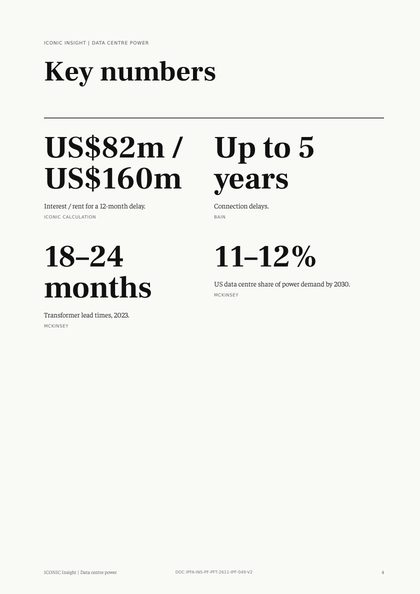
Because demand has outrun the grid. McKinsey expects US data centres to grow from 3–4% of US power demand to 11–12% by 2030. It finds that power unavailability “is driven by limitations in interconnecting to the transmission grid, rather than an inability to generate the power” (McKinsey, 2024). Lead times for medium-voltage transformers rose from 4–6 months in 2019 to 18–24 months in 2023 (McKinsey, 2024).
Grid operators are now rationing access:
- Germany. Transmission operators received more than 200 GW of battery connection requests alone. A draft law would bring “use-it-or-lose-it” reservations, a EUR 50,000 application fee and a EUR 1,500/MW realisation bond (Norton Rose Fulbright, 2026).
- Norway. On 9 November 2026, Statnett temporarily suspended new grid capacity reservations, citing data centres’ effect on system stability (Wikborg Rein, 2026).
What does a delayed connection do to the debt?
A data centre without power is a warehouse. The loan is drawn and interest accrues, but a hyperscale lease usually starts rent at energisation. Masanet et al. (2020) showed that data centre energy use grew far more slowly than computing output in the 2010s. That efficiency gain has not removed the need for grid capacity at today’s scale.
Topics to consider at this stage
- When will the grid connection be energised, and how firm is the date?
- Is there a behind-the-meter or interim supply option?
A data centre without power is a warehouse.
Key number
Up to 5 years
Inside the paper
Who carries the grid risk in a data centre’s debt?
DOC IPFA-INS-PF-PFT-2611-IPF-049-V2
Fill out the form to read the full paper.
Download the PDFPDF edition
Download the full Insight
Register below. We will ask you to confirm your e-mail address and then send you a personal download link.
Chapter 2
Test 1. What does delay cost?
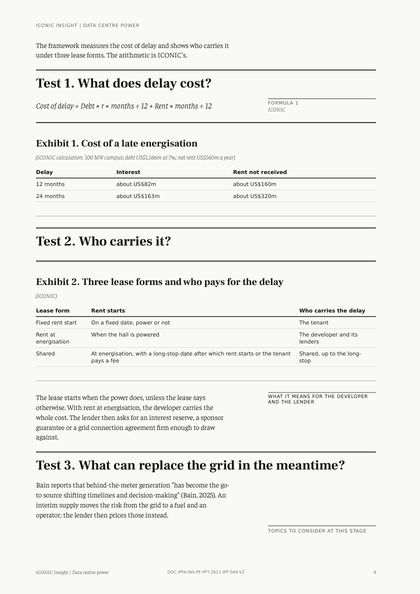
The framework measures the cost of delay and shows who carries it under three lease forms.
The framework measures the cost of delay and shows who carries it under three lease forms. The arithmetic is ICONIC’s.
Formula 1 (ICONIC): Cost of delay = Debt × r × months ÷ 12 + Rent × months ÷ 12
| Delay | Interest | Rent not received |
|---|---|---|
| 12 months | about US$82m | about US$160m |
| 24 months | about US$163m | about US$320m |
Key number
US$82m / US$160m
Chapter 3
Test 2. Who carries it?
With rent at energisation, the developer carries the whole cost.
| Lease form | Rent starts | Who carries the delay |
|---|---|---|
| Fixed rent start | On a fixed date, power or not | The tenant |
| Rent at energisation | When the hall is powered | The developer and its lenders |
| Shared | At energisation, with a long-stop date after which rent starts or the tenant pays a fee | Shared, up to the long-stop |
What it means for the developer and the lender. The lease starts when the power does, unless the lease says otherwise. With rent at energisation, the developer carries the whole cost. The lender then asks for an interest reserve, a sponsor guarantee or a grid connection agreement firm enough to draw against.
The lease starts when the power does, unless the lease says otherwise.
Key number
18–24 months
Chapter 4
Test 3. What can replace the grid in the meantime?
Bain reports that behind-the-meter generation “has become the go-to source shifting timelines and decision-making” (Bain, 2025).
Bain reports that behind-the-meter generation “has become the go-to source shifting timelines and decision-making” (Bain, 2025). An interim supply moves the risk from the grid to a fuel and an operator; the lender then prices those instead.
Topics to consider at this stage
- Is the grid connection agreement a condition to first drawdown?
- Who pays the reservation fees and bonds the grid operator now asks for?
Chapter 5
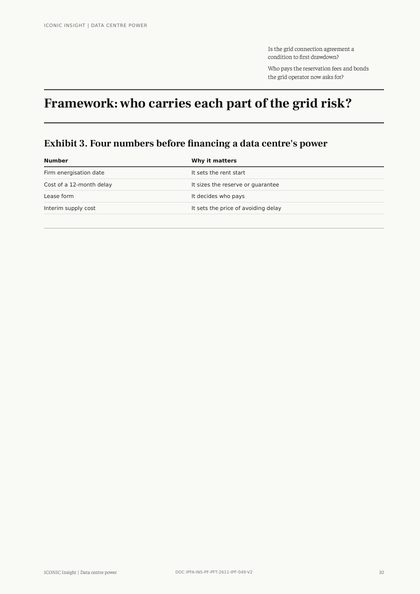
Framework: who carries each part of the grid risk?
The framework measures the cost of delay and shows who carries it under three lease forms.
| Number | Why it matters |
|---|---|
| Firm energisation date | It sets the rent start |
| Cost of a 12-month delay | It sizes the reserve or guarantee |
| Lease form | It decides who pays |
| Interim supply cost | It sets the price of avoiding delay |
Chapter 6
What’s the bottom line?
With connection delays measured in years, a data centre’s financing should state who pays for a late connection before the first drawdown, not after.
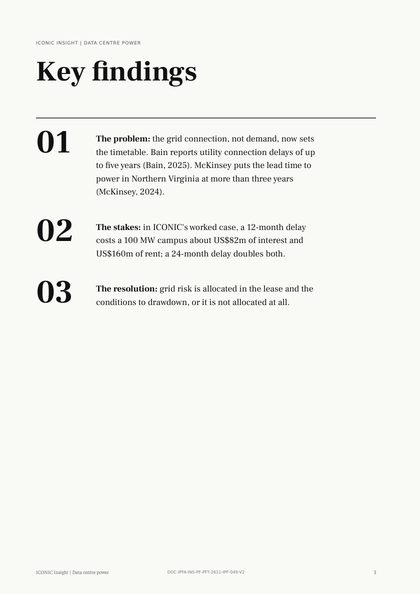
Grid risk is allocated in the lease and the conditions to drawdown, or it is not allocated at all. With connection delays measured in years, a data centre’s financing should state who pays for a late connection before the first drawdown, not after.
For the developer, this leads to three steps:
- Price a 12- and a 24-month delay in interest and rent.
- Negotiate the lease’s rent start and long-stop date with that cost in view.
- Make the grid agreement, or an interim supply, a condition the lender can rely on.
Grid risk is allocated in the lease and the conditions to drawdown, or it is not allocated at all.
How ICONIC can help
ICONIC Project Finance Advisory works with sponsors, owners and investors on the questions this Insight raises.
- Data centre programmes. Power, grid and lease risk in the financing. Discuss your campus.
- Energy. Behind-the-meter and interim supply contracts. Pre-screen your power strategy.
Summary
Grid connections now set data centre timetables, with delays of up to five years (Bain, 2025) and more than three years in Northern Virginia (McKinsey, 2024). Grid operators in Germany and Norway are rationing access (Norton Rose Fulbright, 2026; Wikborg Rein, 2026). In ICONIC’s worked case, a 12-month delay costs a 100 MW campus about US$82m of interest and US$160m of rent; the lease decides who pays.
Frequently asked questions
What is energisation?
The point at which the grid operator connects a site and power can flow.
What is behind-the-meter power?
Generation on or next to the site that supplies it directly, not through the public grid.
References
- Bain & Company (2025) Next phase of data center growth to be more disciplined but risks of power constraints and construction delays remain. 22 October 2025.
- Masanet, E., Shehabi, A., Lei, N., Smith, S. and Koomey, J. (2020) ‘Recalibrating global data center energy-use estimates’, Science, 367(6481).
- McKinsey & Company (2024) How data centers and the energy sector can sate AI’s hunger for power. September 2024.
- Norton Rose Fulbright (2026) Grid connections for BESS and data centers reimagined. February 2026.
- Wikborg Rein (2026) Norwegian Government announces plans for data centre licensing regime as Statnett temporarily suspends new grid capacity reservations. November 2026.
This Insight is for general information only and does not constitute investment, legal or tax advice.