Chapter 1
What does an offshore wind lender lend against?
The revenue contract decides how much of the price risk the lender must carry.
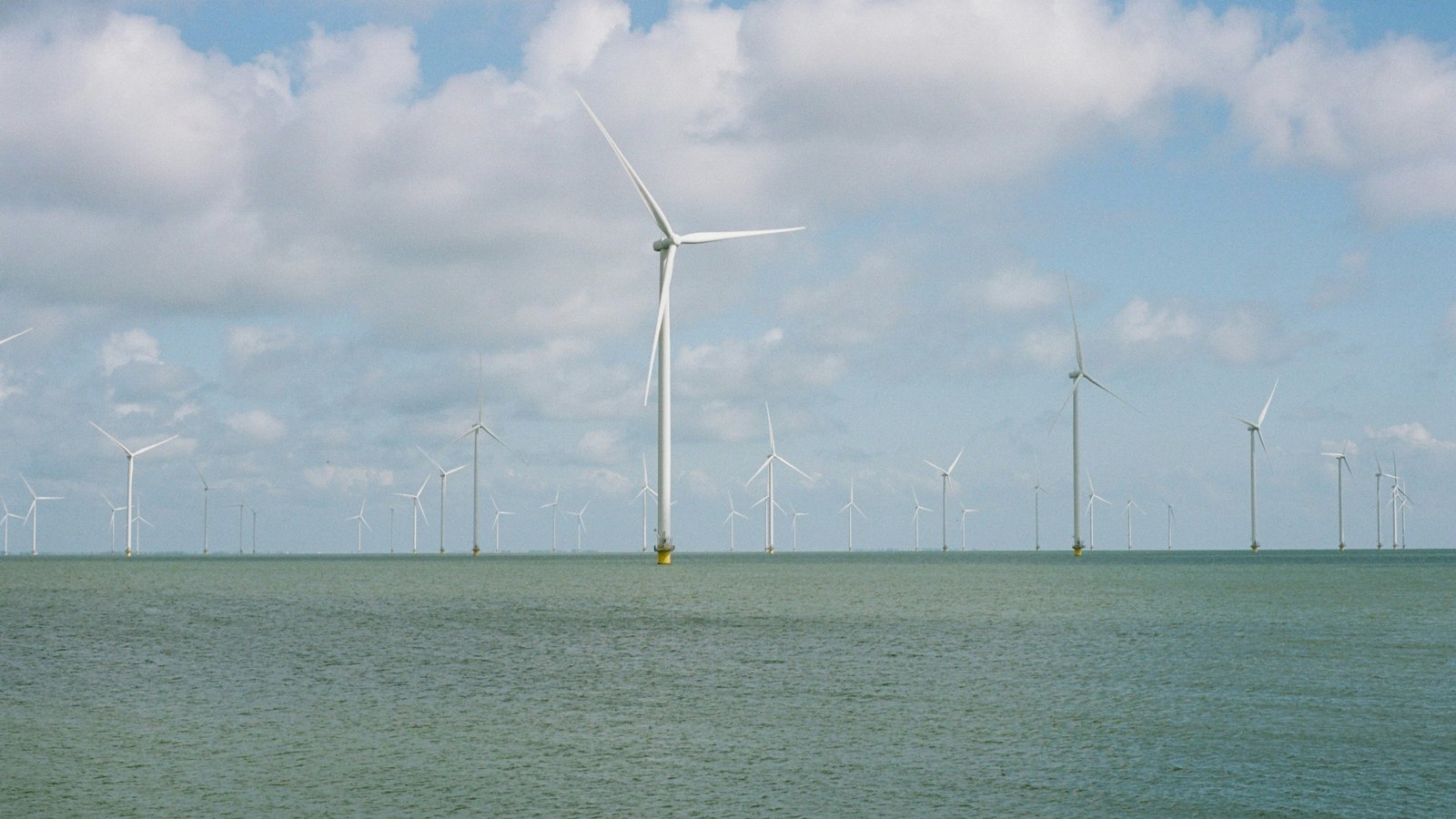
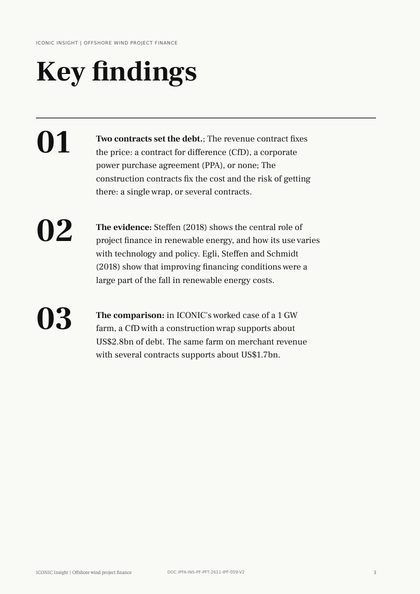
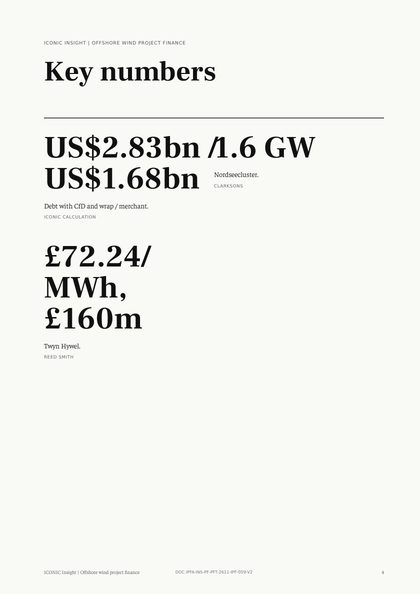
Against the farm’s revenue contract and its construction contracts. The turbines, foundations and cables are the security, but a lender cannot easily sell an offshore wind farm. Wikborg Rein notes that Norwegian law has lacked an adequate basis for security over offshore wind production assets. It calls this unsatisfactory for potential lenders (Wikborg Rein, 2021). Projects are large: Nordseecluster, owned by RWE (51%) and Norges Bank Investment Management (49%), is a 1.6 GW farm, the largest under construction off the German coast (Clarksons, 2025).
Why do the revenue and turbine contracts matter most?
An offshore wind farm is two contracts and a sea. The revenue contract decides how much of the price risk the lender must carry. Norway’s Sørlige Nordsjø II tender offers capped support through a CfD (Wikborg Rein, 2023). Onshore, Bute Energy’s Twyn Hywel project raised £160m of bank debt after securing a CfD at £72.24/MWh for its full capacity (Reed Smith, 2026). The construction contracts decide who carries interface risk between turbine, foundation, cable and installation vessel.
Topics to consider at this stage
- How much of the output is covered by the revenue contract, and for how long?
- Is construction under one wrap, or several contracts with the sponsor managing interfaces?
An offshore wind farm is two contracts and a sea.
Key number
1.6 GW
Inside the paper
In offshore wind, the CfD and the turbine contract set the debt
DOC IPFA-INS-PF-PFT-2611-IPF-059-V2
Fill out the form to read the full paper.
Download the PDFPDF edition
Download the full Insight
Register below. We will ask you to confirm your e-mail address and then send you a personal download link.
Chapter 2
Framework: how much debt does each combination support?
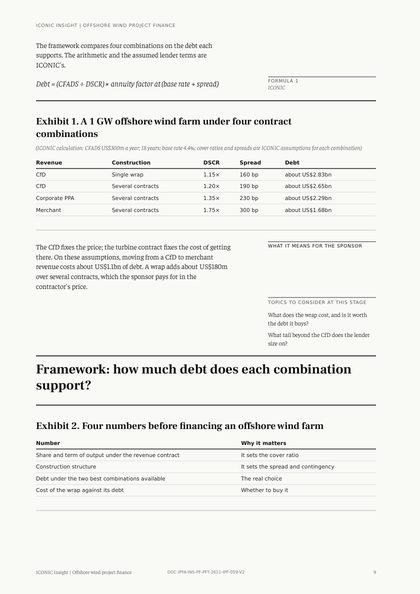
The framework compares four combinations on the debt each supports.
The framework compares four combinations on the debt each supports. The arithmetic and the assumed lender terms are ICONIC’s.
Formula 1 (ICONIC): Debt = (CFADS ÷ DSCR) × annuity factor at (base rate + spread)
| Revenue | Construction | DSCR | Spread | Debt |
|---|---|---|---|---|
| CfD | Single wrap | 1.15× | 160 bp | about US$2.83bn |
| CfD | Several contracts | 1.20× | 190 bp | about US$2.65bn |
| Corporate PPA | Several contracts | 1.35× | 230 bp | about US$2.29bn |
| Merchant | Several contracts | 1.75× | 300 bp | about US$1.68bn |
What it means for the sponsor. The CfD fixes the price; the turbine contract fixes the cost of getting there. On these assumptions, moving from a CfD to merchant revenue costs about US$1.1bn of debt. A wrap adds about US$180m over several contracts, which the sponsor pays for in the contractor’s price.
Topics to consider at this stage
- What does the wrap cost, and is it worth the debt it buys?
- What tail beyond the CfD does the lender size on?
| Number | Why it matters |
|---|---|
| Share and term of output under the revenue contract | It sets the cover ratio |
| Construction structure | It sets the spread and contingency |
| Debt under the two best combinations available | The real choice |
| Cost of the wrap against its debt | Whether to buy it |
The CfD fixes the price; the turbine contract fixes the cost of getting there.
Key number
US$2.83bn / US$1.68bn
Chapter 3
What’s the bottom line?
A sponsor who chooses the revenue and construction structure with the debt in view raises more from the same farm, or pays less for it.
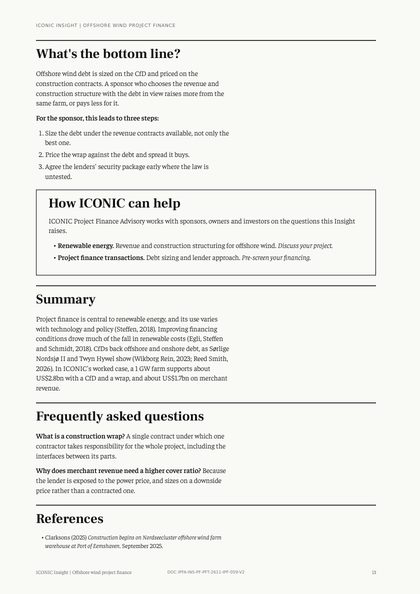
Offshore wind debt is sized on the CfD and priced on the construction contracts. A sponsor who chooses the revenue and construction structure with the debt in view raises more from the same farm, or pays less for it.
For the sponsor, this leads to three steps:
- Size the debt under the revenue contracts available, not only the best one.
- Price the wrap against the debt and spread it buys.
- Agree the lenders’ security package early where the law is untested.
Offshore wind debt is sized on the CfD and priced on the construction contracts.
Key number
£72.24/MWh, £160m
How ICONIC can help
ICONIC Project Finance Advisory works with sponsors, owners and investors on the questions this Insight raises.
- Renewable energy. Revenue and construction structuring for offshore wind. Discuss your project.
- Project finance transactions. Debt sizing and lender approach. Pre-screen your financing.
Summary
Project finance is central to renewable energy, and its use varies with technology and policy (Steffen, 2018). Improving financing conditions drove much of the fall in renewable costs (Egli, Steffen and Schmidt, 2018). CfDs back offshore and onshore debt, as Sørlige Nordsjø II and Twyn Hywel show (Wikborg Rein, 2023; Reed Smith, 2026). In ICONIC’s worked case, a 1 GW farm supports about US$2.8bn with a CfD and a wrap, and about US$1.7bn on merchant revenue.
Frequently asked questions
What is a construction wrap?
A single contract under which one contractor takes responsibility for the whole project, including the interfaces between its parts.
Why does merchant revenue need a higher cover ratio?
Because the lender is exposed to the power price, and sizes on a downside price rather than a contracted one.
References
- Clarksons (2025) Construction begins on Nordseecluster offshore wind farm warehouse at Port of Eemshaven. September 2025.
- Egli, F., Steffen, B. and Schmidt, T.S. (2018) ‘A dynamic analysis of financing conditions for renewable energy technologies’, Nature Energy, 3(12).
- Reed Smith (2026) Reed Smith advises Bute Energy on £160 million financing for Twyn Hywel Energy Park.
- Steffen, B. (2018) ‘The importance of project finance for renewable energy projects’, Energy Economics, 69.
- Wikborg Rein (2021) Debt capital financing of offshore wind projects.
- Wikborg Rein (2023) Launch of offshore wind tenders for Sørlige Nordsjø II and Utsira Nord.
This Insight is for general information only and does not constitute investment, legal or tax advice.