Chapter 1
Why is a hotel harder to fund during construction than an office?
HVS reported in 2021 that building material prices in India had risen by 30–50% in a year, and that developers were turning to prefabricated and modular methods (HVS, 2021).
An office is let before it opens; a hotel starts selling rooms on the day it opens. Its income depends on how quickly it builds occupancy and rate in its market. That takes years, not months, and the loan starts accruing interest on the first drawdown. HVS reports that the practice of benchmarking new construction costs against sales prices has given way to lending on in-place cash flow (HVS, 2024), which a hotel under construction does not have.
What do rising input costs do to the budget?
They raise the equity needed and narrow the margin for error. HVS reported in 2021 that building material prices in India had risen by 30–50% in a year, and that developers were turning to prefabricated and modular methods (HVS, 2021). The Bain brief on large projects notes that 80–90% of costs are incurred in the later phases, so the decisions that set cost are made early (Bain). Flyvbjerg, Holm and Buhl (2002) show that underestimated costs are the rule in large projects, not the exception.
Topics to consider at this stage
- How long will the hotel take to reach stabilised occupancy in its market?
- What contingency does the budget hold, and who pays above it?
An office is let before it opens; a hotel starts selling rooms on the day it opens.
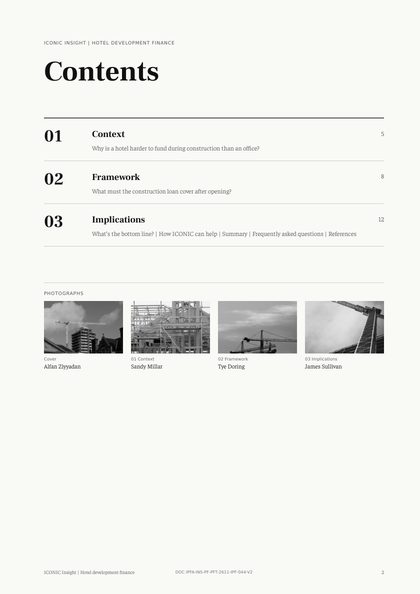
Inside the paper
A hotel opens before it earns, and its construction loan has to allow for that
DOC IPFA-INS-PF-PFT-2611-IPF-044-V2
Fill out the form to read the full paper.
Download the PDFPDF edition
Download the full Insight
Register below. We will ask you to confirm your e-mail address and then send you a personal download link.
Chapter 2
Step 1. Interest during construction
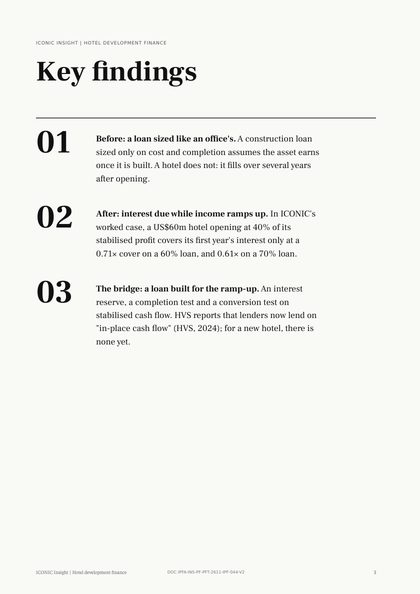
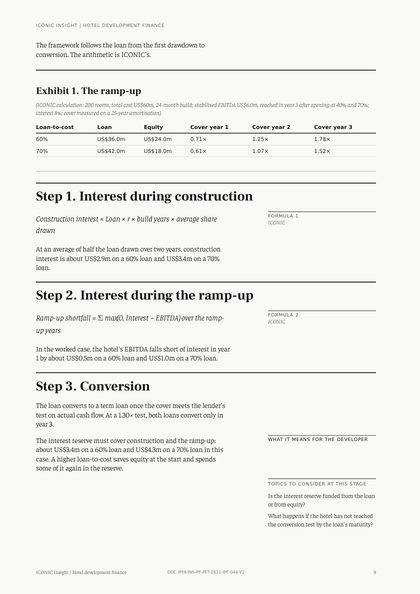
At an average of half the loan drawn over two years, construction interest is about US$2.9m on a 60% loan and US$3.4m on a 70% loan.
The framework follows the loan from the first drawdown to conversion. The arithmetic is ICONIC’s.
| Loan-to-cost | Loan | Equity | Cover year 1 | Cover year 2 | Cover year 3 |
|---|---|---|---|---|---|
| 60% | US$36.0m | US$24.0m | 0.71× | 1.25× | 1.78× |
| 70% | US$42.0m | US$18.0m | 0.61× | 1.07× | 1.52× |
Formula 1 (ICONIC): Construction interest ≈ Loan × r × build years × average share drawn
At an average of half the loan drawn over two years, construction interest is about US$2.9m on a 60% loan and US$3.4m on a 70% loan.
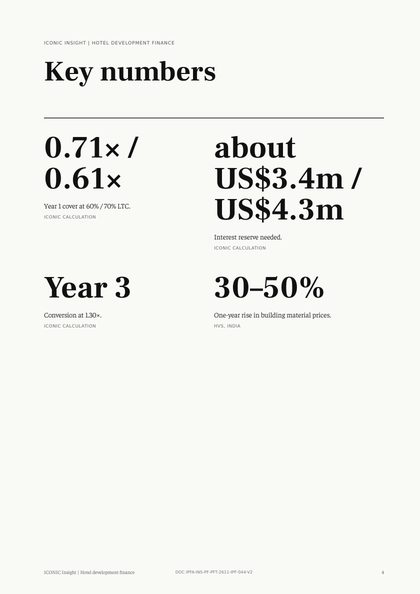
Key number
0.71× / 0.61×
Chapter 3
Step 2. Interest during the ramp-up
In the worked case, the hotel’s EBITDA falls short of interest in year 1 by about US$0.5m on a 60% loan and US$1.0m on a 70% loan.
Formula 2 (ICONIC): Ramp-up shortfall = Σ max(0, Interest − EBITDA) over the ramp-up years
In the worked case, the hotel’s EBITDA falls short of interest in year 1 by about US$0.5m on a 60% loan and US$1.0m on a 70% loan.
Chapter 4
Step 3. Conversion
The interest reserve must cover construction and the ramp-up: about US$3.4m on a 60% loan and US$4.3m on a 70% loan in this case.
The loan converts to a term loan once the cover meets the lender’s test on actual cash flow. At a 1.30× test, both loans convert only in year 3.
What it means for the developer. The interest reserve must cover construction and the ramp-up: about US$3.4m on a 60% loan and US$4.3m on a 70% loan in this case. A higher loan-to-cost saves equity at the start and spends some of it again in the reserve.
Topics to consider at this stage
- Is the interest reserve funded from the loan or from equity?
- What happens if the hotel has not reached the conversion test by the loan’s maturity?
A higher loan-to-cost saves equity at the start and spends some of it again in the reserve.
Key number
about US$3.4m / US$4.3m
Chapter 5
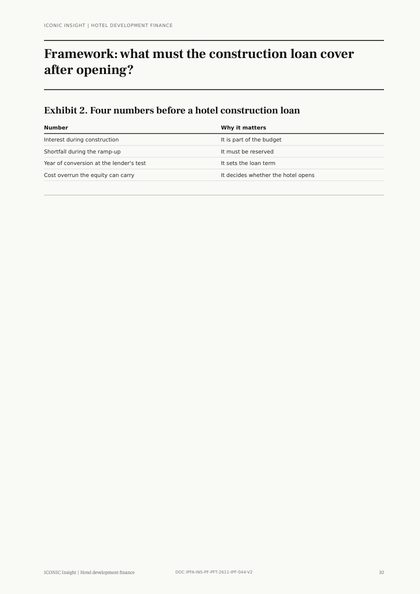
Framework: what must the construction loan cover after opening?
The framework follows the loan from the first drawdown to conversion.
| Number | Why it matters |
|---|---|
| Interest during construction | It is part of the budget |
| Shortfall during the ramp-up | It must be reserved |
| Year of conversion at the lender’s test | It sets the loan term |
| Cost overrun the equity can carry | It decides whether the hotel opens |
Key number
Year 3
Chapter 6
What’s the bottom line?
The developer who models the ramp-up and funds the reserve for it avoids a loan that is in breach before the hotel has a chance to earn.
A hotel construction loan is sized to the year the hotel stabilises, not the day it opens. The developer who models the ramp-up and funds the reserve for it avoids a loan that is in breach before the hotel has a chance to earn.
For the developer, this leads to three steps:
- Model occupancy and rate year by year from opening, not a stabilised year from day one.
- Size the interest reserve to cover construction and the ramp-up.
- Agree a conversion test, and a term long enough for the hotel to reach it.
A hotel construction loan is sized to the year the hotel stabilises, not the day it opens.
How ICONIC can help
ICONIC Project Finance Advisory works with sponsors, owners and investors on the questions this Insight raises.
- Real estate. Feasibility, ramp-up modelling and construction loan sizing. Discuss your hotel project.
- Development finance. Lender approach, reserves and completion tests. Pre-screen your financing.
Summary
A new hotel fills over years after it opens, and lenders now lend on in-place cash flow (HVS, 2024). Input costs can rise fast (HVS, 2021), and most costs are set by early decisions (Bain). In ICONIC’s worked case, a US$60m hotel covers its first year’s interest at only 0.71× on a 60% loan. It needs an interest reserve of about US$3.4m to reach conversion in year 3.
Frequently asked questions
What is an interest reserve?
An amount set aside in the loan budget to pay interest until the project earns enough to pay it itself.
Why not borrow more to cover the ramp-up?
Because the extra debt also bears interest, and the conversion test is on actual cash flow. Borrowing more lowers the cover in every ramp-up year.
References
- Bain & Company (n.d.) Large project management in oil and gas. Bain Brief.
- Flyvbjerg, B., Holm, M.S. and Buhl, S. (2002) ‘Underestimating costs in public works projects: error or lie?’, Journal of the American Planning Association, 68(3).
- HVS (2021) Monday Musings: hotel development feels the heat of rising input costs. HVS.
- HVS (2024) Understanding the current state of the hotel transaction market. HVS.
This Insight is for general information only and does not constitute investment, legal or tax advice.