Chapter 1
Why do owners sell the buildings they use?
The buyer pays a price and sets a rent that gives it a return, including the value it expects the building to hold at the end of the lease.
To turn property into cash for the business. The structure is used well beyond offices and shops:
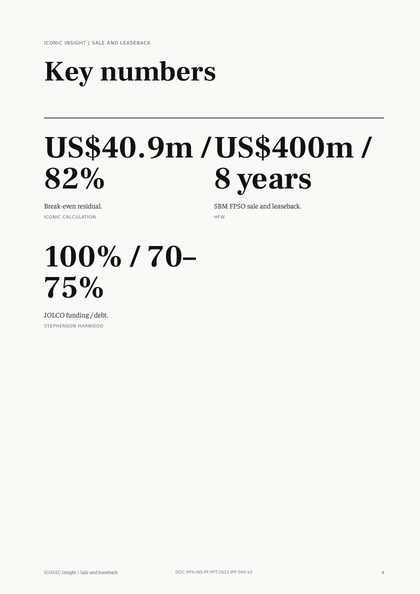
- HFW advised on SBM Offshore’s US$400m non-recourse sale and leaseback of an FPSO, with an eight-year tenor and four Chinese leasing companies (HFW, 2025).
- In shipping, a Japanese operating lease with a call option (JOLCO) is a sale and leaseback that funds 100% of a vessel. Its financing is 70–75% debt and 25–30% Japanese equity, and the lessor keeps the residual risk (Stephenson Harwood, 2025).
What does the buyer price into the rent?
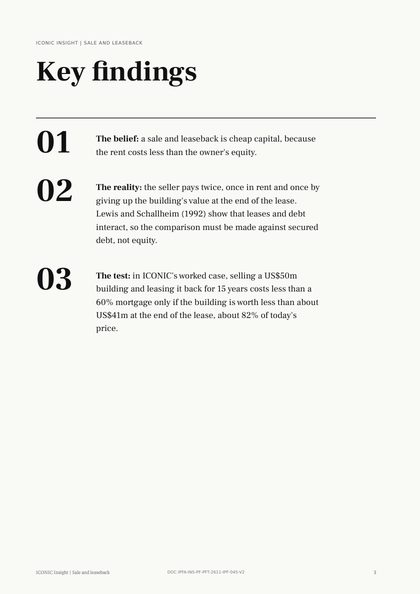
The buyer pays a price and sets a rent that gives it a return, including the value it expects the building to hold at the end of the lease. That residual is part of what the seller sells. Lewis and Schallheim (1992) show that leasing and borrowing interact through tax and through the residual, so whether a lease is cheaper depends on what it is compared with.
Topics to consider at this stage
- Does the business need to own the building to run it, or only to use it?
- What could the building be worth at the end of the lease?
That residual is part of what the seller sells.
Key number
US$400m / 8 years
Inside the paper
Sale and leaseback: cash today, rent and a lost residual value tomorrow
DOC IPFA-INS-PF-PFT-2611-IPF-045-V2
Fill out the form to read the full paper.
Download the PDFPDF edition
Download the full Insight
Register below. We will ask you to confirm your e-mail address and then send you a personal download link.
Chapter 2
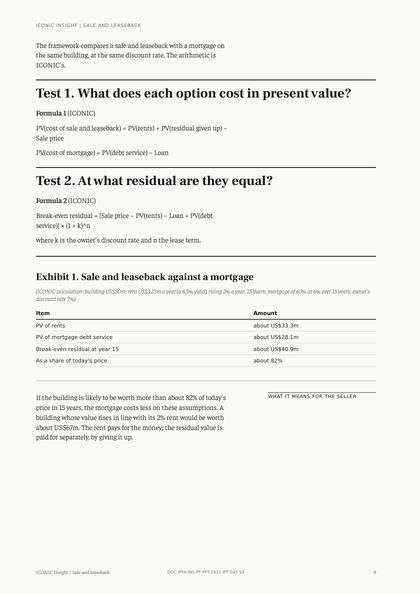
Test 1. What does each option cost in present value?
PV(cost of sale and leaseback) = PV(rents) + PV(residual given up) − Sale price
The framework compares a sale and leaseback with a mortgage on the same building, at the same discount rate. The arithmetic is ICONIC’s.
Formula 1 (ICONIC)
PV(cost of sale and leaseback) = PV(rents) + PV(residual given up) − Sale price
PV(cost of mortgage) = PV(debt service) − Loan
Key number
100% / 70–75%
Chapter 3
Test 2. At what residual are they equal?
If the building is likely to be worth more than about 82% of today’s price in 15 years, the mortgage costs less on these assumptions.
Formula 2 (ICONIC)
Break-even residual = [Sale price − PV(rents) − Loan + PV(debt service)] × (1 + k)^n
where k is the owner’s discount rate and n the lease term.
| Item | Amount |
|---|---|
| PV of rents | about US$33.3m |
| PV of mortgage debt service | about US$28.1m |
| Break-even residual at year 15 | about US$40.9m |
| As a share of today’s price | about 82% |
What it means for the seller. If the building is likely to be worth more than about 82% of today’s price in 15 years, the mortgage costs less on these assumptions. A building whose value rises in line with its 2% rent would be worth about US$67m. The rent pays for the money; the residual value is paid for separately, by giving it up.
Topics to consider at this stage
- What does the lease allow at the end: renewal, purchase, or nothing?
- Which option keeps the flexibility to move, expand or sell the business?
The rent pays for the money; the residual value is paid for separately, by giving it up.
Key number
US$40.9m / 82%
Chapter 4
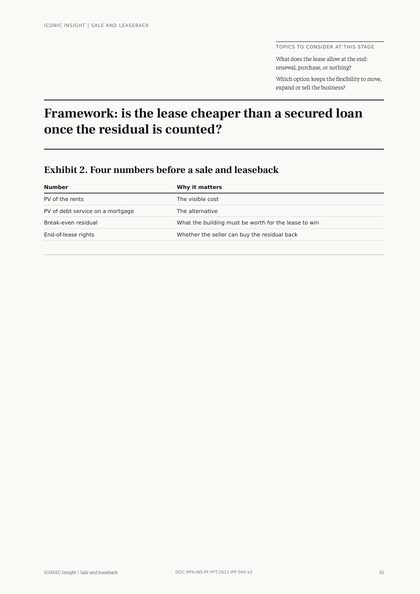
Framework: is the lease cheaper than a secured loan once the residual is counted?
The framework compares a sale and leaseback with a mortgage on the same building, at the same discount rate.
| Number | Why it matters |
|---|---|
| PV of the rents | The visible cost |
| PV of debt service on a mortgage | The alternative |
| Break-even residual | What the building must be worth for the lease to win |
| End-of-lease rights | Whether the seller can buy the residual back |
Chapter 5
What’s the bottom line?
It raises more cash than a mortgage, and that can be worth paying for.
A sale and leaseback is cheaper than a loan only when the residual is worth less than the difference in rate. It raises more cash than a mortgage, and that can be worth paying for. But it should be compared with secured debt on the same building, with the residual counted, not with the cost of equity.
For the seller, this leads to three steps:
- Compare the lease with a mortgage on the same building, not with equity.
- Compute the residual value at which the two cost the same.
- Negotiate the end-of-lease rights: renewal and a purchase option.
A sale and leaseback is cheaper than a loan only when the residual is worth less than the difference in rate.
How ICONIC can help
ICONIC Project Finance Advisory works with sponsors, owners and investors on the questions this Insight raises.
- Real estate. Sale and leaseback against mortgage analysis. Discuss your property.
- Debt advisory. Secured financing alternatives. Pre-screen your options.
Summary
Sale and leaseback is used from offices to FPSOs and ships (HFW, 2025; Stephenson Harwood, 2025). Leases and debt interact (Lewis and Schallheim, 1992), so a lease should be compared with secured debt. In ICONIC’s worked case, selling and leasing back a US$50m building for 15 years costs less than a 60% mortgage only if it is worth less than about 82% of today’s price at the end of the lease.
Frequently asked questions
Is a sale and leaseback a loan?
Economically, it can work like one, and accounting rules may treat it as one, depending on the terms. Legally, the seller no longer owns the asset.
What is a JOLCO?
A Japanese operating lease with a call option: a sale and leaseback in which Japanese investors take tax benefits and the residual risk, and the lessee can buy the asset back at set dates.
References
- HFW (2025) HFW advises SBM Offshore on US$400m FPSO sale and leaseback financing. HFW.
- Lewis, C.M. and Schallheim, J.S. (1992) ‘Are debt and leases substitutes?’, Journal of Financial and Quantitative Analysis, 27(4).
- Stephenson Harwood (2025) Overview of a Japanese operating lease (with call option) in the shipping sector. Stephenson Harwood LLP.
This Insight is for general information only and does not constitute investment, legal, accounting or tax advice.