
Chapter 1
Which tests does a property lender apply?
JLL reports that rising policy and benchmark rates are “weighing on underwriting assumptions and resetting price expectations”, while credit markets “remain broadly liquid” (JLL, 2026).
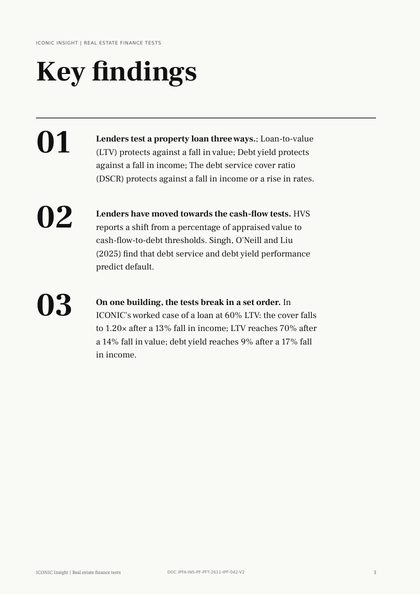
A commercial property loan is usually tested three ways:
- LTV: the loan divided by the value of the property;
- debt yield: net operating income (NOI) divided by the loan;
- DSCR: NOI divided by interest and principal due.
The three tests overlap but are not the same. LTV moves with valuers’ judgement and market yields. Debt yield ignores the interest rate and the loan term. The cover ratio moves with both income and rates.
Why did lenders move from value to cash flow?
Because values moved faster than income. JLL reports that rising policy and benchmark rates are “weighing on underwriting assumptions and resetting price expectations”, while credit markets “remain broadly liquid” (JLL, 2026). In hotels, where income is most visible, HVS reports that lenders now use “in-place cash flow” rather than appraisal estimates (HVS, 2024). Research supports the cash-flow tests: Singh, O’Neill and Liu (2025) find that debt service and debt yield performance predict default. Titman, Tompaidis and Tsyplakov (2005) model how the terms and the property’s risk set spreads on commercial mortgages.
Topics to consider at this stage
- Which test will the lender use to size the loan, and which only as a covenant?
- How is value defined in the covenant: by appraisal, by an index, or by income at a fixed yield?
The three tests overlap but are not the same.
Key number
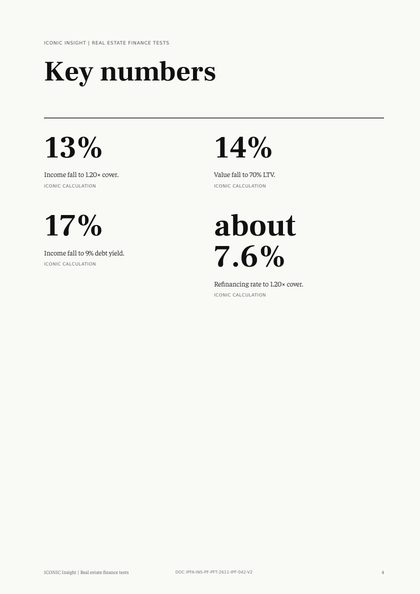
14%

Inside the paper
Three tests size a property loan, and each fails in its own way
DOC IPFA-INS-PF-PFT-2611-IPF-042-V2
Fill out the form to read the full paper.
Download the PDFPDF edition
Download the full Insight
Register below. We will ask you to confirm your e-mail address and then send you a personal download link.
Chapter 2
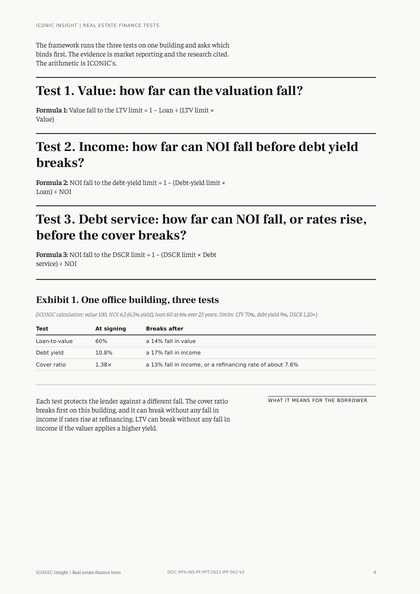
Test 1. Value: how far can the valuation fall?
The framework runs the three tests on one building and asks which binds first.
The framework runs the three tests on one building and asks which binds first. The evidence is market reporting and the research cited. The arithmetic is ICONIC’s.
Formula 1: Value fall to the LTV limit = 1 − Loan ÷ (LTV limit × Value)
Key number
17%
Chapter 3
Test 2. Income: how far can NOI fall before debt yield breaks?
The framework runs the three tests on one building and asks which binds first.
Formula 2: NOI fall to the debt-yield limit = 1 − (Debt-yield limit × Loan) ÷ NOI
Chapter 4
Test 3. Debt service: how far can NOI fall, or rates rise, before the cover breaks?
The cover ratio breaks first on this building, and it can break without any fall in income if rates rise at refinancing.
Formula 3: NOI fall to the DSCR limit = 1 − (DSCR limit × Debt service) ÷ NOI
| Test | At signing | Breaks after |
|---|---|---|
| Loan-to-value | 60% | a 14% fall in value |
| Debt yield | 10.8% | a 17% fall in income |
| Cover ratio | 1.38× | a 13% fall in income, or a refinancing rate of about 7.6% |
What it means for the borrower. Each test protects the lender against a different fall. The cover ratio breaks first on this building, and it can break without any fall in income if rates rise at refinancing. LTV can break without any fall in income if the valuer applies a higher yield.
Topics to consider at this stage
- What is the cure for each breach: cash, a partial repayment or a cash trap?
- Is the DSCR tested on actual or projected rates?
Each test protects the lender against a different fall.
Key number
13%
Chapter 5
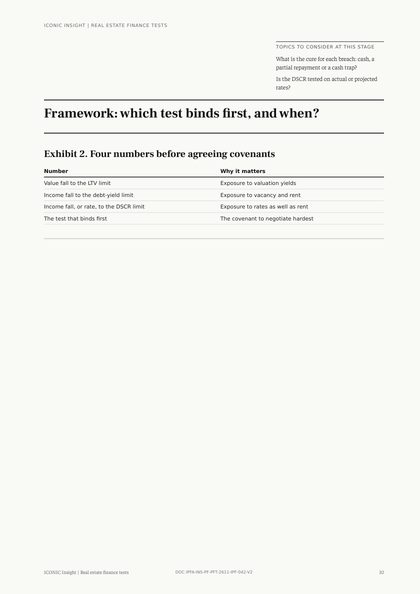
Framework: which test binds first, and when?
The framework runs the three tests on one building and asks which binds first.
| Number | Why it matters |
|---|---|
| Value fall to the LTV limit | Exposure to valuation yields |
| Income fall to the debt-yield limit | Exposure to vacancy and rent |
| Income fall, or rate, to the DSCR limit | Exposure to rates as well as rent |
| The test that binds first | The covenant to negotiate hardest |
Chapter 6
What’s the bottom line?
A borrower who computes all three on its own building knows which to negotiate hardest, and which fall it is really exposed to.
Each test protects the lender against a different fall. The test that binds decides the loan; the other two decide the covenants. A borrower who computes all three on its own building knows which to negotiate hardest, and which fall it is really exposed to.
For the borrower, this leads to three steps:
- Compute the headroom on all three tests at signing, not only the one the lender sizes on.
- Negotiate the definition and the cure of the test that binds first.
- Test the refinancing rate at which the cover breaks.
The test that binds decides the loan; the other two decide the covenants.
How ICONIC can help
ICONIC Project Finance Advisory works with sponsors, owners and investors on the questions this Insight raises.
- Real estate. Loan sizing and covenant testing on the borrower’s own building. Discuss your financing.
- Debt advisory. Lender approach and covenant negotiation. Pre-screen your terms.
Summary
Property lenders test LTV, debt yield and the cover ratio, and have moved towards the cash-flow tests (HVS, 2024; JLL, 2026). Debt yield and debt service performance predict default (Singh, O’Neill and Liu, 2025). In ICONIC’s worked case of a 60% loan, the cover breaks after a 13% fall in income or at a refinancing rate of about 7.6%. LTV breaks after a 14% fall in value, and debt yield after a 17% fall in income.
Frequently asked questions
What is debt yield?
Net operating income divided by the loan. It shows the return a lender would earn on the property if it took it over, whatever the interest rate.
Why can the cover ratio break without any fall in rent?
Because it depends on debt service. A loan refinanced at a higher rate costs more to service, and the cover falls.
References
- HVS (2024) Understanding the current state of the hotel transaction market. HVS.
- JLL (2026) Global real estate trends and perspectives, November 2026. JLL Research.
- Singh, A., O’Neill, J.W. and Liu, P. (2025) ‘The influence of hotel characteristics on debt servicing and default in the U.S. lodging sector’, Cornell Hospitality Quarterly, 66(2), pp. 137–155.
- Titman, S., Tompaidis, S. and Tsyplakov, S. (2005) ‘Determinants of credit spreads in commercial mortgages’, Real Estate Economics, 33(4).
This Insight is for general information only and does not constitute investment, legal or tax advice.