Chapter 1
Why is more output being switched off?
Many regimes compensate curtailment ordered for grid reasons.
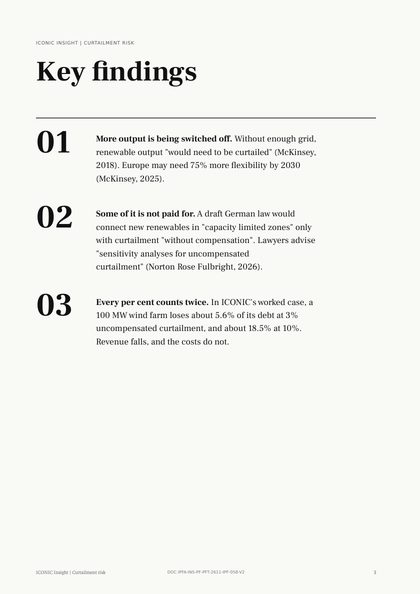
Because grids have not kept up with wind and solar. McKinsey’s 2018 analysis of grid expansion found that, without enough transmission and storage, renewable feed-in “could not be absorbed by the system and would need to be curtailed” (McKinsey, 2018). Its 2025 analysis finds that Europe may need 75% more flexibility by 2030 than it has today (McKinsey, 2025). In Germany, transmission operators report connection capacity at high voltage “essentially exhausted into the 2030s” (Norton Rose Fulbright, 2026). Joskow (2011) showed why intermittent output cannot be valued like dispatchable output: its value depends on when it is produced, and whether the system can take it.
When is curtailment paid for, and when is it not?
Curtailed output is energy that was produced and not paid for, unless a rule or contract pays for it. Many regimes compensate curtailment ordered for grid reasons. The German draft law would allow grid operators in capacity limited zones to connect new renewable plants only with a curtailment reservation “without compensation”. Norton Rose Fulbright notes that this “weakens revenue security” (Norton Rose Fulbright, 2026).
Topics to consider at this stage
- Is curtailment at this site compensated, and under what rule?
- What share of output was curtailed at nearby plants last year?
Curtailed output is energy that was produced and not paid for, unless a rule or contract pays for it.
Key number
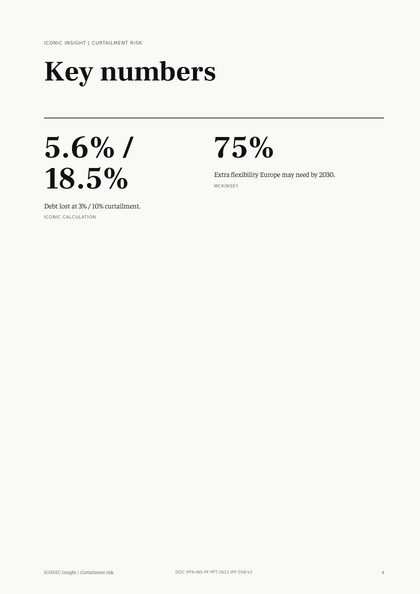
75%

Inside the paper
What does lost output do to a renewable project’s debt?
DOC IPFA-INS-PF-PFT-2611-IPF-058-V2
Fill out the form to read the full paper.
Download the PDFPDF edition
Download the full Insight
Register below. We will ask you to confirm your e-mail address and then send you a personal download link.
Chapter 2
Framework: how much debt does each per cent of lost output cost?
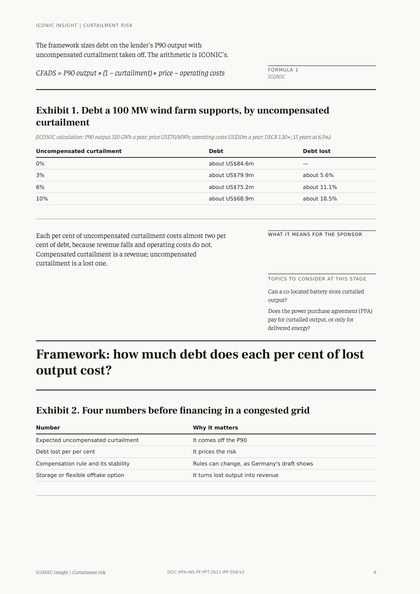
The framework sizes debt on the lender’s P90 output with uncompensated curtailment taken off.
The framework sizes debt on the lender’s P90 output with uncompensated curtailment taken off. The arithmetic is ICONIC’s.
Formula 1 (ICONIC): CFADS = P90 output × (1 − curtailment) × price − operating costs
| Uncompensated curtailment | Debt | Debt lost |
|---|---|---|
| 0% | about US$84.6m | — |
| 3% | about US$79.9m | about 5.6% |
| 6% | about US$75.2m | about 11.1% |
| 10% | about US$68.9m | about 18.5% |
What it means for the sponsor. Each per cent of uncompensated curtailment costs almost two per cent of debt, because revenue falls and operating costs do not. Compensated curtailment is a revenue; uncompensated curtailment is a lost one.
Topics to consider at this stage
- Can a co-located battery store curtailed output?
- Does the power purchase agreement (PPA) pay for curtailed output, or only for delivered energy?
| Number | Why it matters |
|---|---|
| Expected uncompensated curtailment | It comes off the P90 |
| Debt lost per per cent | It prices the risk |
| Compensation rule and its stability | Rules can change, as Germany’s draft shows |
| Storage or flexible offtake option | It turns lost output into revenue |
Compensated curtailment is a revenue; uncompensated curtailment is a lost one.
Key number
5.6% / 18.5%
Chapter 3
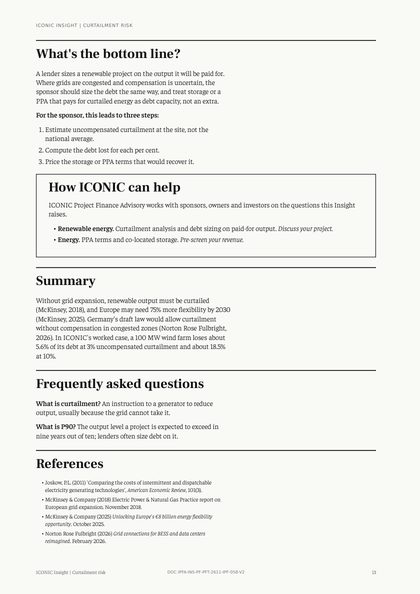
What’s the bottom line?
Where grids are congested and compensation is uncertain, the sponsor should size the debt the same way, and treat storage or a PPA that pays for curtailed energy as debt capacity, not an extra.
A lender sizes a renewable project on the output it will be paid for. Where grids are congested and compensation is uncertain, the sponsor should size the debt the same way, and treat storage or a PPA that pays for curtailed energy as debt capacity, not an extra.
For the sponsor, this leads to three steps:
- Estimate uncompensated curtailment at the site, not the national average.
- Compute the debt lost for each per cent.
- Price the storage or PPA terms that would recover it.
A lender sizes a renewable project on the output it will be paid for.
Key number
“Essentially exhausted into the 2030s”
How ICONIC can help
ICONIC Project Finance Advisory works with sponsors, owners and investors on the questions this Insight raises.
- Renewable energy. Curtailment analysis and debt sizing on paid-for output. Discuss your project.
- Energy. PPA terms and co-located storage. Pre-screen your revenue.
Summary
Without grid expansion, renewable output must be curtailed (McKinsey, 2018), and Europe may need 75% more flexibility by 2030 (McKinsey, 2025). Germany’s draft law would allow curtailment without compensation in congested zones (Norton Rose Fulbright, 2026). In ICONIC’s worked case, a 100 MW wind farm loses about 5.6% of its debt at 3% uncompensated curtailment and about 18.5% at 10%.
Frequently asked questions
What is curtailment?
An instruction to a generator to reduce output, usually because the grid cannot take it.
What is P90?
The output level a project is expected to exceed in nine years out of ten; lenders often size debt on it.
References
- Joskow, P.L. (2011) ‘Comparing the costs of intermittent and dispatchable electricity generating technologies’, American Economic Review, 101(3).
- McKinsey & Company (2018) Electric Power & Natural Gas Practice report on European grid expansion. November 2018.
- McKinsey & Company (2025) Unlocking Europe’s €8 billion energy flexibility opportunity. October 2025.
- Norton Rose Fulbright (2026) Grid connections for BESS and data centers reimagined. February 2026.
This Insight is for general information only and does not constitute investment, legal or tax advice.