Chapter 1
How are offshore wind sites awarded?
The sponsor must then put in more equity, renegotiate, or walk away and pay the penalty.
Increasingly by auction. Norway’s Sørlige Nordsjø II, 1,500 MW, was offered to one consortium through an English-style open-bid auction (Wikborg Rein, 2023):
- at most eight bidders were pre-qualified;
- the winner is eligible for capped support through a contract for difference (CfD);
- each bidder had to post an on-demand guarantee for a possible NOK 400m penalty;
- the tender rules allow “limited possibilities to change the projects negatively after award”.
The bid is the first financing decision, taken before any lender sees the project.
What happens to projects that bid too low?
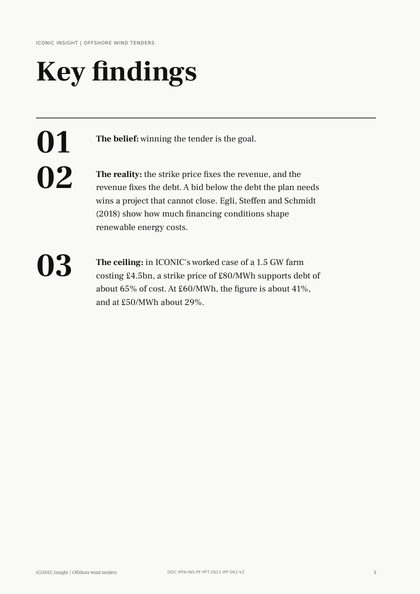
They win a CfD whose revenue cannot carry the debt the plan assumed. The sponsor must then put in more equity, renegotiate, or walk away and pay the penalty. Egli, Steffen and Schmidt (2018) show that financing conditions are a large part of the cost of renewable energy. A bid that ignores what lenders will lend against the strike price ignores a large part of its own cost.
Topics to consider at this stage
- What gearing does the bid model assume, and at what cover ratio?
- What penalty or guarantee is lost if the project does not proceed?
The bid is the first financing decision, taken before any lender sees the project.
Key number
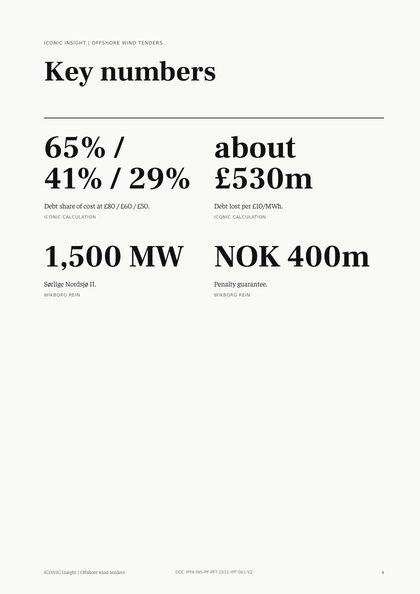
about £530m
Inside the paper
Every offshore wind bid sets a ceiling on the debt, whether the bidder sees it or not
DOC IPFA-INS-PF-PFT-2611-IPF-061-V2
Fill out the form to read the full paper.
Download the PDFPDF edition
Download the full Insight
Register below. We will ask you to confirm your e-mail address and then send you a personal download link.
Chapter 2
Framework: how low can a bid go before the debt no longer closes?
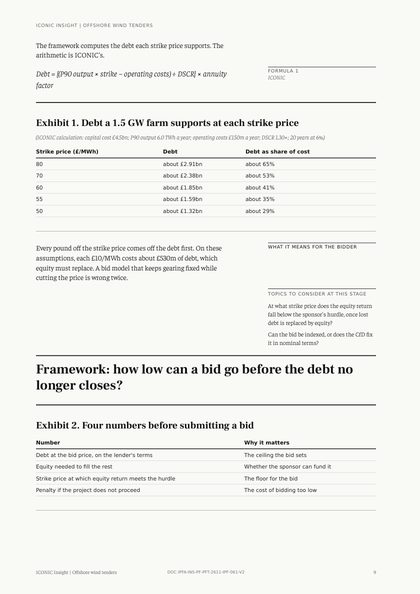
The framework computes the debt each strike price supports.
The framework computes the debt each strike price supports. The arithmetic is ICONIC’s.
Formula 1 (ICONIC): Debt = [(P90 output × strike − operating costs) ÷ DSCR] × annuity factor
| Strike price (£/MWh) | Debt | Debt as share of cost |
|---|---|---|
| 80 | about £2.91bn | about 65% |
| 70 | about £2.38bn | about 53% |
| 60 | about £1.85bn | about 41% |
| 55 | about £1.59bn | about 35% |
| 50 | about £1.32bn | about 29% |
What it means for the bidder. Every pound off the strike price comes off the debt first. On these assumptions, each £10/MWh costs about £530m of debt, which equity must replace. A bid model that keeps gearing fixed while cutting the price is wrong twice.
Topics to consider at this stage
- At what strike price does the equity return fall below the sponsor’s hurdle, once lost debt is replaced by equity?
- Can the bid be indexed, or does the CfD fix it in nominal terms?
| Number | Why it matters |
|---|---|
| Debt at the bid price, on the lender’s terms | The ceiling the bid sets |
| Equity needed to fill the rest | Whether the sponsor can fund it |
| Strike price at which equity return meets the hurdle | The floor for the bid |
| Penalty if the project does not proceed | The cost of bidding too low |
Every pound off the strike price comes off the debt first.
Key number
65% / 41% / 29%
Chapter 3
What’s the bottom line?
The bidder who sizes the debt at each strike price before bidding knows the lowest price at which it can still close, and does not win a project it cannot build.
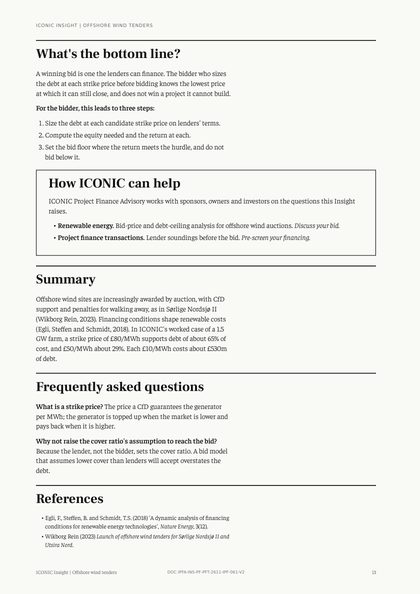
A winning bid is one the lenders can finance. The bidder who sizes the debt at each strike price before bidding knows the lowest price at which it can still close, and does not win a project it cannot build.
For the bidder, this leads to three steps:
- Size the debt at each candidate strike price on lenders’ terms.
- Compute the equity needed and the return at each.
- Set the bid floor where the return meets the hurdle, and do not bid below it.
A winning bid is one the lenders can finance.
Key number
1,500 MW
How ICONIC can help
ICONIC Project Finance Advisory works with sponsors, owners and investors on the questions this Insight raises.
- Renewable energy. Bid-price and debt-ceiling analysis for offshore wind auctions. Discuss your bid.
- Project finance transactions. Lender soundings before the bid. Pre-screen your financing.
Summary
Offshore wind sites are increasingly awarded by auction, with CfD support and penalties for walking away, as in Sørlige Nordsjø II (Wikborg Rein, 2023). Financing conditions shape renewable costs (Egli, Steffen and Schmidt, 2018). In ICONIC’s worked case of a 1.5 GW farm, a strike price of £80/MWh supports debt of about 65% of cost, and £50/MWh about 29%. Each £10/MWh costs about £530m of debt.
Frequently asked questions
What is a strike price?
The price a CfD guarantees the generator per MWh; the generator is topped up when the market is lower and pays back when it is higher.
Why not raise the cover ratio’s assumption to reach the bid?
Because the lender, not the bidder, sets the cover ratio. A bid model that assumes lower cover than lenders will accept overstates the debt.
References
- Egli, F., Steffen, B. and Schmidt, T.S. (2018) ‘A dynamic analysis of financing conditions for renewable energy technologies’, Nature Energy, 3(12).
- Wikborg Rein (2023) Launch of offshore wind tenders for Sørlige Nordsjø II and Utsira Nord.
This Insight is for general information only and does not constitute investment, legal or tax advice.