Chapter 1
What makes a bond green?
Very little, if at all:
Its use of proceeds and its reporting. The International Capital Market Association’s Green Bond Principles set four core components. Proceeds must go to eligible green projects and be kept separate from the issuer’s other funds, and issuers report on their allocation (Wikborg Rein, 2019; 2021). The market reaches well beyond utilities:
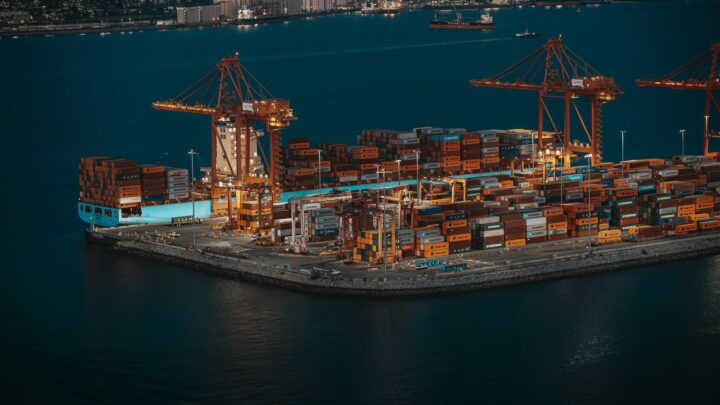
- Teekay Shuttle Tankers placed a US$125m green bond, the first from the maritime industries in the Nordic market (Wikborg Rein, 2019).
- Amarenco refinanced 123 MW of French solar with a €29m ten-year bond from private debt funds, subordinated to its banks (WFW, 2024).
Do investors pay more for it?
Very little, if at all:
- Larcker and Watts (2020) match green municipal bonds with ordinary bonds from the same issuer, issued on the same day. They find the two “priced economically the same”: investors treat them as near-perfect substitutes.
- Zerbib (2019) finds a small negative premium across a wider sample.
- Flammer (2021) finds that corporate green bonds bring a positive response from investors, and that issuers then improve their environmental performance. The label works as a signal.
A green bond is an ordinary bond with a promise about its use of proceeds.
Topics to consider at this stage
- Do the project’s assets meet a green taxonomy, or only the issuer’s own framework?
- Which investors would buy the green bond who would not buy an ordinary one?
A green bond is an ordinary bond with a promise about its use of proceeds.
Key number
about 0
Inside the paper
Does the green label lower the price of infrastructure debt?
DOC IPFA-INS-PF-CMF-2611-IPF-054-V2
Fill out the form to read the full paper.
Download the PDFPDF edition
Download the full Insight
Register below. We will ask you to confirm your e-mail address and then send you a personal download link.
Chapter 2
Framework: does the label pay for its reporting?
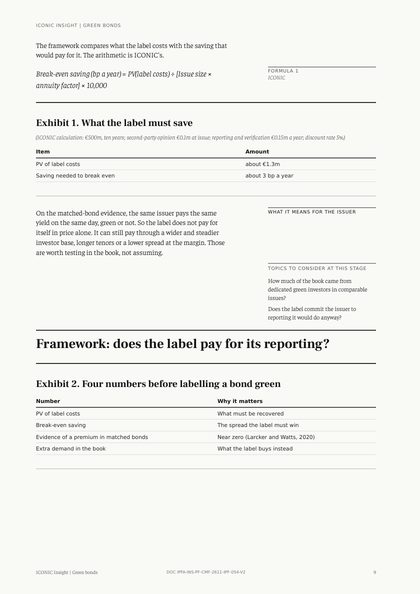
The framework compares what the label costs with the saving that would pay for it.
The framework compares what the label costs with the saving that would pay for it. The arithmetic is ICONIC’s.
Formula 1 (ICONIC): Break-even saving (bp a year) = PV(label costs) ÷ [Issue size × annuity factor] × 10,000
| Item | Amount |
|---|---|
| PV of label costs | about €1.3m |
| Saving needed to break even | about 3 bp a year |
What it means for the issuer. On the matched-bond evidence, the same issuer pays the same yield on the same day, green or not. So the label does not pay for itself in price alone. It can still pay through a wider and steadier investor base, longer tenors or a lower spread at the margin. Those are worth testing in the book, not assuming.
Topics to consider at this stage
- How much of the book came from dedicated green investors in comparable issues?
- Does the label commit the issuer to reporting it would do anyway?
| Number | Why it matters |
|---|---|
| PV of label costs | What must be recovered |
| Break-even saving | The spread the label must win |
| Evidence of a premium in matched bonds | Near zero (Larcker and Watts, 2020) |
| Extra demand in the book | What the label buys instead |
On the matched-bond evidence, the same issuer pays the same yield on the same day, green or not.
Key number
€1.3m
Chapter 3
What’s the bottom line?
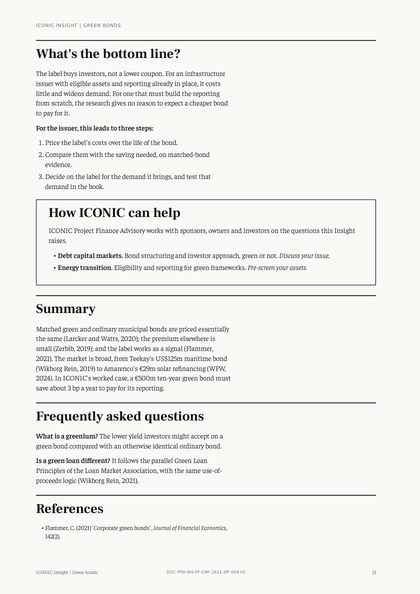
For an infrastructure issuer with eligible assets and reporting already in place, it costs little and widens demand.
The label buys investors, not a lower coupon. For an infrastructure issuer with eligible assets and reporting already in place, it costs little and widens demand. For one that must build the reporting from scratch, the research gives no reason to expect a cheaper bond to pay for it.
For the issuer, this leads to three steps:
- Price the label’s costs over the life of the bond.
- Compare them with the saving needed, on matched-bond evidence.
- Decide on the label for the demand it brings, and test that demand in the book.
The label buys investors, not a lower coupon.
Key number
about 3 bp
How ICONIC can help
ICONIC Project Finance Advisory works with sponsors, owners and investors on the questions this Insight raises.
- Debt capital markets. Bond structuring and investor approach, green or not. Discuss your issue.
- Energy transition. Eligibility and reporting for green frameworks. Pre-screen your assets.
Summary
Matched green and ordinary municipal bonds are priced essentially the same (Larcker and Watts, 2020); the premium elsewhere is small (Zerbib, 2019); and the label works as a signal (Flammer, 2021). The market is broad, from Teekay’s US$125m maritime bond (Wikborg Rein, 2019) to Amarenco’s €29m solar refinancing (WFW, 2024). In ICONIC’s worked case, a €500m ten-year green bond must save about 3 bp a year to pay for its reporting.
Frequently asked questions
What is a greenium?
The lower yield investors might accept on a green bond compared with an otherwise identical ordinary bond.
Is a green loan different?
It follows the parallel Green Loan Principles of the Loan Market Association, with the same use-of-proceeds logic (Wikborg Rein, 2021).
References
- Flammer, C. (2021) ‘Corporate green bonds’, Journal of Financial Economics, 142(2).
- Larcker, D.F. and Watts, E.M. (2020) ‘Where’s the greenium?’, Journal of Accounting and Economics, 69(2–3), 101312. doi:10.1016/j.jacceco.2020.101312
- WFW (2024) WFW advises Amarenco on a 123 MW solar portfolio bond refinancing. Watson Farley & Williams.
- Wikborg Rein (2019) Teekay Shuttle Tankers issues the first Nordic maritime green bond.
- Wikborg Rein (2021) Debt capital financing of offshore wind projects.
- Zerbib, O.D. (2019) ‘The effect of pro-environmental preferences on bond prices: evidence from green bonds’, Journal of Banking & Finance, 98.
This Insight is for general information only and does not constitute investment, legal or tax advice.