
Chapter 1
What is a public sector comparator?
A public project spends most of its money at the start; a PPP spreads payments over the contract.
A comparator compares a real bid with a public project that will never be built. It estimates what the public side would pay to deliver the same service itself, then compares that cost, in present value, with the payments it would make to the PPP. PPPs remain a live way to procure and refinance public assets. WFW advised on the refinancing of seven wastewater treatment plants held under a public concession in Aragón (WFW, 2023).
Why can the same project pass and fail?
Because the two streams of cost have different shapes. A public project spends most of its money at the start; a PPP spreads payments over the contract. A higher discount rate shrinks the PPP’s later payments more than the public project’s early capital. The discount rate often decides the answer before the risks are counted. Engel, Fischer and Galetovic (2013) show that PPPs cannot be justified because they free public funds: every project is paid for by users, taxpayers or both. Iossa and Martimort (2015) show that the gains from a PPP come from bundling construction and operation and allocating risk to the party that can manage it.
Topics to consider at this stage
- What discount rate does the guidance require, and why?
- Which risks does the comparator price, and how?
A comparator compares a real bid with a public project that will never be built.
Key number
Fail / conditional / pass
Inside the paper
PPP value for money: what the comparator measures and what it misses
DOC IPFA-INS-PF-PPP-2611-IPF-062-V2
Fill out the form to read the full paper.
Download the PDFPDF edition
Download the full Insight
Register below. We will ask you to confirm your e-mail address and then send you a personal download link.
Chapter 2
Framework: what should a value-for-money test include?
The framework runs the same comparison at three discount rates, with and without retained risk.
The framework runs the same comparison at three discount rates, with and without retained risk. The arithmetic is ICONIC’s.
Formula 1 (ICONIC): PSC = Capital cost + PV(operating cost) + PV(retained risk); PPP = PV(unitary payments)
| Discount rate | PPP | PSC, cost only | PSC with retained risk | PPP passes? |
|---|---|---|---|---|
| 3.5% | 1,839 | 1,560 | 1,707 | No |
| 5% | 1,537 | 1,484 | 1,607 | Only if risk is counted |
| 7% | 1,241 | 1,410 | 1,509 | Yes |
What it means for the public side. The discount rate turns a fail into a pass on the same project. Risk transfer is what should decide the answer. It is also the hardest number to estimate, and the easiest to adjust.
Topics to consider at this stage
- Is the retained risk priced from evidence of past public projects, or assumed?
- Does the PPP actually transfer the risks the comparator credits it with?
| Number | Why it matters |
|---|---|
| Result at the guidance rate and at the public borrowing rate | Shows how much the rate decides |
| Retained risk, with its evidence | The case for the PPP rests on it |
| Risks actually transferred under the contract | The credit taken must match the contract |
| Long-term payment commitment | PPP payments are a public liability whatever the accounting |
The discount rate turns a fail into a pass on the same project.
Key number
1,839 against 1,560
Chapter 3
What’s the bottom line?
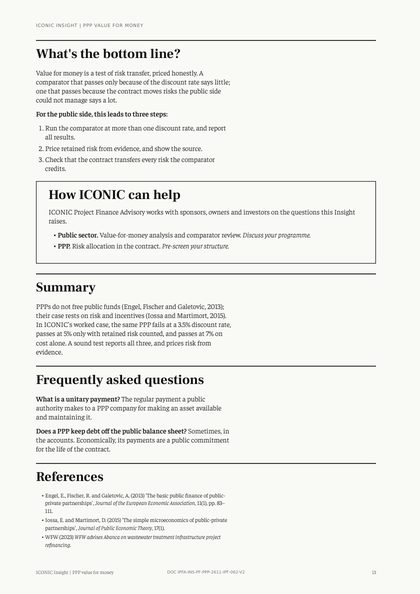
A comparator that passes only because of the discount rate says little; one that passes because the contract moves risks the public side could not manage says a lot.
Value for money is a test of risk transfer, priced honestly. A comparator that passes only because of the discount rate says little; one that passes because the contract moves risks the public side could not manage says a lot.
For the public side, this leads to three steps:
- Run the comparator at more than one discount rate, and report all results.
- Price retained risk from evidence, and show the source.
- Check that the contract transfers every risk the comparator credits.
Value for money is a test of risk transfer, priced honestly.
Key number
1,241 against 1,410
How ICONIC can help
ICONIC Project Finance Advisory works with sponsors, owners and investors on the questions this Insight raises.
- Public sector. Value-for-money analysis and comparator review. Discuss your programme.
- PPP. Risk allocation in the contract. Pre-screen your structure.
Summary
PPPs do not free public funds (Engel, Fischer and Galetovic, 2013); their case rests on risk and incentives (Iossa and Martimort, 2015). In ICONIC’s worked case, the same PPP fails at a 3.5% discount rate, passes at 5% only with retained risk counted, and passes at 7% on cost alone. A sound test reports all three, and prices risk from evidence.
Frequently asked questions
What is a unitary payment?
The regular payment a public authority makes to a PPP company for making an asset available and maintaining it.
Does a PPP keep debt off the public balance sheet?
Sometimes, in the accounts. Economically, its payments are a public commitment for the life of the contract.
References
- Engel, E., Fischer, R. and Galetovic, A. (2013) ‘The basic public finance of public-private partnerships’, Journal of the European Economic Association, 11(1), pp. 83–111.
- Iossa, E. and Martimort, D. (2015) ‘The simple microeconomics of public-private partnerships’, Journal of Public Economic Theory, 17(1).
- WFW (2023) WFW advises Abanca on wastewater treatment infrastructure project refinancing.
This Insight is for general information only and does not constitute investment, legal or tax advice.