Chapter 1
Why are projects built with bank debt?
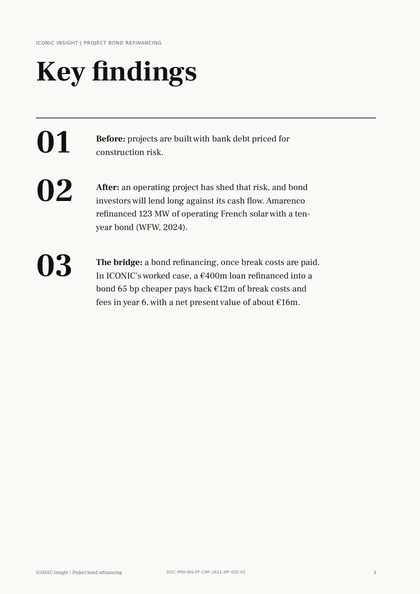
The project now has a record of output and cash flow.
Because banks lend through construction and can monitor it. Draws follow progress, waivers can be agreed, and the lenders’ technical adviser sees the site. Bond investors want a fixed amount on a fixed date. Sorge and Gadanecz (2008) show that the term structure of project finance spreads differs from that of corporate debt, reflecting how project risk changes over a project’s life. Dailami and Hauswald (2007) show how contracts reach bond spreads.
What changes once the project operates?
Operation removes the risk the bank was paid to carry. The project now has a record of output and cash flow. Refinancings follow:
- WFW advised on a refinancing of seven wastewater treatment plants under a PPP concession in Aragón (WFW, 2023);
- it also advised on Amarenco’s €29m ten-year bond for operating solar assets (WFW, 2024).
Where the bank loan carries an export credit agency guarantee, the agency’s consent is usually needed for transfers and changes (Norton Rose Fulbright, 2026).
Topics to consider at this stage
- How long has the project operated, and how close has output been to forecast?
- What does the loan cost to repay early: swap breakage, prepayment fees, ECA consent?
Operation removes the risk the bank was paid to carry.
Key number
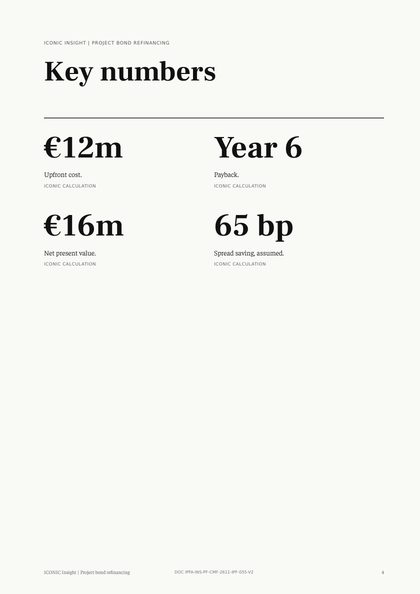
Year 6

Inside the paper
Once construction risk has gone, a bond can replace the bank loan
DOC IPFA-INS-PF-CMF-2611-IPF-055-V2
Fill out the form to read the full paper.
Download the PDFPDF edition
Download the full Insight
Register below. We will ask you to confirm your e-mail address and then send you a personal download link.
Chapter 2
Framework: when does a bond beat the loan, after costs?
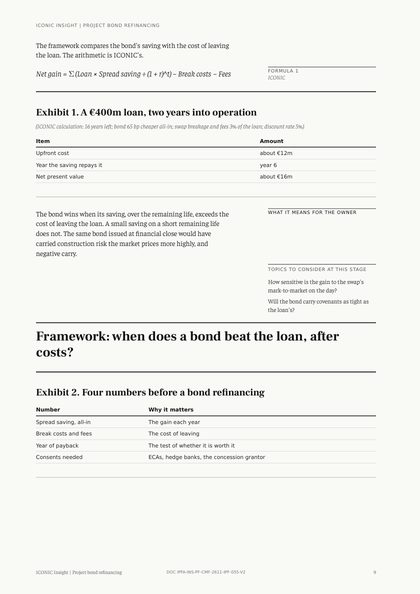
The framework compares the bond’s saving with the cost of leaving the loan.
The framework compares the bond’s saving with the cost of leaving the loan. The arithmetic is ICONIC’s.
Formula 1 (ICONIC): Net gain = Σ (Loan × Spread saving ÷ (1 + r)^t) − Break costs − Fees
| Item | Amount |
|---|---|
| Upfront cost | about €12m |
| Year the saving repays it | year 6 |
| Net present value | about €16m |
What it means for the owner. The bond wins when its saving, over the remaining life, exceeds the cost of leaving the loan. A small saving on a short remaining life does not. The same bond issued at financial close would have carried construction risk the market prices more highly, and negative carry.
Topics to consider at this stage
- How sensitive is the gain to the swap’s mark-to-market on the day?
- Will the bond carry covenants as tight as the loan’s?
| Number | Why it matters |
|---|---|
| Spread saving, all-in | The gain each year |
| Break costs and fees | The cost of leaving |
| Year of payback | The test of whether it is worth it |
| Consents needed | ECAs, hedge banks, the concession grantor |
The bond wins when its saving, over the remaining life, exceeds the cost of leaving the loan.
Key number
€12m
Chapter 3
What’s the bottom line?
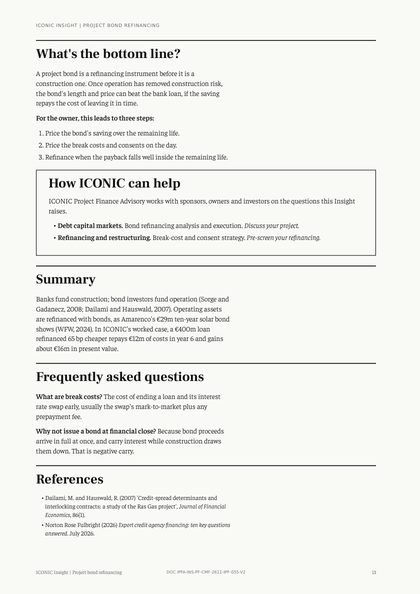
Once operation has removed construction risk, the bond’s length and price can beat the bank loan, if the saving repays the cost of leaving it in time.
A project bond is a refinancing instrument before it is a construction one. Once operation has removed construction risk, the bond’s length and price can beat the bank loan, if the saving repays the cost of leaving it in time.
For the owner, this leads to three steps:
- Price the bond’s saving over the remaining life.
- Price the break costs and consents on the day.
- Refinance when the payback falls well inside the remaining life.
A project bond is a refinancing instrument before it is a construction one.
Key number
€16m
How ICONIC can help
ICONIC Project Finance Advisory works with sponsors, owners and investors on the questions this Insight raises.
- Debt capital markets. Bond refinancing analysis and execution. Discuss your project.
- Refinancing and restructuring. Break-cost and consent strategy. Pre-screen your refinancing.
Summary
Banks fund construction; bond investors fund operation (Sorge and Gadanecz, 2008; Dailami and Hauswald, 2007). Operating assets are refinanced with bonds, as Amarenco’s €29m ten-year solar bond shows (WFW, 2024). In ICONIC’s worked case, a €400m loan refinanced 65 bp cheaper repays €12m of costs in year 6 and gains about €16m in present value.
Frequently asked questions
What are break costs?
The cost of ending a loan and its interest rate swap early, usually the swap’s mark-to-market plus any prepayment fee.
Why not issue a bond at financial close?
Because bond proceeds arrive in full at once, and carry interest while construction draws them down. That is negative carry.
References
- Dailami, M. and Hauswald, R. (2007) ‘Credit-spread determinants and interlocking contracts: a study of the Ras Gas project’, Journal of Financial Economics, 86(1).
- Norton Rose Fulbright (2026) Export credit agency financing: ten key questions answered. July 2026.
- Sorge, M. and Gadanecz, B. (2008) ‘The term structure of credit spreads in project finance’, International Journal of Finance and Economics, 13(1), pp. 68–81.
- WFW (2023) WFW advises Abanca on wastewater treatment infrastructure project refinancing.
- WFW (2024) WFW advises Amarenco on a 123 MW solar portfolio bond refinancing.
This Insight is for general information only and does not constitute investment, legal or tax advice.