Chapter 1
Why is a capture plant only one link of a chain?
The capture plant has nowhere to put its CO2.
A tonne of CO2 is only captured when it is stored. The capture plant needs a pipeline or a ship to move the CO2, and a store to inject it. Clarksons notes several constraints:
- CCS value chains have taken six to eight years to reach operation;
- LCO2 carriers take two to three years to build, and few owners will order one without a long-term contract;
- CO2 “is a commodity with virtually negative value”, so subsidies remain essential (Clarksons, 2025).
In the UK, the government has committed £21.7bn over 25 years to the HyNet and East Coast clusters (Norton Rose Fulbright, 2025). McKinsey counts CCS among the technologies “taking longer to mature” (McKinsey, 2025).
What happens if the store fails?
The capture plant has nowhere to put its CO2. If its revenue depends on storage, as it does under a contract for difference paid per tonne stored, it earns nothing. Lane, Greig and Garnett (2021) argue that uncertain storage prospects are a central problem for CCS ambitions. The emitter cannot finance a risk it does not control.
Topics to consider at this stage
- Who owns the transport and the store, and what do they promise?
- Is revenue paid per tonne captured or per tonne stored?
A tonne of CO2 is only captured when it is stored.
Key number
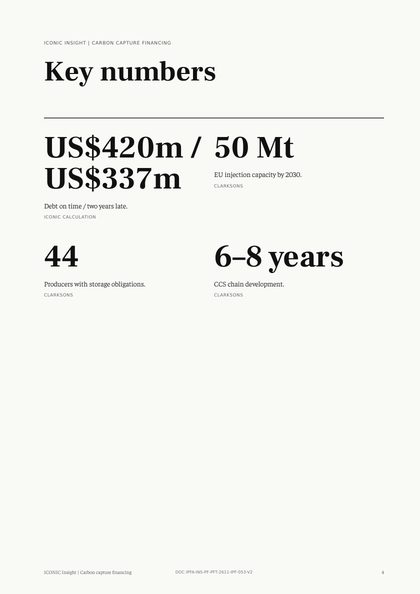
50 Mt
Inside the paper
Who carries the storage risk in a carbon capture project?
DOC IPFA-INS-PF-PFT-2611-IPF-053-V2
Fill out the form to read the full paper.
Download the PDFPDF edition
Download the full Insight
Register below. We will ask you to confirm your e-mail address and then send you a personal download link.
Chapter 2
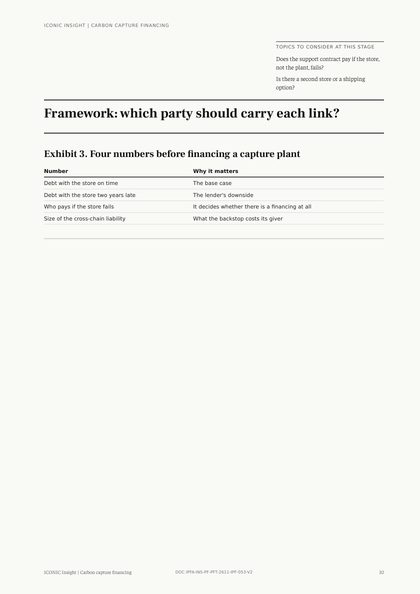
Framework: which party should carry each link?
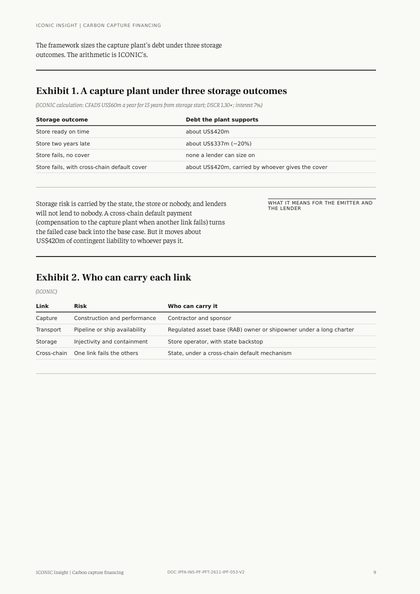
The framework sizes the capture plant’s debt under three storage outcomes.
The framework sizes the capture plant’s debt under three storage outcomes. The arithmetic is ICONIC’s.
| Storage outcome | Debt the plant supports |
|---|---|
| Store ready on time | about US$420m |
| Store two years late | about US$337m (−20%) |
| Store fails, no cover | none a lender can size on |
| Store fails, with cross-chain default cover | about US$420m, carried by whoever gives the cover |
What it means for the emitter and the lender. Storage risk is carried by the state, the store or nobody, and lenders will not lend to nobody. A cross-chain default payment (compensation to the capture plant when another link fails) turns the failed case back into the base case. But it moves about US$420m of contingent liability to whoever pays it.
| Link | Risk | Who can carry it |
|---|---|---|
| Capture | Construction and performance | Contractor and sponsor |
| Transport | Pipeline or ship availability | Regulated asset base (RAB) owner or shipowner under a long charter |
| Storage | Injectivity and containment | Store operator, with state backstop |
| Cross-chain | One link fails the others | State, under a cross-chain default mechanism |
Topics to consider at this stage
- Does the support contract pay if the store, not the plant, fails?
- Is there a second store or a shipping option?
| Number | Why it matters |
|---|---|
| Debt with the store on time | The base case |
| Debt with the store two years late | The lender’s downside |
| Who pays if the store fails | It decides whether there is a financing at all |
| Size of the cross-chain liability | What the backstop costs its giver |
Storage risk is carried by the state, the store or nobody, and lenders will not lend to nobody.
Key number
US$420m / US$337m
Chapter 3
What’s the bottom line?
A capture project is bankable when its contracts say who pays if another link fails, and that party can pay.
Storage risk is carried by the state, the store or nobody, and lenders will not lend to nobody. A capture project is bankable when its contracts say who pays if another link fails, and that party can pay.
For the emitter, this leads to three steps:
- Map each link of the chain and who owns it.
- Size the debt with the store two years late, as a lender will.
- Secure a cross-chain default mechanism, or a second route to storage, before seeking debt.
A capture project is bankable when its contracts say who pays if another link fails, and that party can pay.
Key number
44
How ICONIC can help
ICONIC Project Finance Advisory works with sponsors, owners and investors on the questions this Insight raises.
- Energy transition. Chain risk allocation and debt sizing for CCS. Discuss your project.
- Public sector. Support and backstop design. Pre-screen your structure.
Summary
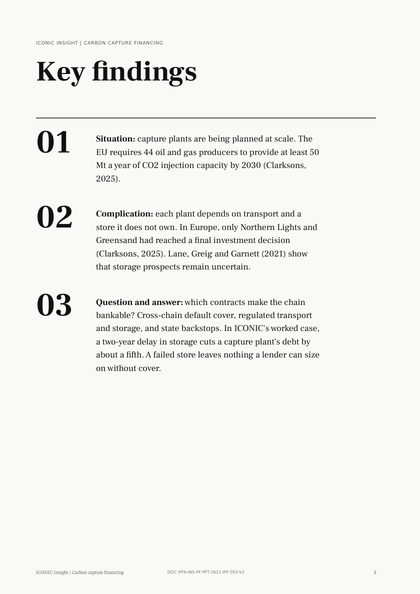
The EU requires at least 50 Mt a year of CO2 injection capacity by 2030, but only two European stores had reached FID (Clarksons, 2025). Chains take six to eight years (Clarksons, 2025), the UK has committed £21.7bn to two clusters (Norton Rose Fulbright, 2025), and storage remains uncertain (Lane, Greig and Garnett, 2021). In ICONIC’s worked case, a two-year storage delay cuts a capture plant’s debt by about a fifth, and a failed store leaves nothing to lend against without cross-chain cover.
Frequently asked questions
What is cross-chain default?
A failure of one link of a CCS chain, such as the store, that stops the others from operating. Some support schemes compensate the links that did not fail.
Why are ships used for CO2?
Because shipping offers “shorter lead times than pipelines, greater flexibility and scalability” for emitters far from a store (Clarksons, 2025).
References
- Clarksons (2025) No time to waste: Clarksons calls for immediate action on LCO2 shipping post-NZIA. June 2025.
- Lane, J., Greig, C. and Garnett, A. (2021) ‘Uncertain storage prospects create a conundrum for carbon capture and storage ambitions’, Nature Climate Change, 11.
- McKinsey & Company (2025) Global Energy Perspective 2025.
- Norton Rose Fulbright (2025) UK Hydrogen Guide 2025. March 2025.
This Insight is for general information only and does not constitute investment, legal or tax advice.