Chapter 1
What makes a data centre different from other property?
For a hyperscale tenant, the lease sets the cash flow, its term and its credit.
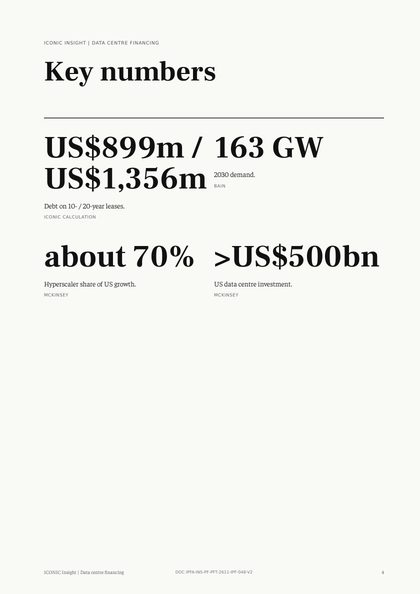
Its scale, its power and its tenants. Bain forecasts global data centre demand of 163 GW by 2030, twice today’s (Bain, 2025). McKinsey expects about 70% of US growth to 2030 to be met by hyperscalers, directly or through built-to-suit colocation. It estimates that the US capacity needed would require more than US$500bn of investment in data centre infrastructure alone (McKinsey, 2024).
The real estate still matters, but as a condition rather than the collateral that sizes the loan. Wikborg Rein notes that lenders often require a mortgage before a site’s subdivision is complete. Option agreements give developers site control, which grid operators now test before granting capacity (Wikborg Rein, 2026).
What does a lender read first?
The lease. For a hyperscale tenant, the lease sets the cash flow, its term and its credit. Rent usually starts when the hall is ready and powered, so the gap between construction and the rent start is also the lender’s risk. Even tax follows the lease: in Norway, a landlord can recover VAT on construction only once leases with VAT-liable tenants are signed (Wikborg Rein, 2026).
Topics to consider at this stage
- How long is the lease, and how strong is the tenant?
- When does rent start: at handover, at energisation, or at a fixed date?
The real estate still matters, but as a condition rather than the collateral that sizes the loan.
Key number
163 GW
Inside the paper
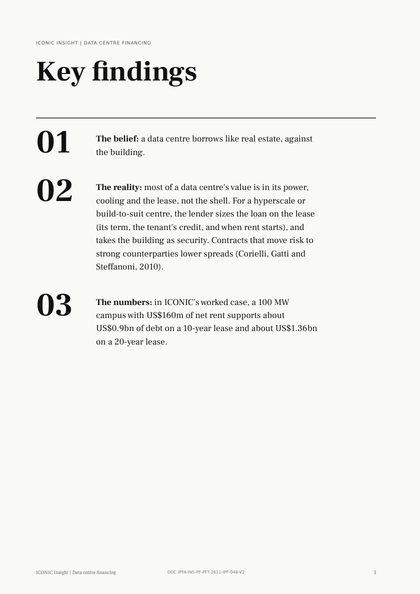
The tenant lease, not the building, decides how much a data centre can borrow
DOC IPFA-INS-PF-PFT-2611-IPF-048-V2
Fill out the form to read the full paper.
Download the PDFPDF edition
Download the full Insight
Register below. We will ask you to confirm your e-mail address and then send you a personal download link.
Chapter 2
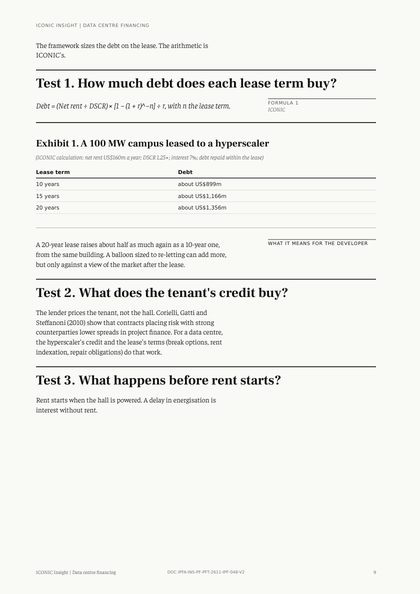
Test 1. How much debt does each lease term buy?
A 20-year lease raises about half as much again as a 10-year one, from the same building.
The framework sizes the debt on the lease. The arithmetic is ICONIC’s.
Formula 1 (ICONIC): Debt = (Net rent ÷ DSCR) × [1 − (1 + r)^−n] ÷ r, with n the lease term.
| Lease term | Debt |
|---|---|
| 10 years | about US$899m |
| 15 years | about US$1,166m |
| 20 years | about US$1,356m |
What it means for the developer. A 20-year lease raises about half as much again as a 10-year one, from the same building. A balloon sized to re-letting can add more, but only against a view of the market after the lease.
Key number
US$899m / US$1,356m
Chapter 3
Test 2. What does the tenant’s credit buy?
Corielli, Gatti and Steffanoni (2010) show that contracts placing risk with strong counterparties lower spreads in project finance.
The lender prices the tenant, not the hall. Corielli, Gatti and Steffanoni (2010) show that contracts placing risk with strong counterparties lower spreads in project finance. For a data centre, the hyperscaler’s credit and the lease’s terms (break options, rent indexation, repair obligations) do that work.
The lender prices the tenant, not the hall.
Key number
about 70%
Chapter 4
Test 3. What happens before rent starts?
Rent starts when the hall is powered.
Rent starts when the hall is powered. A delay in energisation is interest without rent.
Topics to consider at this stage
- Does the lease have break options before the debt is repaid?
- Who pays if energisation is late?
Chapter 5
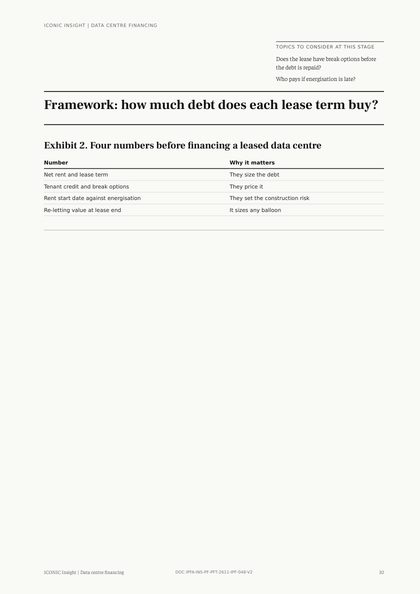
Framework: how much debt does each lease term buy?
The framework sizes the debt on the lease.
| Number | Why it matters |
|---|---|
| Net rent and lease term | They size the debt |
| Tenant credit and break options | They price it |
| Rent start date against energisation | They set the construction risk |
| Re-letting value at lease end | It sizes any balloon |
Chapter 6
What’s the bottom line?
The building and the land must be right for the lender to take security, but it is the lease that sizes the loan.
A data centre borrows against its tenant’s promise to pay. The building and the land must be right for the lender to take security, but it is the lease that sizes the loan. A developer who negotiates the lease with the debt in mind raises more from the same building.
For the developer, this leads to three steps:
- Negotiate lease term and break options with the debt in view.
- Align the rent start with energisation, or agree who pays for the gap.
- Size any balloon on a re-letting case, not the current rent.
A data centre borrows against its tenant’s promise to pay.
How ICONIC can help
ICONIC Project Finance Advisory works with sponsors, owners and investors on the questions this Insight raises.
- Data centre programmes. Lease-based debt sizing and lender approach. Discuss your campus.
- Project finance transactions. Contract and credit structuring. Pre-screen your financing.
Summary
Data centre demand is set to double by 2030 (Bain, 2025), with hyperscalers taking most of the growth (McKinsey, 2024). Site control and grid capacity condition the loan (Wikborg Rein, 2026), but contracts and counterparty credit price it (Corielli, Gatti and Steffanoni, 2010). In ICONIC’s worked case, a 100 MW campus supports about US$0.9bn of debt on a 10-year lease and about US$1.36bn on a 20-year lease.
Frequently asked questions
What is a hyperscaler?
A large cloud provider that leases or builds data centres at scale for its own services.
Does this apply to colocation?
Only to the part that is let. Capacity not yet let behaves like merchant revenue.
References
- Bain & Company (2025) Next phase of data center growth to be more disciplined but risks of power constraints and construction delays remain. Press release, 22 October 2025.
- Corielli, F., Gatti, S. and Steffanoni, A. (2010) ‘Risk shifting through nonfinancial contracts: effects on loan spreads and capital structure of project finance deals’, Journal of Money, Credit and Banking, 42(7), pp. 1295–1320.
- McKinsey & Company (2024) How data centers and the energy sector can sate AI’s hunger for power. September 2024.
- Wikborg Rein (2026) Real estate structuring in data centre projects; Option agreements in data centre development; Construction of data centre and VAT.
This Insight is for general information only and does not constitute investment, legal or tax advice.