Chapter 1
How often do financial models contain errors?
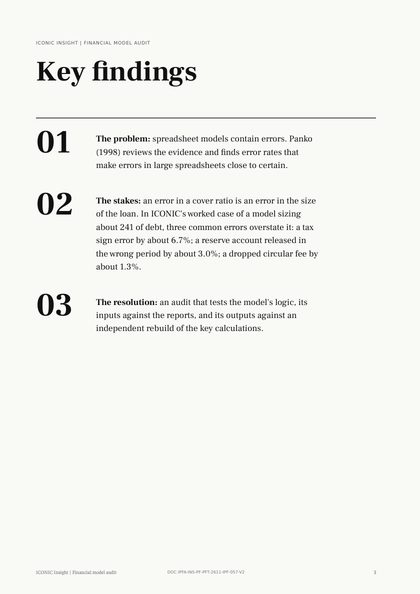
The ones that touch cash flow available for debt service (CFADS) or debt service.
Often enough that lenders assume they do. Panko (1998) surveys field audits and experiments on spreadsheets. He finds that a small error rate per cell becomes a high probability of error across a large model. Every model that has not been tested has errors nobody has found.
Which errors move the loan?
The ones that touch cash flow available for debt service (CFADS) or debt service. A project finance model sizes debt from the cover ratio. Anything that overstates CFADS, or understates the debt service it must meet, overstates the loan:
- tax: a sign or timing error;
- reserves: a debt service reserve account (DSRA) counted as cash in the wrong period;
- fees: commitment or agency fees dropped to break a circular reference;
- indexation: applied to revenue but not to costs.
Topics to consider at this stage
- Has the model been built to a standard, with inputs, calculations and outputs separated?
- Which outputs does the term sheet rely on?
Every model that has not been tested has errors nobody has found.
Key number
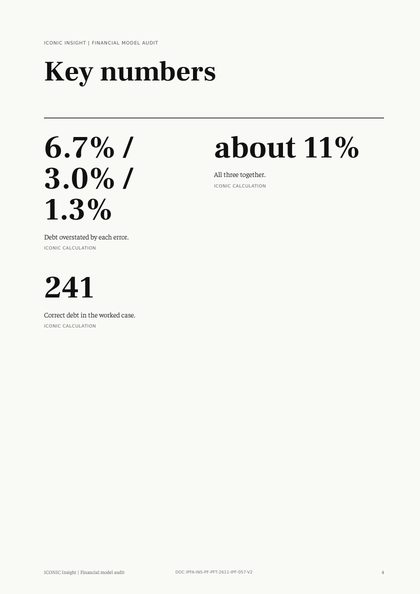
about 11%
Inside the paper
A lender relies on the model only after someone has tried to break it
DOC IPFA-INS-PF-PFT-2611-IPF-057-V2
Fill out the form to read the full paper.
Download the PDFPDF edition
Download the full Insight
Register below. We will ask you to confirm your e-mail address and then send you a personal download link.
Chapter 2
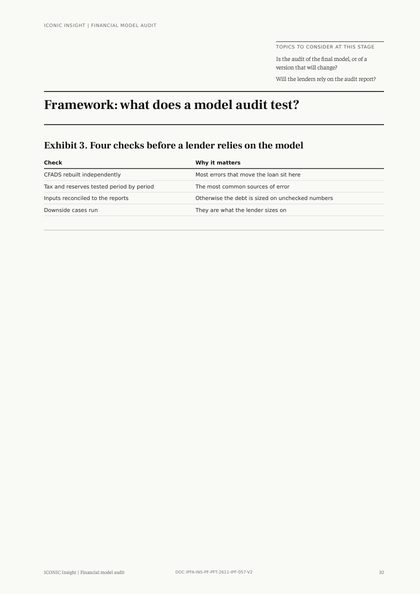
Framework: what does a model audit test?
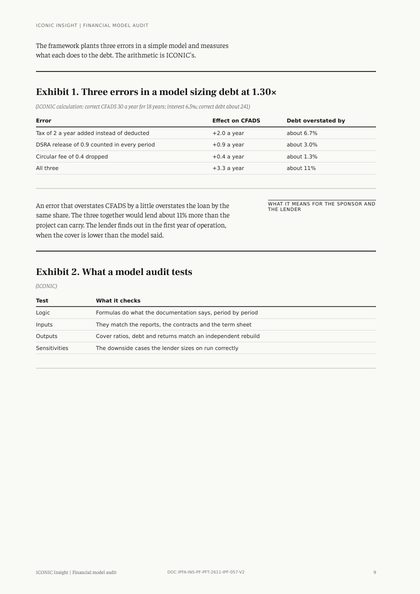
The framework plants three errors in a simple model and measures what each does to the debt.
The framework plants three errors in a simple model and measures what each does to the debt. The arithmetic is ICONIC’s.
| Error | Effect on CFADS | Debt overstated by |
|---|---|---|
| Tax of 2 a year added instead of deducted | +2.0 a year | about 6.7% |
| DSRA release of 0.9 counted in every period | +0.9 a year | about 3.0% |
| Circular fee of 0.4 dropped | +0.4 a year | about 1.3% |
| All three | +3.3 a year | about 11% |
What it means for the sponsor and the lender. An error that overstates CFADS by a little overstates the loan by the same share. The three together would lend about 11% more than the project can carry. The lender finds out in the first year of operation, when the cover is lower than the model said.
| Test | What it checks |
|---|---|
| Logic | Formulas do what the documentation says, period by period |
| Inputs | They match the reports, the contracts and the term sheet |
| Outputs | Cover ratios, debt and returns match an independent rebuild |
| Sensitivities | The downside cases the lender sizes on run correctly |
Topics to consider at this stage
- Is the audit of the final model, or of a version that will change?
- Will the lenders rely on the audit report?
| Check | Why it matters |
|---|---|
| CFADS rebuilt independently | Most errors that move the loan sit here |
| Tax and reserves tested period by period | The most common sources of error |
| Inputs reconciled to the reports | Otherwise the debt is sized on unchecked numbers |
| Downside cases run | They are what the lender sizes on |
An error that overstates CFADS by a little overstates the loan by the same share.
Key number
6.7% / 3.0% / 1.3%
Chapter 3
What’s the bottom line?
For a sponsor, an audit before the lenders see the model is cheaper than an error found after they do.
A lender relies on a model that someone else has tried to break. For a sponsor, an audit before the lenders see the model is cheaper than an error found after they do.
For the sponsor, this leads to three steps:
- Audit the model before it goes to lenders, not only after.
- Rebuild CFADS and the cover ratio independently.
- Reconcile every input to a report, a contract or the term sheet.
A lender relies on a model that someone else has tried to break.
Key number
241
How ICONIC can help
ICONIC Project Finance Advisory works with sponsors, owners and investors on the questions this Insight raises.
- Model audit. Independent testing of project finance models. Pre-screen your model.
- Project finance transactions. Debt sizing and lender approach. Discuss your financing.
Summary
Spreadsheet errors are common (Panko, 1998), and in a project finance model an error in CFADS is an error in the loan. In ICONIC’s worked case, a tax sign error, a mistimed reserve release and a dropped fee together overstate debt by about 11%. An audit tests logic, inputs, outputs and downside cases before a lender relies on them.
Frequently asked questions
What is CFADS?
Cash flow available for debt service: the cash a project has left, after operating costs and tax, to pay its lenders.
Is a model audit the same as due diligence?
It is one part of it: the report that checks the numbers the other reports feed into.
References
- Panko, R.R. (1998) ‘What we know about spreadsheet errors’, Journal of End User Computing, 10(2).
This Insight is for general information only and does not constitute investment, legal or tax advice.