Chapter 1
What does an FLNG unit earn, and from whom?
An LNG carrier can trade with many charterers.
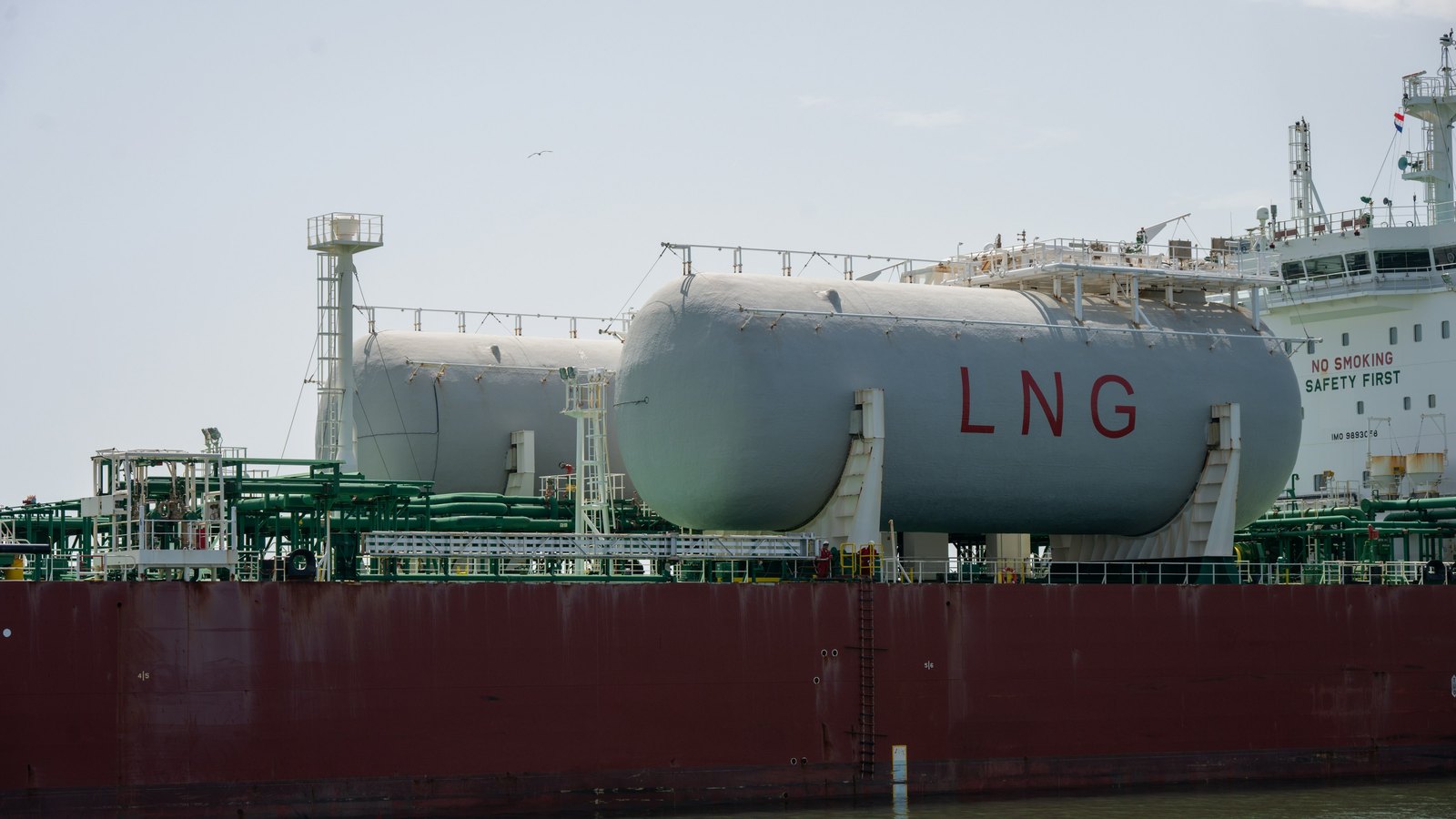
A floating LNG unit is a liquefaction plant on a hull, moored at a gas field. It earns a charter or tolling fee from the gas owner, who sells the LNG. McKinsey’s review of 2021 LNG flows notes Coral South FLNG among the new capacity entering the market in 2022 (McKinsey, 2022). Deloitte lists Delfin FLNG among US export projects (Deloitte, 2025).
Lenders price the charterer’s credit and the term. In LNG, Dailami and Hauswald (2007) show that the credit of the offtaker and the terms of the contract are priced into project bond spreads.
Why does the end of the charter matter more than for a carrier?
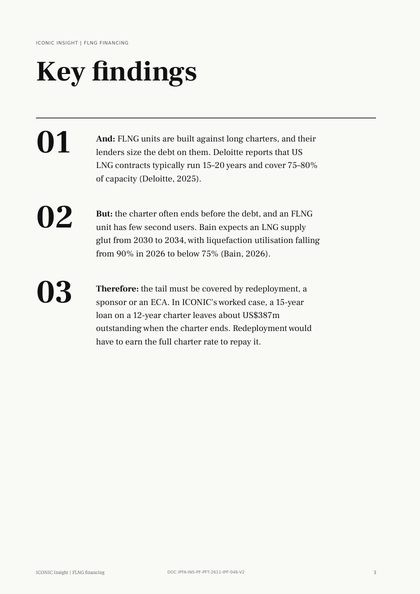
Because an FLNG unit is a liquefaction plant without a site of its own. An LNG carrier can trade with many charterers. An FLNG unit needs a new gas field, and the topsides may need changes to suit it. Market conditions at the end of the charter matter too. Bain expects LNG trading profits “could turn negative” in the 2030–2034 glut. If sanctioned capacity arrives on time, about one in six US cargoes could go unlifted (Bain, 2026). Deloitte reports global liquefaction capacity of about 485 mtpa growing by 230 mtpa, more than 45%, by 2030 (Deloitte, 2025).
Topics to consider at this stage
- Who is the charterer, and what is its credit?
- Where could the unit work after the charter, and at what cost?
Because an FLNG unit is a liquefaction plant without a site of its own.
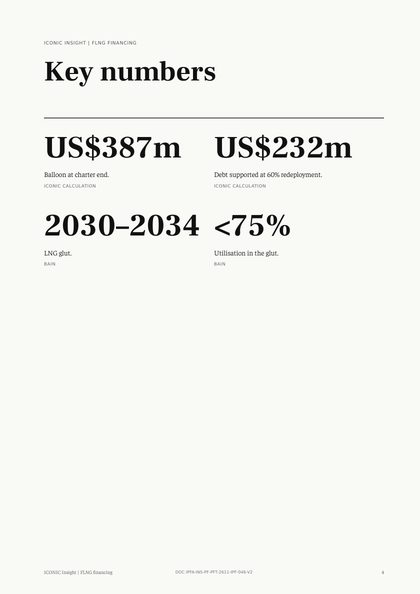
Key number
2030–2034
Inside the paper
A floating LNG unit borrows against a charter shorter than its loan
DOC IPFA-INS-PF-PFT-2611-IPF-046-V2
Fill out the form to read the full paper.
Download the PDFPDF edition
Download the full Insight
Register below. We will ask you to confirm your e-mail address and then send you a personal download link.
Chapter 2
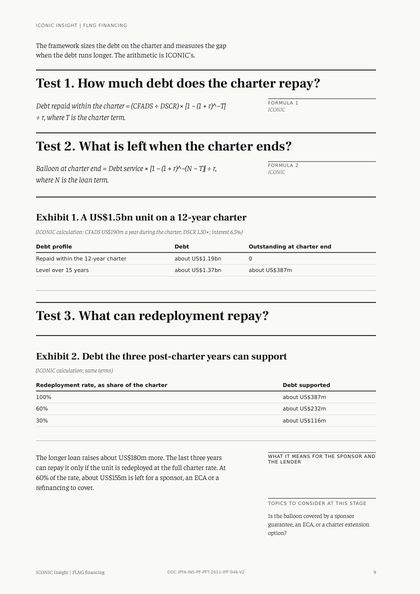
Test 1. How much debt does the charter repay?
The framework sizes the debt on the charter and measures the gap when the debt runs longer.
The framework sizes the debt on the charter and measures the gap when the debt runs longer. The arithmetic is ICONIC’s.
Formula 1 (ICONIC): Debt repaid within the charter = (CFADS ÷ DSCR) × [1 − (1 + r)^−T] ÷ r, where T is the charter term.
Chapter 3
Test 2. What is left when the charter ends?
The framework sizes the debt on the charter and measures the gap when the debt runs longer.
Formula 2 (ICONIC): Balloon at charter end = Debt service × [1 − (1 + r)^−(N − T)] ÷ r, where N is the loan term.
| Debt profile | Debt | Outstanding at charter end |
|---|---|---|
| Repaid within the 12-year charter | about US$1.19bn | 0 |
| Level over 15 years | about US$1.37bn | about US$387m |
Key number
US$387m
Chapter 4
Test 3. What can redeployment repay?
The longer loan raises about US$180m more.
| Redeployment rate, as share of the charter | Debt supported |
|---|---|
| 100% | about US$387m |
| 60% | about US$232m |
| 30% | about US$116m |
What it means for the sponsor and the lender. The longer loan raises about US$180m more. The last three years can repay it only if the unit is redeployed at the full charter rate. At 60% of the rate, about US$155m is left for a sponsor, an ECA or a refinancing to cover.
Topics to consider at this stage
- Is the balloon covered by a sponsor guarantee, an ECA, or a charter extension option?
- What does the unit’s scrap or redeployment value assume about the market in the 2030s?
The last three years can repay it only if the unit is redeployed at the full charter rate.
Key number
US$232m
Chapter 5
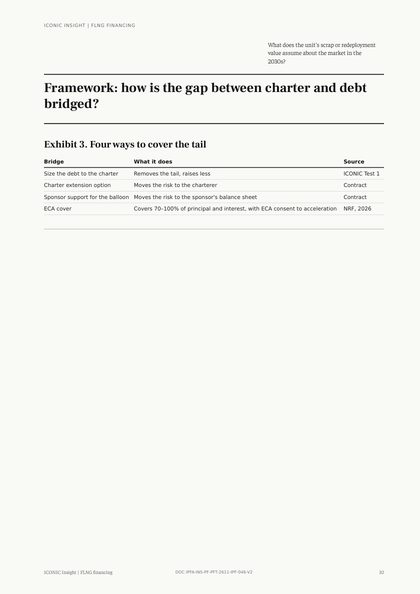
Framework: how is the gap between charter and debt bridged?
The framework sizes the debt on the charter and measures the gap when the debt runs longer.
| Bridge | What it does | Source |
|---|---|---|
| Size the debt to the charter | Removes the tail, raises less | ICONIC Test 1 |
| Charter extension option | Moves the risk to the charterer | Contract |
| Sponsor support for the balloon | Moves the risk to the sponsor’s balance sheet | Contract |
| ECA cover | Covers 70–100% of principal and interest, with ECA consent to acceleration | NRF, 2026 |
Chapter 6
What’s the bottom line?
The extra debt a longer loan raises is real only if someone carries the years after the charter.
FLNG financing is sized on the charter and secured on what happens after it. The extra debt a longer loan raises is real only if someone carries the years after the charter. In a market Bain expects to be oversupplied in the early 2030s, the lender will want to know who.
For the sponsor, this leads to three steps:
- Size the debt the charter alone can repay.
- Price the balloon on a redeployment rate, not the charter rate.
- Decide who carries the tail before talking to lenders.
FLNG financing is sized on the charter and secured on what happens after it.
How ICONIC can help
ICONIC Project Finance Advisory works with sponsors, owners and investors on the questions this Insight raises.
- Energy (LNG). Charter-based debt sizing and tail analysis for floating units. Discuss your project.
- Project finance transactions. Lender and ECA approach. Pre-screen your financing.
Summary
LNG contracts run 15–20 years (Deloitte, 2025), and Bain expects a glut from 2030 to 2034 with utilisation below 75% (Bain, 2026). Lenders price contracts and offtaker credit (Dailami and Hauswald, 2007). In ICONIC’s worked case, a 15-year loan on a 12-year charter leaves about US$387m at the charter’s end. Redeployment at 60% of the rate repays only about US$232m of it.
Frequently asked questions
What is FLNG?
Floating liquefied natural gas: a vessel or barge that liquefies gas offshore, at or near the field.
Why not repay the debt within the charter?
That is the safest structure, but it raises less debt. Sponsors accept a tail to raise more, and must then show who carries it.
References
- Bain & Company (2026) LNG trading profits could turn negative in next supply glut. Press release, 19 November 2026.
- Dailami, M. and Hauswald, R. (2007) ‘Credit-spread determinants and interlocking contracts: a study of the Ras Gas project’, Journal of Financial Economics, 86(1).
- Deloitte (2025) US natural gas and LNG market analysis. Deloitte Research Center for Energy & Industrials, October 2025.
- McKinsey & Company (2022) Reflecting on 2021 global LNG and European pipeline flows.
- Norton Rose Fulbright (2026) Export credit agency financing: ten key questions answered. July 2026.
This Insight is for general information only and does not constitute investment, legal or tax advice. Figures from public sources are as reported at the dates shown.