Chapter 1
What does a hotel lender lend against?
Several parties are paid out of that income before the lender:
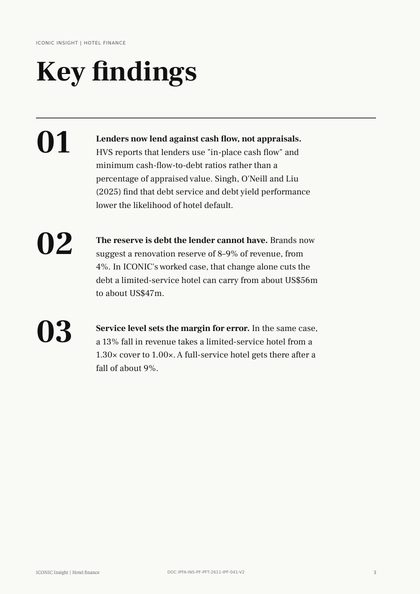
A hotel lender lends against the cash a hotel produces, and the building is its security. That has always been true in principle. In practice, hotel loans were long sized as a share of appraised value. HVS reports that this has changed: lenders now use “in-place cash flow” as their basis, and “the once-standard practice of obtaining debt based on a percentage of appraisal has changed to a basis of simple cash flow to debt-ratio minimum thresholds” (HVS, 2024).
The cost of that debt has also risen. In late 2022, HVS put hotel mortgage rates at 6–8%. In its case study, a hotel could borrow at a 60% loan-to-value on current terms, against 70% at the terms it called normal (HVS, 2022).
Why is a hotel’s income riskier than an office’s rent?
An office is let for years; a hotel re-lets every room every night. Its income moves with occupancy and room rates. Several parties are paid out of that income before the lender:
- the brand, through franchise or licence fees;
- the operator, through a management fee;
- the building itself, through a reserve for furniture, fixtures and renovation.
Those claims have grown. HVS reports that property improvement plan costs, required by brands at mid-cycle or on a change of owner, are 25–45% above pre-pandemic levels. Brands have suggested that the renovation reserve, long 4% of revenue, should now be “closer to 8–9%” over a ten-year cycle (HVS, 2024).
The evidence on default points the same way. In a study of US hotel loans, Singh, O’Neill and Liu (2025) find that debt service and debt yield performance are “significantly and negatively associated with the likelihood of default”. The same study finds lower default rates for:
- economy and midscale hotels;
- smaller hotels;
- newer hotels;
- hotels that belong to portfolios.
Topics to consider at this stage
- Who is paid before the lender, and on what basis: revenue, profit or a fixed amount?
- What renovation does the brand require, and when?
An office is let for years; a hotel re-lets every room every night.
Key number
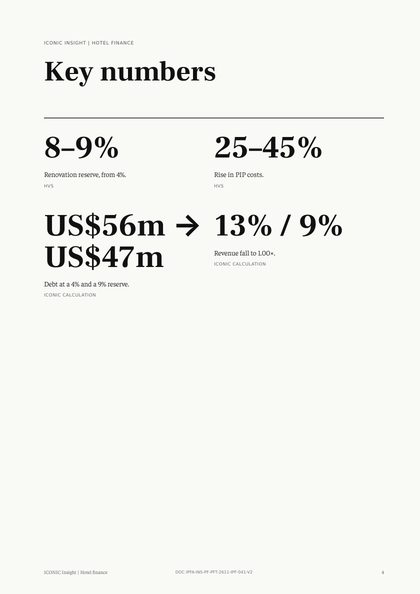
8–9%
Inside the paper
How much debt can a hotel’s cash flow carry?
DOC IPFA-INS-PF-PFT-2611-IPF-041-V2
Fill out the form to read the full paper.
Download the PDFPDF edition
Download the full Insight
Register below. We will ask you to confirm your e-mail address and then send you a personal download link.
Chapter 2
Test 1. What cash is left for the lender?
A renovation reserve that doubles from 4% to 8–9% of revenue takes four to five points off the margin.
The framework answers the title question in three steps:
- what cash is left for the lender;
- how much debt that cash supports;
- how far revenue can fall before the cover breaks.
The evidence is HVS’s market reporting and Singh, O’Neill and Liu (2025). The arithmetic is ICONIC’s.
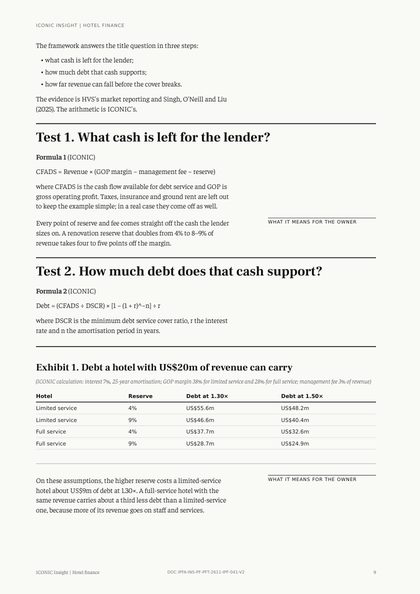
Formula 1 (ICONIC)
CFADS = Revenue × (GOP margin − management fee − reserve)
where CFADS is the cash flow available for debt service and GOP is gross operating profit. Taxes, insurance and ground rent are left out to keep the example simple; in a real case they come off as well.
What it means for the owner. Every point of reserve and fee comes straight off the cash the lender sizes on. A renovation reserve that doubles from 4% to 8–9% of revenue takes four to five points off the margin.
Every point of reserve and fee comes straight off the cash the lender sizes on.
Key number
25–45%
Chapter 3
Test 2. How much debt does that cash support?
On these assumptions, the higher reserve costs a limited-service hotel about US$9m of debt at 1.30×.
Formula 2 (ICONIC)
Debt = (CFADS ÷ DSCR) × [1 − (1 + r)^−n] ÷ r
where DSCR is the minimum debt service cover ratio, r the interest rate and n the amortisation period in years.
| Hotel | Reserve | Debt at 1.30× | Debt at 1.50× |
|---|---|---|---|
| Limited service | 4% | US$55.6m | US$48.2m |
| Limited service | 9% | US$46.6m | US$40.4m |
| Full service | 4% | US$37.7m | US$32.6m |
| Full service | 9% | US$28.7m | US$24.9m |
What it means for the owner. On these assumptions, the higher reserve costs a limited-service hotel about US$9m of debt at 1.30×. A full-service hotel with the same revenue carries about a third less debt than a limited-service one, because more of its revenue goes on staff and services.
Key number
US$56m → US$47m
Chapter 4
Test 3. How far can revenue fall before the cover breaks?
A cover of 1.30× sounds comfortable.
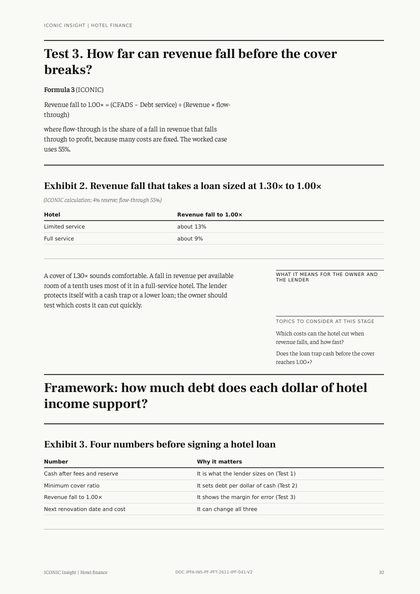
Formula 3 (ICONIC)
Revenue fall to 1.00× = (CFADS − Debt service) ÷ (Revenue × flow-through)
where flow-through is the share of a fall in revenue that falls through to profit, because many costs are fixed. The worked case uses 55%.
| Hotel | Revenue fall to 1.00× |
|---|---|
| Limited service | about 13% |
| Full service | about 9% |
What it means for the owner and the lender. A cover of 1.30× sounds comfortable. A fall in revenue per available room of a tenth uses most of it in a full-service hotel. The lender protects itself with a cash trap or a lower loan; the owner should test which costs it can cut quickly.
Topics to consider at this stage
- Which costs can the hotel cut when revenue falls, and how fast?
- Does the loan trap cash before the cover reaches 1.00×?
Chapter 5
Framework: how much debt does each dollar of hotel income support?
The framework answers the title question in three steps:
| Number | Why it matters |
|---|---|
| Cash after fees and reserve | It is what the lender sizes on (Test 1) |
| Minimum cover ratio | It sets debt per dollar of cash (Test 2) |
| Revenue fall to 1.00× | It shows the margin for error (Test 3) |
| Next renovation date and cost | It can change all three |
Chapter 6
What’s the bottom line?
Lenders have moved from appraisals to that cash, and the claims on it have grown.
A hotel borrows against the income left after the brand, the manager and the next renovation have been paid. Lenders have moved from appraisals to that cash, and the claims on it have grown. The owner who computes the four numbers in Exhibit 3 before talking to lenders knows the loan the hotel can carry, and the fall it can survive.
For the owner, this leads to three steps:
- Compute the cash left after fees and the brand’s reserve, not the gross operating profit.
- Size the debt on the cover ratio lenders will apply, and test it at 1.50× as well as 1.30×.
- Test the revenue fall the loan can take, and agree a cash trap before the cover is reached.
A hotel borrows against the income left after the brand, the manager and the next renovation have been paid.
How ICONIC can help
ICONIC Project Finance Advisory works with owners and buyers on the financing of hotels and other real estate.
- Real estate. Debt sizing on cash flow, with reserves and fees modelled. Discuss your hotel.
- Debt advisory. Lender approach and terms. Pre-screen your financing.
Summary
Hotel lenders now size loans on in-place cash flow rather than appraisal (HVS, 2024). The renovation reserve brands suggest has risen from 4% to 8–9% of revenue, and PIP costs are 25–45% above pre-pandemic levels (HVS, 2024). Singh, O’Neill and Liu (2025) find that debt service and debt yield performance lower the likelihood of default. In ICONIC’s worked case, a limited-service hotel with US$20m of revenue carries about US$56m of debt at a 4% reserve and about US$47m at 9%. A revenue fall of about 13% takes its cover from 1.30× to 1.00×; for a full-service hotel, the fall is about 9%.
Frequently asked questions
What is a debt service cover ratio?
The cash available for debt service divided by the interest and principal due. A ratio of 1.30× means the hotel earns 30% more than it must pay its lenders.
What is a property improvement plan?
The renovation a brand requires, at mid-cycle or when a hotel changes owner, to keep it to the brand’s standard.
Why do limited-service hotels carry more debt?
Because more of their revenue becomes profit. They have fewer staff and services, so a larger share of each dollar is left for the lender.
References
- HVS (2022) Valuing hotels amid rising capital market costs: a case study. HVS.
- HVS (2024) Understanding the current state of the hotel transaction market. HVS.
- Singh, A., O’Neill, J.W. and Liu, P. (2025) ‘The influence of hotel characteristics on debt servicing and default in the U.S. lodging sector’, Cornell Hospitality Quarterly, 66(2), pp. 137–155. doi:10.1177/19389655241267241
This Insight is for general information only and does not constitute investment, legal or tax advice. Figures from public sources are as reported at the dates shown.