Chapter 1
What does a reserve-based loan lend against?
Large upstream projects carry that risk at scale.
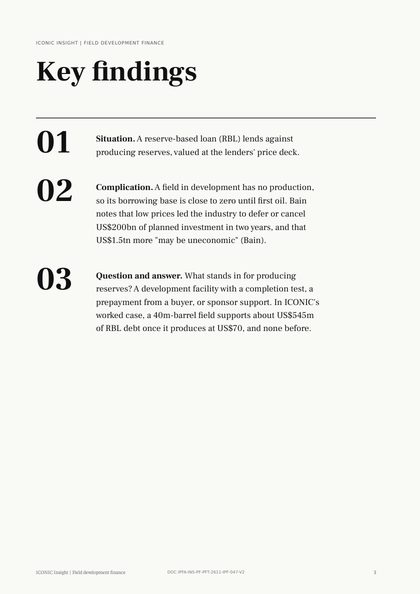
Against barrels that flow. The lenders value proved developed producing (PDP) reserves at their own price deck, discount the cash flow and lend a share of that value: the borrowing base.
Why does a field in development fall outside it?
Because it has no production. Its reserves are proved but undeveloped, and the lender would be taking completion risk on a reservoir and a facility not yet built. Large upstream projects carry that risk at scale. Bain cites an Arctic offshore facility budgeted at more than US$3bn. It notes that 80–90% of costs are incurred in the later phases, while the decisions that set them are made early (Bain). Investment itself responds to uncertainty: Kellogg (2014) shows that Texas oil drilling falls when expected price volatility rises.
Topics to consider at this stage
- How much of the field’s value is in producing reserves at first oil?
- Who carries the risk that first oil is late or production is lower?
Against barrels that flow.
Key number
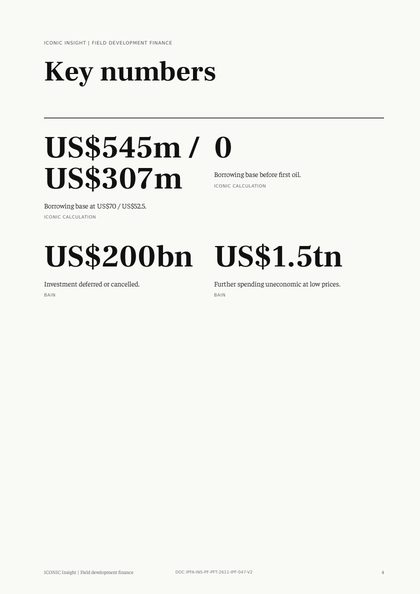
0
Inside the paper
How do lenders fund an oil field before the first barrel flows?
DOC IPFA-INS-PF-PFT-2611-IPF-047-V2
Fill out the form to read the full paper.
Download the PDFPDF edition
Download the full Insight
Register below. We will ask you to confirm your e-mail address and then send you a personal download link.
Chapter 2
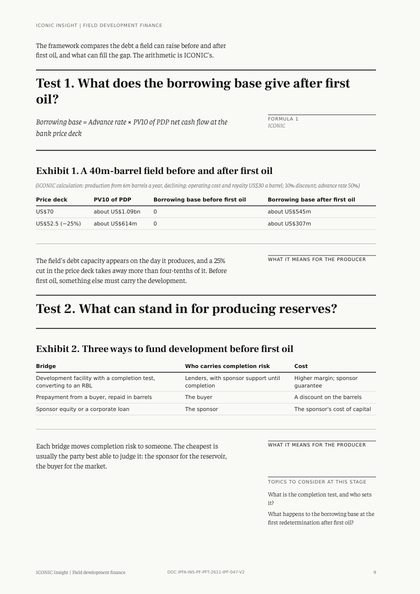
Test 1. What does the borrowing base give after first oil?
The field’s debt capacity appears on the day it produces, and a 25% cut in the price deck takes away more than four-tenths of it.
The framework compares the debt a field can raise before and after first oil, and what can fill the gap. The arithmetic is ICONIC’s.
Formula 1 (ICONIC): Borrowing base = Advance rate × PV10 of PDP net cash flow at the bank price deck
| Price deck | PV10 of PDP | Borrowing base before first oil | Borrowing base after first oil |
|---|---|---|---|
| US$70 | about US$1.09bn | 0 | about US$545m |
| US$52.5 (−25%) | about US$614m | 0 | about US$307m |
What it means for the producer. The field’s debt capacity appears on the day it produces, and a 25% cut in the price deck takes away more than four-tenths of it. Before first oil, something else must carry the development.
Key number
US$545m / US$307m
Chapter 3
Test 2. What can stand in for producing reserves?
The cheapest is usually the party best able to judge it: the sponsor for the reservoir, the buyer for the market.
| Bridge | Who carries completion risk | Cost |
|---|---|---|
| Development facility with a completion test, converting to an RBL | Lenders, with sponsor support until completion | Higher margin; sponsor guarantee |
| Prepayment from a buyer, repaid in barrels | The buyer | A discount on the barrels |
| Sponsor equity or a corporate loan | The sponsor | The sponsor’s cost of capital |
What it means for the producer. Each bridge moves completion risk to someone. The cheapest is usually the party best able to judge it: the sponsor for the reservoir, the buyer for the market.
Topics to consider at this stage
- What is the completion test, and who sets it?
- What happens to the borrowing base at the first redetermination after first oil?
Each bridge moves completion risk to someone.
Key number
US$200bn
Chapter 4
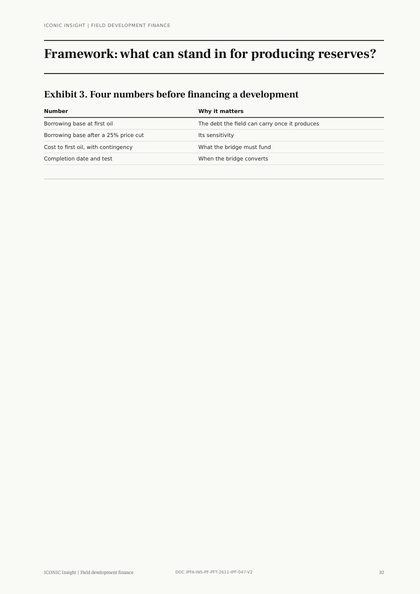
Framework: what can stand in for producing reserves?
The framework compares the debt a field can raise before and after first oil, and what can fill the gap.
| Number | Why it matters |
|---|---|
| Borrowing base at first oil | The debt the field can carry once it produces |
| Borrowing base after a 25% price cut | Its sensitivity |
| Cost to first oil, with contingency | What the bridge must fund |
| Completion date and test | When the bridge converts |
Chapter 5
What’s the bottom line?
The RBL arrives with production; until then, the producer must choose between lender, buyer and sponsor, and pay for the risk each takes.
A field is financed before first oil by whoever carries the completion risk. The RBL arrives with production; until then, the producer must choose between lender, buyer and sponsor, and pay for the risk each takes.
For the producer, this leads to three steps:
- Compute the borrowing base at first oil on the bank price deck, and after a 25% cut.
- Decide who carries completion risk, and price each bridge.
- Agree the completion test and the conversion to an RBL before drawing.
A field is financed before first oil by whoever carries the completion risk.
How ICONIC can help
ICONIC Project Finance Advisory works with sponsors, owners and investors on the questions this Insight raises.
- Energy (upstream). Field development financing, from bridge to RBL. Discuss your field.
- Project finance transactions. Lender approach and completion tests. Pre-screen your financing.
Summary
An RBL lends against producing reserves, and a field in development has none. Upstream projects are large and cost is set early (Bain), and drilling responds to price uncertainty (Kellogg, 2014). In ICONIC’s worked case, a 40m-barrel field supports about US$545m of RBL debt at US$70 once it produces, about US$307m after a 25% price cut, and nothing before first oil.
Frequently asked questions
What is first oil?
The first commercial production from a field.
What is a prepayment?
An advance from a buyer, repaid with future production rather than cash.
References
- Bain & Company (n.d.) Capital productivity for oil and gas in a low-price environment.
- Bain & Company (n.d.) Large project management in oil and gas. Bain Brief.
- Kellogg, R. (2014) ‘The effect of uncertainty on investment: evidence from Texas oil drilling’, American Economic Review, 104(6).
This Insight is for general information only and does not constitute investment, legal or tax advice.