
Chapter 1
Why are so many property loans hard to refinance?
Goldberg and Capone (2002) model default on multifamily mortgages as needing two triggers: the property is worth less than the loan, and its income cannot cover the debt service.
Because rates rose after many loans were written, and values fell with them. HVS reported in 2023 that investors expected more deals “as loans come due and as owners are unable to refinance given the changes in the lending environment” (HVS, 2023). JLL reports that rising benchmark rates are still “resetting price expectations” in 2026 (JLL, 2026). Non-bank lenders have filled part of the gap. HVS notes private equity groups offering “bridge loans, mezzanine debt, construction loans, and PIP loans” as a “lifeline” (HVS, 2023).
What do borrowers and lenders do at maturity?
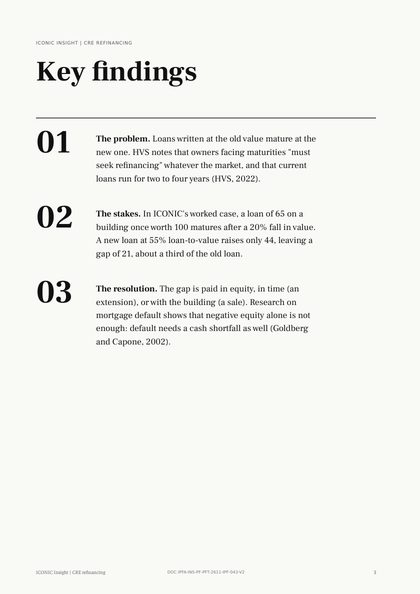
Goldberg and Capone (2002) model default on multifamily mortgages as needing two triggers: the property is worth less than the loan, and its income cannot cover the debt service. A borrower with negative equity but positive cash flow can often extend; one with both problems usually cannot. At maturity, a third trigger is added: the loan must be repaid in full, so even a performing loan must find new money.
Topics to consider at this stage
- What is the property worth now, on the valuation the new lender will use?
- Does its income cover debt service at today’s rates?
At maturity, a third trigger is added: the loan must be repaid in full, so even a performing loan must find new money.
Key number
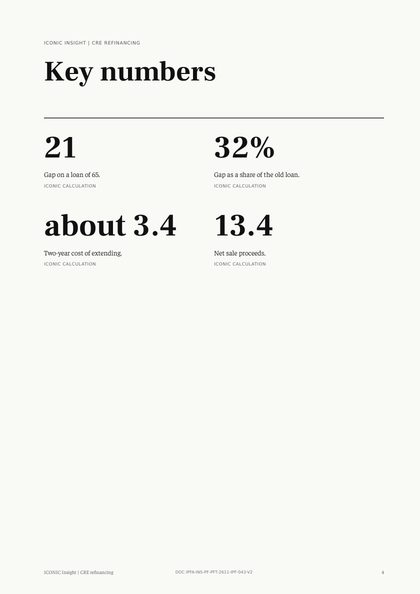
32%

Inside the paper
What happens when a property loan matures and the building is worth less?
DOC IPFA-INS-PF-PFT-2611-IPF-043-V2
Fill out the form to read the full paper.
Download the PDFPDF edition
Download the full Insight
Register below. We will ask you to confirm your e-mail address and then send you a personal download link.
Chapter 2
Option 1. Pay down
The borrower injects 21 of new equity.
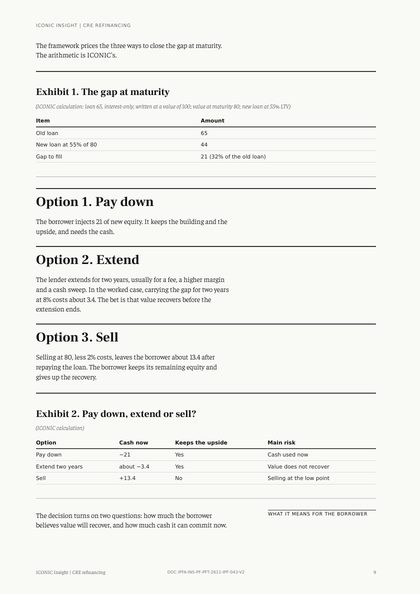
The framework prices the three ways to close the gap at maturity. The arithmetic is ICONIC’s.
| Item | Amount |
|---|---|
| Old loan | 65 |
| New loan at 55% of 80 | 44 |
| Gap to fill | 21 (32% of the old loan) |
The borrower injects 21 of new equity. It keeps the building and the upside, and needs the cash.
Key number
21
Chapter 3
Option 2. Extend
The lender extends for two years, usually for a fee, a higher margin and a cash sweep.
The lender extends for two years, usually for a fee, a higher margin and a cash sweep. In the worked case, carrying the gap for two years at 8% costs about 3.4. The bet is that value recovers before the extension ends.
Key number
about 3.4
Chapter 4
Option 3. Sell
The decision turns on two questions: how much the borrower believes value will recover, and how much cash it can commit now.
Selling at 80, less 2% costs, leaves the borrower about 13.4 after repaying the loan. The borrower keeps its remaining equity and gives up the recovery.
| Option | Cash now | Keeps the upside | Main risk |
|---|---|---|---|
| Pay down | −21 | Yes | Cash used now |
| Extend two years | about −3.4 | Yes | Value does not recover |
| Sell | +13.4 | No | Selling at the low point |
What it means for the borrower. The decision turns on two questions: how much the borrower believes value will recover, and how much cash it can commit now.
The decision turns on two questions: how much the borrower believes value will recover, and how much cash it can commit now.
Chapter 5
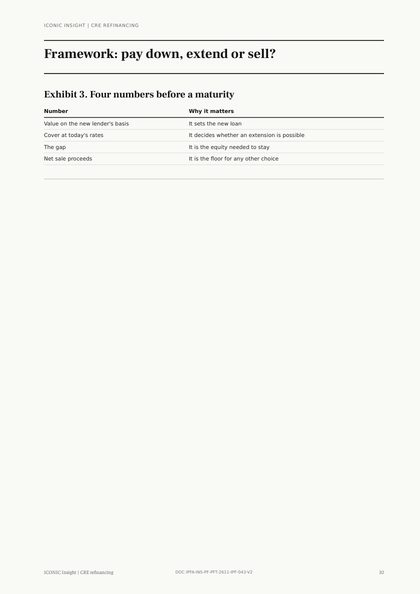
Framework: pay down, extend or sell?
The framework prices the three ways to close the gap at maturity.
| Number | Why it matters |
|---|---|
| Value on the new lender’s basis | It sets the new loan |
| Cover at today’s rates | It decides whether an extension is possible |
| The gap | It is the equity needed to stay |
| Net sale proceeds | It is the floor for any other choice |
Chapter 6
What’s the bottom line?
The borrower who measures the gap a year before maturity has all three options; the one who measures it a month before has only the last.
At maturity, the gap between the old loan and the new one is paid in equity, time or the building. The borrower who measures the gap a year before maturity has all three options; the one who measures it a month before has only the last.
For the borrower, this leads to three steps:
- Value the property on the new lender’s basis a year before maturity.
- Test the cover at current rates to see if an extension is available.
- Compare the cost of paying down, extending and selling, on the same numbers.
At maturity, the gap between the old loan and the new one is paid in equity, time or the building.
How ICONIC can help
ICONIC Project Finance Advisory works with sponsors, owners and investors on the questions this Insight raises.
- Real estate. Refinancing analysis and lender approach. Discuss your maturity.
- Refinancing and restructuring. Extension and pay-down negotiation. Pre-screen your options.
Summary
Loans written at the old value mature at the new one (HVS, 2022; JLL, 2026). Default needs both negative equity and a cash shortfall (Goldberg and Capone, 2002). In ICONIC’s worked case, a 20% fall in value leaves a gap of 21 on a loan of 65. It can be paid down, carried for about 3.4 over a two-year extension, or closed by a sale that returns about 13.4.
Frequently asked questions
What is a maturity default?
A default that occurs when a loan cannot be repaid or refinanced at maturity, even if it has been paid on time until then.
Why would a lender extend rather than enforce?
Because selling into a falling market may recover less than an extension that gives value time to return, if the property’s income still covers the interest.
References
- Goldberg, L. and Capone, C.A. (2002) ‘A dynamic double-trigger model of multifamily mortgage default’, Real Estate Economics, 30(1).
- HVS (2022) Valuing hotels amid rising capital market costs: a case study. HVS.
- HVS (2023) Hunter Conference takeaways: a well-performing hotel industry lives through a tough financing environment. HVS.
- JLL (2026) Global real estate trends and perspectives, November 2026. JLL Research.
This Insight is for general information only and does not constitute investment, legal or tax advice.